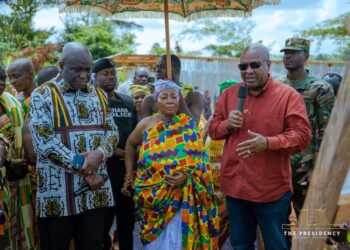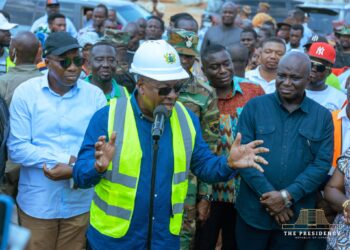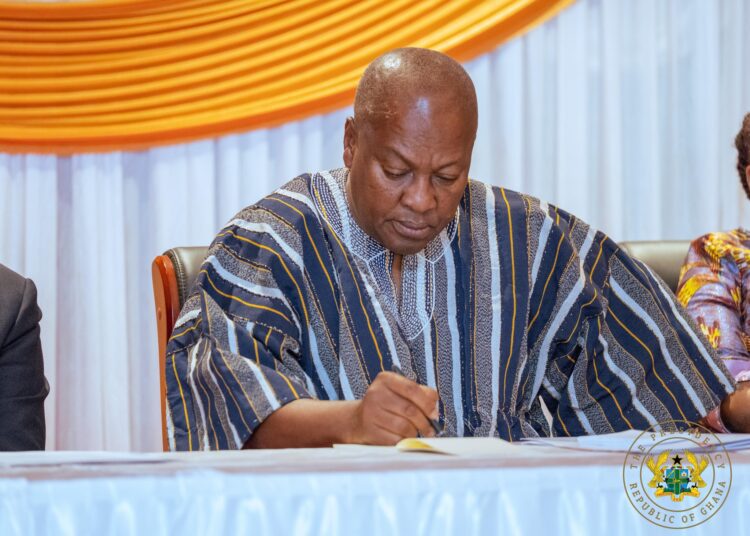
Speaking to a vibrant gathering of the Ghanaian community in Zambia during his three-day state visit, President John Dramani Mahama has signaled a strategic shift in his administration’s agricultural policy.
While the Agriculture for Economic Transformation pillar of the Reset Agenda has successfully triggered a massive surge in food production, the President noted that the resulting price drops now require the government to move from a “production-first” model to an “investor-protection” framework.
The President’s address highlighted the dual success of grassroots poverty alleviation and large-scale commercial farming. However, the sheer volume of grain now hitting the market – specifically maize and soya bean – has created a “good problem,” that the government is now moving to stabilize.
“Indeed we have to consider protecting our farmers now because the prices have dropped so steeply that the farmers are beginning to complain that they are not able to recoup what they put into producing the food”
President John Dramani Mahama

A central highlight of the President’s speech was the recently launched Nkoko Nkitikiti programme, a micro-poultry initiative designed under the Ministry of Food and Agriculture (MoFA) to turn ordinary households into productive economic units.
Unlike previous attempts that struggled with high mortality rates, this programme utilizes a “robust entry” strategy where households are provided with 50 pullets – chickens that are already four weeks old – rather than sensitive day-old chicks.
President Mahama noted that this technical adjustment ensures that families do not lose their initial investment to early-stage diseases. He added that the government also provides the feed for a six-week duration, after which the birds reach market weight.
This creates a repeatable six-week wealth-creation cycle, allowing families to sell, profit, and immediately re-register for a new batch.
Beyond Household Farming
President Mahama also pointed to the broader success of the Feed Ghana Programme, noting that commercial agriculture has seen an unprecedented increase in grain production. The promotion of soya bean and maize at scale was intended to feed the local poultry industry and reduce import dependency.

“Aside from the Nkoko Nkitikiti there are other aspects like the vegetable programme, which has seen an increase in vegetables. There’s also the promotion of commercial agriculture that has seen an increase in grain production maize, soya bean and so many things”
President John Dramani Mahama
However, the President reiterated that the success of the vegetable and grain sectors has been so rapid that the market is currently experiencing a steep price decline.
For him, this is the clearest evidence that the Reset Agenda is working, though it now necessitates state intervention through the National Bufferstock to ensure that farmers do not become victims of their own productivity.
President Mahama emphasized that the ultimate goal of these programs is to ensure that “income enters the household,” consistently. By providing the feed and the birds, the government has effectively de-risked the poultry sector for the average Ghanaian.

As the administration looks toward the second half of 2026, the focus will remain on maintaining this momentum while implementing price floors to safeguard the livelihoods of those at the center of the transformation.
READ ALSO: IMF Review Success Gave Economy New Life