
President John Dramani Mahama has reaffirmed his administration’s commitment to fiscal discipline and long-term economic resilience, stressing that Ghana is being deliberately positioned to withstand future global shocks.
He said the government is determined not only to stabilise the economy after a difficult inheritance, but also to build a system strong enough to absorb external disruptions without plunging citizens into hardship.
The President made these remarks at the Jubilee House when he received members of the Upper East Regional House of Chiefs on a courtesy call. The visit provided an opportunity for him to reflect on the state of the economy, the reforms undertaken since his assumption of office, and the broader vision guiding government policy.
President Mahama noted that the administration took office at a time when Ghana’s economy was under significant strain. Inflation was high, the national currency was depreciating sharply, interest rates were elevated, and the country had entered an International Monetary Fund programme.

According to him, these conditions demanded swift and often difficult policy choices to arrest the decline and restore confidence. “As you are all aware, we inherited quite difficult situation, especially with the economy,” the President said.
He explained that those decisions, while initially painful, are beginning to yield results. President Mahama pointed to emerging signs of macroeconomic stability, including a steady decline in inflation, easing prices of goods and services, and reduced petroleum prices.
President John Mahama also highlighted the relative stability of the Ghanaian cedi as evidence that confidence is gradually returning to the economy.
“But I am pleased to report to you that those decisions are paying off. It is reflecting in the economic stability we are beginning to see, the reduction in inflation, reduction of prices of goods and services in the market, reduction in price of petroleum products, and relative stability in our national currency, the cedi.”
Sustaining Gains through Fiscal Discipline
The President stressed that these gains would be protected through continued fiscal discipline. He described prudent management of public finances as the cornerstone of the government’s economic strategy, warning that abandoning discipline could quickly reverse recent progress.
According to President Mahama, the goal is not merely to recover from current difficulties, but to fundamentally reshape the economy to make it more resilient. He argued that Ghana must be prepared for future global shocks, which he described as inevitable rather than hypothetical.
“And so we will continue to maintain the fiscal discipline that has brought us here, so that we are able to not only turn the economy around, but build what we call a resilient economy. Because it is not a matter of if, it is a matter of when the next global shock might happen.”
President John Dramani Mahama
He noted that global shocks can take many forms, ranging from financial crises to pandemics and other unforeseen international events. Drawing lessons from the COVID period, President Mahama said Ghana cannot afford to be caught unprepared again.

“Global shocks can take many forms. They can come in the form of a financial crisis, a global financial crisis, or pandemics, or any such world events.
“And we must have our economy in such a state that we will be able to ride through any foreseeable global shock, so that we do not experience some of what we experienced during the period of COVID.”
President John Dramani Mahama
Recurring Global Disruptions
The President’s remarks come at a time when governments across the world are reassessing economic models in response to recurring global disruptions. For Ghana, the emphasis on resilience reflects a recognition that external shocks often have disproportionate effects on developing economies, especially those with limited fiscal buffers.
Members of the Upper East Regional House of Chiefs welcomed the President’s assurances, noting that economic stability has direct implications for livelihoods at the local level.
Many communities in the Upper East Region are particularly vulnerable to economic downturns, given their dependence on agriculture, remittances, and public investment.
President Mahama assured the chiefs that government remains mindful of the need to translate macroeconomic stability into tangible improvements in people’s lives.
He said sustaining growth, controlling inflation, and stabilising the currency are essential steps toward creating jobs, reducing poverty, and improving living standards across the country.
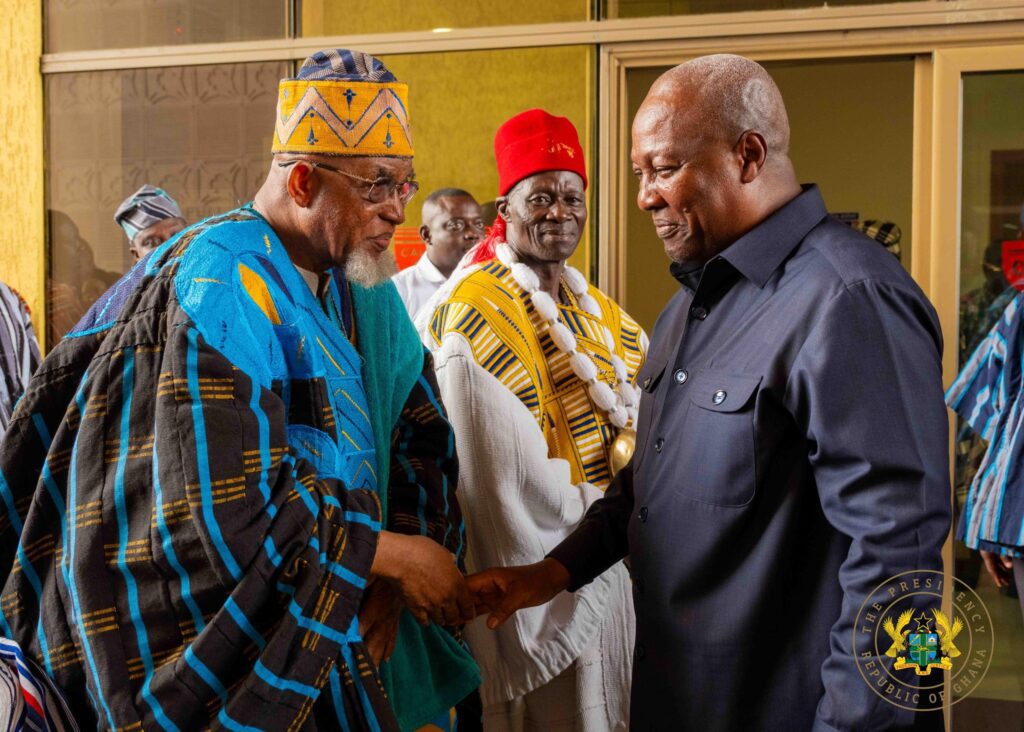
He also reiterated the importance of national unity and social stability in supporting economic recovery. According to him, peace and cooperation between the government, traditional authorities, and citizens are critical in sustaining reforms and ensuring that their benefits are widely shared.
As Ghana continues to implement economic reforms under challenging global conditions, the President’s message signals a focus on caution, discipline, and long-term planning.
By emphasising resilience, President Mahama has framed economic management not just as a response to present difficulties, but as a strategic effort to safeguard the country’s future against uncertainties beyond its control.
READ ALSO: Africa Must Define Its Own Energy Transition Pathway — Dr Oppong