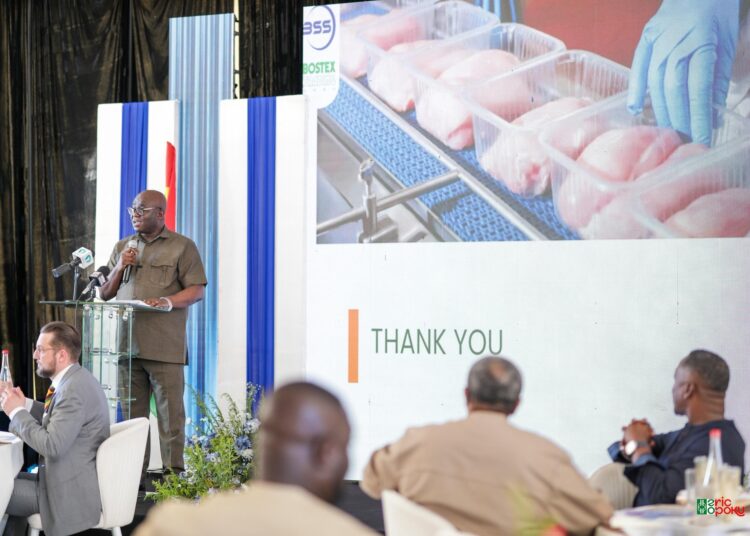
The Minister for Food and Agriculture, Hon. Eric Opoku, has signaled a decisive strike against Ghana’s massive poultry import bill by commissioning an expanded cold storage facility and cutting sod for a modern poultry processing complex in Kpone.
The ceremony marked a critical expansion of the Feed Ghana Programme, specifically targeting the $300 million to $400 million that the nation currently drains into foreign poultry markets annually. By establishing a structured marketplace and industrial “bridge” for local producers, the Ministry aims to reverse a decades-long decline and restore Ghana’s poultry self-sufficiency.
“This investment is timely and aligns with Government’s commitment to revitalize the poultry industry and reduce dependence on imports. Ghana currently spends millions annually on poultry imports, a situation that underscores the urgent need to boost domestic production”
Hon. Eric Opoku, Minister for Food and Agriculture
According to the Minister, the project is a flagship private-sector partnership owned by Beacon Source and Services Ltd. in collaboration with Germany’s Bostex Trading GmbH, promising a fusion of local grit and international technology transfer.
Ghana currently produces only about 18% of its total poultry consumption, a deficit that Hon. Eric Opoku described as an urgent call to action.
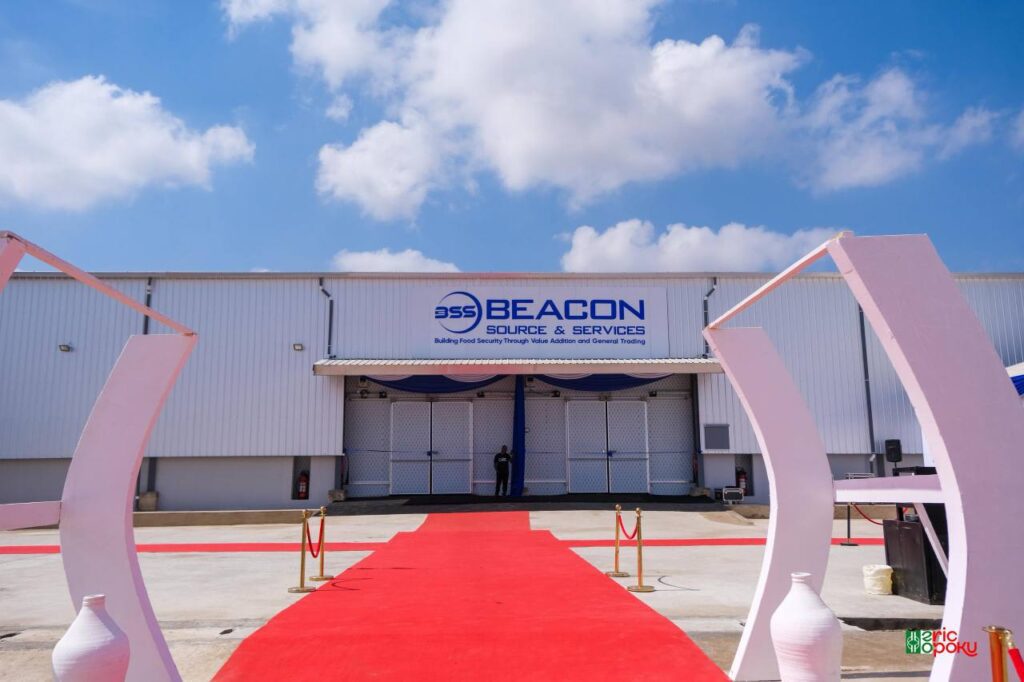
The Kpone project is designed to be the “industrial backbone,” that converts local birds into market-ready products capable of competing with cheap imports. By addressing the lack of processing and cold chain infrastructure – two of the primary “silent killers,” of the local industry- the facility ensures that farmers have a guaranteed off-take and that consumers have access to fresh, safe, and locally-grown meat.
Under the Poultry Industry Revitalization sub-programme, the government, through the Ministry of Food and Agriculture (MoFA) is moving to solve the structural bottlenecks that have historically made local chicken 25-30% more expensive than imports, including high feed costs and weak value-chain coordination.
Three-Pronged Strategy
The Kpone launch serves as the operational anchor for a three-tiered approach to poultry development. This strategy targets everyone from the industrial giant to the rural household, ensuring that the economic gains are distributed across the entire social fabric.
Through large-scale commercial farms, the expanded cold storage facility will support the Poultry-Farm-to-Table model to create anchor farmers who can produce millions of birds for the new processing complex.
The facility will also strengthen small- and medium-scale producers to enhance their productivity through better access to quality day-old chicks and veterinary services. Beyond that, it will also expand household production through the Backyard Poultry sub-programme, (Nkoko Nketenkete) which empowers women, youth, and the vulnerable to contribute to the national meat supply.

According to Hon. Opoku, this “bottom-up” approach ensures that even backyard farmers at the constituency level are integrated into the national food security architecture, provided they adhere to the improved safety standards enabled by the new cold storage facility.
International Partnerships And Technology Transfer
The presence of the German Ambassador and representatives from the German Chamber of Commerce highlighted the international significance of the Kpone project.
MoFA noted that the partnership with Bostex Trading GmbH is expected to facilitate a massive leap in technical capacity, ensuring that the Kpone facility meets the highest global standards for food safety and processing efficiency.
“The expanded cold storage facility enhances our capacity to preserve quality, reduce post-harvest losses, stabilise supply and ensure food safety standards. The processing plant will provide the industrial backbone needed to convert domestic poultry into market-ready products”
Hon. Eric Opoku, Minister for Food and Agriculture
Hon. Eric Opoku praised Beacon Source and Services Ltd. for its “strategic nation-building” through private investment, noting that the successful implementation of the Feed Ghana agenda relies on exactly this kind of robust, capital-intensive infrastructure.

As the construction of the processing complex begins, the Ministry is looking toward the secondary benefits: job creation and agro-industrial stability. By localizing the entire production cycle – from the grain used for feed to the final packaged bird – the government is creating a self-sustaining ecosystem that keeps wealth within the borders.
With the Kpone facility expected to stabilize poultry supply across the Greater Accra Region and beyond, the Ministry has reaffirmed its commitment to deepening public-private partnerships.
The goal is no longer just to “grow” birds, but to build an industry that can finally reclaim the 80% market share that Ghana’s poultry sector once held in the 1990s.
READ ALSO: Africa’s Prosperity Not a Threat to the World – President Mahama