The Government of Ghana has announced a sweeping cancellation of irregular public land transactions following Cabinet approval of far-reaching, high-level reforms aimed at restoring integrity, transparency, and accountability in the administration of state lands.
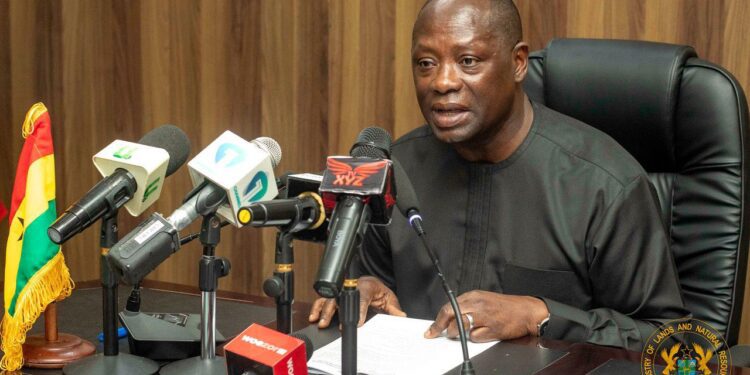
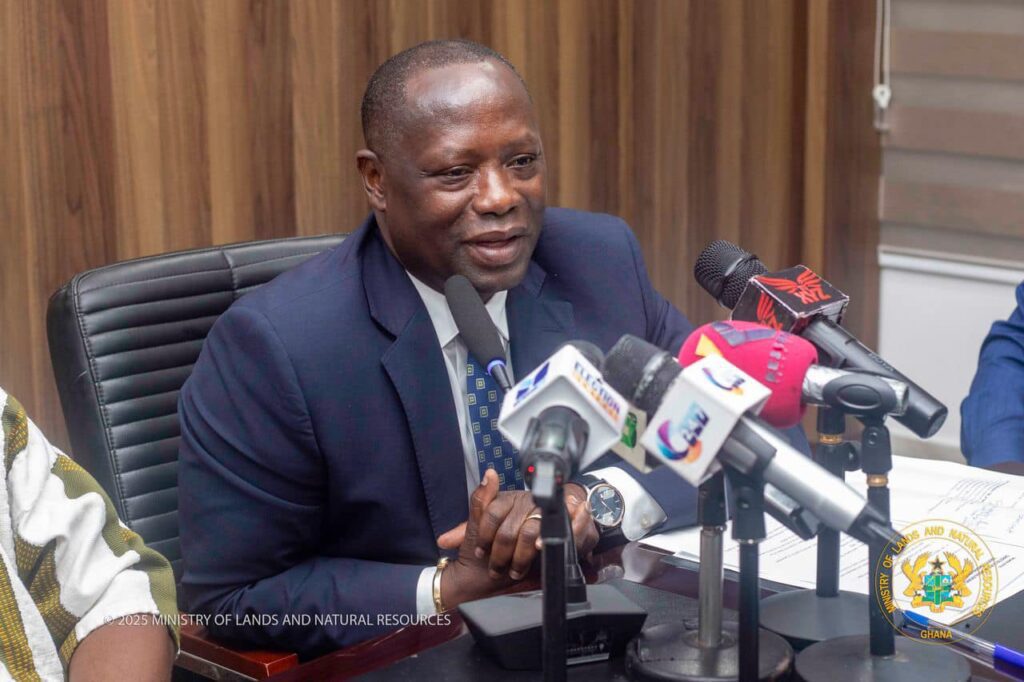
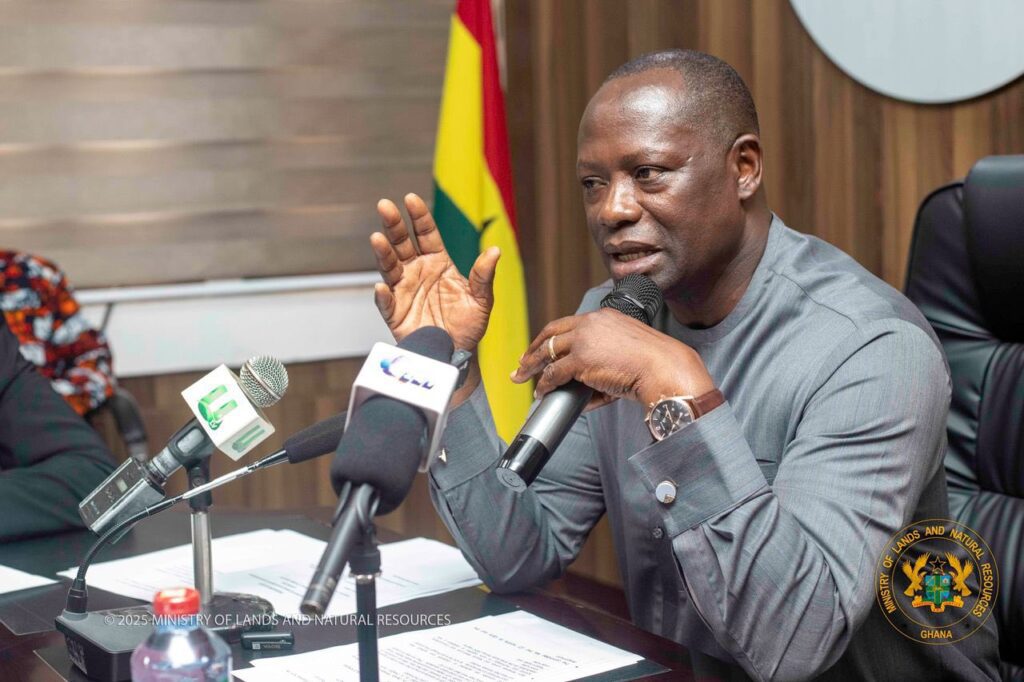
The announcement was made by the Minister for Lands and Natural Resources, Hon. Emmanuel Armah Kofi Buah, after Cabinet considered and approved the high-level committee established to review public land allocations across the country.
Addressing the media after the Cabinet’s decision, the Lands and Natural Resources Minister described the moment as a critical milestone in the government’s broader resetting agenda.
He noted that public lands are held in trust for the people of Ghana and must therefore be managed in a manner that delivers value for money while safeguarding the national interest. According to him, the reforms were necessary to halt long-standing practices that had weakened public confidence in land administration.
“As you recall, on the 10th of January 2025, upon assumption of office, President John Mahama directed the Lands Commission to immediately halt all activities related to the lease and processing of transactions involving public lands.
“This decisive intervention was taken to safeguard public lands from abuse restored discipline in land administration, and ensure that all transactions involving these lands deliver value for money to the state.”
Minister for Lands and Natural Resources, Hon. Emmanuel Armah Kofi Buah
Ministerial Committee and Actions
In line with this presidential directive, the Minister said he constituted and inaugurated a review committee on June 5, 2025, chaired by his Deputy Minister. The mandate of the committee was to conduct a nationwide audit of public land allocations and leases.
This task, he explained, was unprecedented in scale and required a detailed examination of transactions across all 16 regions of the country. The committee’s work revealed the sheer magnitude of public land dealings over the years. In total, 8,160 lease applications that had either been executed or initiated were reviewed nationwide.
These included 4,176 direct land allocations, 2,799 regularisation applications, 19 allocations related to state bungalows, 108 land swap and public private partnership arrangements, 795 subsequent transactions, and 265 fresh allocations, many of which were concentrated in the northern sector.
The Minister clarified that regularisation applications typically involved individuals who had acquired land through various informal means, including transactions with traditional authorities, only to later discover that the land in question was public land requiring formal regularisation.
While acknowledging the complexity of such cases, he stressed that all transactions involving public lands must adhere strictly to established procedures. According to the committee’s findings, a significant number of the reviewed applications failed to fully comply with the Lands Commission’s internal processes.
These lapses, the Minister noted, undermined transparency and accountability, weakened public trust, and exposed the system to abuse. He said the government could not overlook such deficiencies if it was serious about reforming land governance.
Cabinet Approval and Direction
Following the submission of the committee’s report, the Minister presented its findings and recommendations to the Cabinet of Ghana for consideration.
“A thorough review of that work was done and I’m pleased to announce that the cabinet approved those recommendations with a certain directive and directed that we implement those recommendations with additional directives immediately.
“In the course of his work, the committee reviewed a total of eight thousand one hundred and sixty lease applications executed or initiated across all 16 regions in Ghana.”
Minister for Lands and Natural Resources, Hon. Emmanuel Armah Kofi Buah
According to the Minister, the review revealed that a number of these applications and allocations do not fully comply with the Lands Commission’s internal processes for the allocation of public lands. These lapses, he noted undermine transparency, accountability, and the public trust and expose the system to potential abuse.
As part of the measures approved, all uncompleted public land transactions falling within the reviewed categories have been cancelled. Affected applicants, the Minister said, will be formally notified.
Completed transactions, on the other hand, will be subjected to a rigorous case by case review. Any allocation found to have been processed without full compliance with due process will also face cancellation.
In addition, all completed regularisation applications have been suspended pending a comprehensive review and standardisation of the Lands Commission’s internal procedures.
The Minister explained that the revised procedures would apply to all pending and future regularisation applications to ensure consistency and fairness across the system. To eliminate ambiguity, the government has defined a completed transaction as one in which a formal offer has been issued and accepted by the applicant.
Transactions that do not meet this threshold are classified as uncompleted and are therefore affected by the blanket cancellation. This clarification, the Minister said, is intended to ensure uniform interpretation and implementation of the reforms nationwide.
Publication of Lists
In a move to promote transparency, the Ministry of Lands and Natural Resources and the Lands Commission will publish lists of both completed and uncompleted applications on a region-by-region basis.
The publication process will begin with the Greater Accra Region and will be accessible on the official websites of the Ministry and the Lands Commission. This step, the Minister said, is designed to keep the public informed and to strengthen accountability.
For completed transactions undergoing case by case review, assessments will be guided by clear benchmarks. These include compliance with statutory and administrative procedures, value for money considerations, conformity with land use and planning requirements, and enhanced disclosure standards to prevent the misuse of corporate structures in public land acquisitions.
“Ladies and gentlemen, let me emphasise that these measures are not intended to unfairly disadvantage anyone or affected applicants will be allowed to reapply once the ministry completes the following reforms.”
Minister for Lands and Natural Resources, Hon. Emmanuel Armah Kofi Buah
Inconsistent Use of Public Land Application Forms
One of the most significant issues identified by the committee was the inconsistent use of public land application forms across regional offices of the Lands Commission.
The Minister described the situation as unorthodox, noting that different regions operated with different versions of what is known as Form Five. This lack of uniformity, he said, encouraged discretionary practices and uneven standards.

To address this, the Ministry, in collaboration with the Lands Commission, has completed a comprehensive review of Form Five. The revised form will now serve as the single mandatory application instrument for all public land transactions nationwide. It will apply to reapplications arising from the current exercise as well as all future applications.
The revised Form Five is being published on the Lands Commission’s official website and will be made available for public access in the coming weeks. Applicants will be able to download, complete, and submit the form electronically, a move the Minister said will further enhance transparency and efficiency.
He concluded by reiterating the government’s commitment to managing public lands with integrity and in the best interest of national development. According to him, the reforms mark a decisive step toward rebuilding trust in land administration and ensuring that public resources are protected for present and future generations.
READ ALSO: Petroleum Hub Lot One to Employ Over 30,000 Ghanaians