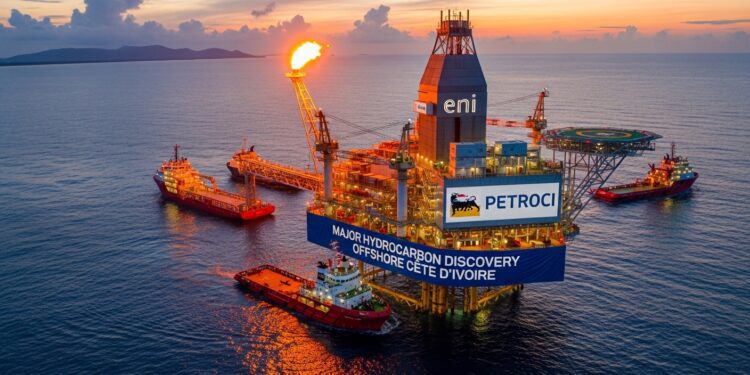
A major hydrocarbon discovery offshore Côte d’Ivoire is set to reshape the energy outlook of the sub-region, following an announcement by Eni and its partner PETROCI Holding.
In a press release issued by the Ministry of Mines, Petroleum and Energy of Côte d’Ivoire, the government confirmed that the Italian oil major and the state oil company made a new commercial hydrocarbon discovery in early February 2026 on Block CI-501 in the Ivorian sedimentary basin.
The discovery, named CALAO South, comes on the back of intensified offshore exploration activity and further strengthens the country’s profile as one of West Africa’s emerging energy hubs.
“Murène South-1X, located 8 km southwest of the Murène-1X well (Block CI-205), encountered light oil, natural gas, and condensates.”
Ministry of Mines, Petroleum and Energy of Côte d’Ivoire
The well reached a total depth of 5,058 metres, including a water depth of approximately 2,200 metres. The presence of multiple hydrocarbon types, light crude, gas and condensates points to a commercially attractive resource base that could support both domestic energy needs and export ambitions.
At this stage of appraisal studies, authorities estimate that total resources in place identified across Blocks CI-501 and CI-205 stand at approximately 1.4 billion barrels of oil equivalent. The scale of the discovery underscores the growing significance of Côte d’Ivoire’s offshore basin within the Gulf of Guinea.
Boost for Gas-to-Power Ambitions
Government officials say the new find will play a critical role in strengthening the country’s natural gas supply, particularly for electricity generation.
“This new discovery strengthens the natural gas potential for electricity generation in Côte d’Ivoire.”
Ministry of Mines, Petroleum and Energy of Côte d’Ivoire
Côte d’Ivoire has positioned gas-to-power as a central pillar of its energy strategy, supplying electricity domestically and exporting power to neighbouring countries.
The additional volumes expected from CALAO South and surrounding blocks could improve supply security, stabilise generation capacity, and support industrial expansion.
For international investors, the discovery signals continued geological prospectivity in the Ivorian basin, potentially attracting further upstream investments in exploration and development drilling.
Opportunity for Ghana’s Petroleum Hub

The discovery also presents a strategic opportunity for neighbouring Ghana, particularly in relation to its proposed Petroleum Hub project in Jomoro in the Western Region.
With Côte d’Ivoire confirming substantial hydrocarbon volumes offshore, there is potential for cross-border collaboration in processing and value addition.
If Ghana accelerates the development of its planned refining and petrochemical infrastructure, it could position itself as a regional processing centre for West African crude and gas.
Rather than viewing the discovery purely through a competitive lens, policymakers could leverage it to strengthen regional integration. By securing feedstock from neighbouring producers, Ghana’s Petroleum Hub could enhance its commercial viability while contributing to regional energy security.
The race to monetise West African gas is gathering pace, and infrastructure development timelines will be decisive. Countries that move swiftly to build refineries, petrochemical plants, storage and export systems are likely to attract long-term investment and secure stable revenue streams.
Regional Implications for West Africa

Beyond Côte d’Ivoire’s borders, the discovery carries significant implications for the broader West African energy landscape. With an estimated 1.4 billion barrels of oil equivalent identified across the two blocks, the find ranks among the most substantial recent offshore discoveries in the sub-region.
Energy analysts suggest that the development of these resources could intensify competition among Gulf of Guinea producers seeking to monetise oil and gas reserves amid global energy transition pressures. At the same time, it opens the door for deeper regional collaboration.
As countries race to commercialise gas resources for domestic industrialisation and export markets, infrastructure readiness will be critical.
Processing capacity, storage facilities, export terminals and petrochemical plants will determine which nations capture maximum value from the region’s hydrocarbon wealth.
Strengthening Côte d’Ivoire’s Energy Profile
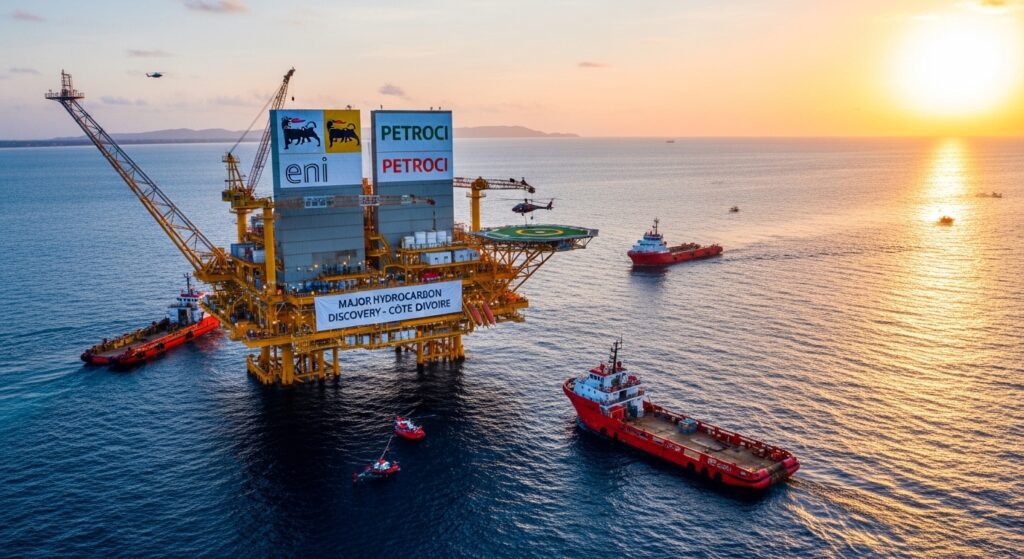
For Côte d’Ivoire, the CALAO South discovery reinforces the country’s growing stature as a hydrocarbon producer. Over the past decade, consistent exploration efforts and strategic partnerships with international oil companies have expanded proven reserves and boosted output potential.
With light oil, gas and condensates confirmed in the Murène South-1X well, the next steps will involve further appraisal, field development planning and eventual production decisions.
If development proceeds on schedule, the new resources could significantly contribute to state revenues, job creation and energy security.
For Côte d’Ivoire, and indeed for the wider West African region, the announcement marks not just a geological success, but a strategic moment in the ongoing quest for energy-driven economic transformation.
READ ALSO: Orbán Hails US-Hungary Ties