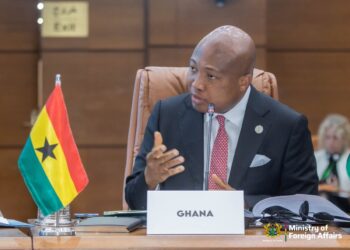

The recent turmoil in Ghana’s cocoa sector has reopened a long-simmering debate about compensation practices in the public sector, with the Executive Director of the CDD-Ghana and Chairman of President John Mahama’s Constitutional Review Committee, Professor H. Kwesi Prempeh, calling for a fundamental reset of how top public officials are paid.
In a strongly worded commentary, Professor Prempeh argued that the cocoa crisis should not only be viewed as a commodity shock but also as an opportunity to reassess accountability and fairness in state institutions.
He suggested that when cocoa farmers bear the brunt of global market developments beyond their control, it is only just that those managing the state monopsony in cocoa also make meaningful sacrifices.
Professor Prempeh questioned why farmers are expected to absorb losses while senior executives and board members of public institutions remain insulated. In his view, leadership responsibility in public enterprises demands shared sacrifice during periods of distress.
“In fact, the cut on the management side must also extend to the board members. (After all, in standard corporate governance practice and law, it is they, the directors, more so than the officers of the company, who must be held accountable as fiduciaries for the business decisions made by and in behalf of the company.)”
Professor H. Kwesi Prempeh, Executive Director, Centre for Democratic Development, Ghana
A Broader Public Sector Problem
While the immediate focus of the debate has been cocoa, Professor Prempeh made it clear that his concerns extend well beyond the sector, covering wide sectors of the country.

He argued that questionable compensation practices are widespread across state-owned and other public enterprises, raising serious questions about value for money and fairness within the public wage bill.
He cautioned against reducing the discussion to headline figures alone, noting that debates focused solely on salary numbers often descend into accusations of envy or political bias. Instead, he urged a deeper examination of the processes used to justify compensation packages for chief executives, directors, and senior managers in the public sector.
At the heart of Professor Prempeh’s argument is the issue of recruitment. He questioned how public sector leaders could be awarded compensation packages comparable to internationally recruited executives when many of them were not selected through competitive, transparent, or merit based processes.
He asked how such remuneration can be benchmarked without reference to prior salary histories, competitive negotiations, or alternative employment prospects. In his view, the absence of rigorous recruitment standards makes it difficult to justify the scale of compensation often attached to senior public sector roles.
According to him, the legitimacy of pay and benefits must be grounded in clear evidence of merit, competitive selection, and demonstrable value creation. Without these elements, he argued, public confidence in state institutions is inevitably eroded.
Beyond Cocoa to State Enterprises
The Chairman of the 2025 Constitutional Review Committee, Professor Prempeh, emphasized that the compensation debate applies across Ghana’s state-owned enterprises and regulatory bodies.
He referenced institutions such as the Ghana National Petroleum Corporation, Electricity Company of Ghana, and GIHOC Distilleries as examples where questions about leadership pay and accountability deserve closer scrutiny.

He argued that if the state is unwilling to recruit senior managers competitively and meritocratically, it must reconsider the share of public resources devoted to compensating them. In his assessment, the central question is not how much leaders earn, but what value the public receives in return.
Professor Prempeh’s comments follow a recent directive by the Chief Executive Officer of COCOBOD, Dr. Ransford Abbey, announcing voluntary salary reductions within the institution.
Under the directive, executive management accepted a 20 percent pay cut while senior staff agreed to a 10 percent reduction for the remainder of the 2025 and 2026 crop year.
The move was presented as a response to a liquidity crisis confronting the cocoa board, as operational costs continue to rise amid declining global revenues. For many observers, the decision was seen as a rare example of leadership sharing the burden of sector wide challenges.
A Moment for Structural Reform
Professor Prempeh described the development as more than a symbolic gesture. He argued that it should serve as a catalyst for deeper reforms in public sector compensation and governance.
In his view, temporary pay cuts are insufficient if they are not accompanied by systemic changes in how leaders are appointed, evaluated, and rewarded across all commercial and regulatory state entities.
He maintained that the cocoa crisis presents a unique moment for honest national reflection on leadership accountability. According to him, aligning compensation with transparent recruitment, measurable performance, and public interest outcomes is essential to restoring trust in state institutions.

As Ghana continues to navigate economic pressures and sector specific shocks, the call to reset public sector compensation is likely to gain traction. Professor Prempeh’s intervention places accountability, fairness, and governance at the center of the debate, challenging policymakers to look beyond immediate crises and address long standing structural weaknesses.
He concluded that meaningful reform requires courage and consistency. In his view, leadership in the public sector must not only speak about sacrifice and accountability but also embody these principles in times of difficulty.
Only then, Professor Prempeh argued, can public institutions regain credibility and deliver sustainable value for the citizens they are meant to serve.
READ ALSO: Gold Prices Drop as Dollar Strengthens