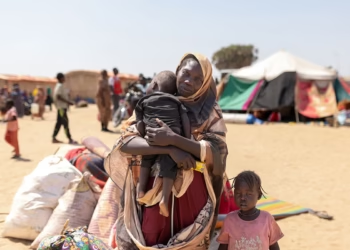
The UN World Food Programme has issued an urgent warning that its life-saving emergency food and nutrition assistance operations in Somalia are at imminent risk of coming to a standstill without immediate new funding commitments.
The agency said its available resources are expected to be depleted within weeks unless donors step forward with urgent financial support, raising fears of worsening hunger in one of the world’s most vulnerable countries.
In a report, the WFP warned that the country is facing one of the most complex hunger crises in recent years, driven by two consecutive failed rainy seasons, conflict and a sharp drop in humanitarian funding.
The warning comes as at least 4.4 million people, roughly a quarter of the population, face crisis-levels of food insecurity or worse, including nearly one million women, men and children experiencing severe hunger, according to WFP data. Ranked among the world’s most climate-vulnerable countries, Somalia has endured recurrent droughts and floods.
Ross Smith, WFP Director of emergency preparedness and response, asserted that the situation is deteriorating at an alarming rate.
“Families have lost everything, and many are already being pushed to the brink. Without immediate emergency food support, conditions will worsen quickly.
“We are at the cusp of a decisive moment; without urgent action, we may be unable to reach the most vulnerable in time, most of them women and children.”
Ross Smith
WFP, the largest humanitarian agency in Somalia, works alongside partners to support the majority of the country’s food security response.
In 2022, the longest drought in recorded history brought Somalia to the brink of famine. In response, with critical support from donors, partners and the government, WFP launched a robust scale up of life-saving assistance.
Working together, they reached record numbers of the most vulnerable, helping keep famine at bay. WFP has the teams on the ground and capacity to push back extreme hunger again.
However, WFP said that it has already been forced to reduce the number of people receiving emergency food assistance from 2.2 million in early 2025 to about 600,000.
This translates into the agency being able to support only one in every seven people in need of food assistance, according to the report. Nutrition programmes have also been slashed from assisting nearly 400,000 pregnant and breastfeeding women and young children in October last year to 90,000 in December.
USD95 million Urgently Required
According to the report, WFP urgently requires USD95 million to continue supporting the most food insecure people in Somalia between March and August 2026. “Without immediate funding, WFP will be forced to halt humanitarian assistance by April,” it iterated.
Smith stressed that in 2022, WFP showed that when “we have the resources, we can scale up quickly and reach people at the very moment they need us most.” “Today, we’re facing that critical moment again,” Smith said.
“If our already reduced assistance ends, the humanitarian, security, and economic consequences will be devastating, with the effects felt far beyond Somalia’s borders. WFP and partners are ready to deliver, but we need urgent support to avoid a preventable catastrophe.”
Ross Smith
Humanitarian agencies have long warned that gaps in funding can translate directly into cuts in rations or reductions in the number of people reached. In Somalia, where needs remain significant, such reductions could quickly exacerbate food insecurity.
The WFP’s alert signals that without urgent support, the progress made in stabilizing vulnerable communities could be reversed.
This warning comes on the heels of another issued last month by Doctors Without Borders, known by its French acronym, MSF.
The organisation said that its teams in Somalia had been witnessing “a worrying trend” of increasing numbers of children suffering from preventable diseases, such as severe acute malnutrition, measles, diphtheria and acute watery diarrhoea.
READ ALSO: Yoon Rejects Rebellion Verdict