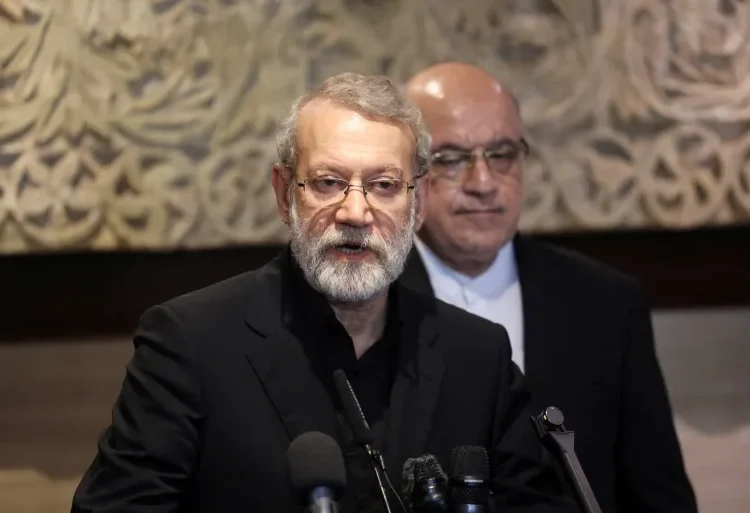
Iran’s top national security official, Ali Larijani has said that Iran “will not negotiate with the United States,” rejecting media reports suggesting Iran had reached out to the United States through intermediaries asking to resume talks.
His remarks on X come at a moment of heightened conflict and uncertainty following US-Israeli attacks on Iran and Iran’s retaliatory strikes.
The remarks highlight Tehran’s current stance on direct engagement with the United States, even as the region remains volatile and the prospects for peace negotiations appear uncertain.
Larijani, Secretary of Iran’s Supreme National Security Council, said that US President Donald Trump has “plunged the region into chaos with his ‘false hopes’ and is now worried about further casualties of American troops.”
“With his delusional actions, he has transformed his self-made slogan of ‘America First’ into ‘Israel First’ and sacrificed American soldiers for Israel’s quest for power.”
Ali Larijani
Larijani, who was a key adviser to the late Supreme Leader Ayatollah Ali Khamenei, stressed that Iranian forces “did not initiate the invasion.”
Also, Iran’s Minister of Foreign Affairs, Abbas Araghchi condemned the US and Israel’s military operation in Iran, calling it a “violation” of international law in a letter to the United Nations.
“In a new series of unprovoked and unjustified acts of aggression against the sovereignty and territorial integrity of the Islamic Republic of Iran, the United States and the Israeli regime deliberately targeted the highest official of an independent member state of the United Nations.”
Abbas Araghchi
He called the killing of Iran’s Ayatollah Ali Khamenei an attack which “has profound and far reaching consequences, for which the perpetrators bear full responsibility alone.”
“This will in no way negate the inherent and inalienable right of the Islamic Republic of Iran to defend its sovereignty, territorial integrity, and people in full compliance with Article 51 of the United Nations Charter.”
Abbas Araghchi
Hezbollah Joins Ongoing Conflict
Meanwhile, Hezbollah said that it launched “missiles and a swarm of drones” at an Israeli army base south of Haifa “in revenge” for the killing of Iran’s Supreme Leader Ayatollah Ali Khamenei.
It marks the first rocket fire by the Iran-backed militant group since November 2024, when Israel and Hezbollah agreed to a US-brokered ceasefire.
Hezbollah said in a statement that the attack targeted Israel’s Mishmar HaCarmel missile-defense site at midnight today.
“The Israeli enemy cannot continue its aggression, ongoing for fifteen months, without receiving a warning response aimed at halting this aggression and withdrawing from occupied Lebanese territory.”
Hezbollah
However, Lebanon’s Prime Minister, Nawaf Salam called the firing of rockets from southern Lebanon “an irresponsible and suspicious act.”
“We will not allow the country to be dragged into new adventures, and we will take all necessary measures to stop those responsible and protect the Lebanese people.”
Nawaf Salam
The Israeli military launched a series of strikes in Lebanon, including the capital Beirut early today, after Iran-backed militant group Hezbollah claimed responsibility for firing projectiles from Lebanon into Israel.
The Israeli military confirmed that it struck “senior Hezbollah terrorists in the Beirut area,” early Monday local time. “Additionally, the IDF struck a central Hezbollah terrorist in southern Lebanon,” the Israel Defense Force (IDF) said in a statement.
The Israel Defense Forces ordered evacuations across 52 settlements in the south of Lebanon and confirmed plans to strike Hezbollah.
Lebanese state media reported that evacuations are underway after a series of Israeli strikes in Beirut’s southern suburbs, including Dahiyeh, a Hezbollah stronghold.
The Israeli military said that it will increase and intensify its strikes on Lebanon and it has reinforced troop deployment along the border.
READ ALSO: Resetting Ghana Agenda Targets Economic Stability, Prosperity – President Mahama