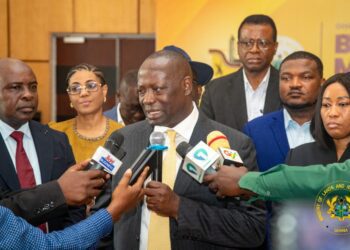
Dr. Theo Acheampong, Economist and Technical Advisor at the Finance Ministry, has disclosed that Ghana has reached an unprecedented economic milestone as gold export earnings surged to a historic $20 billion in 2025.
According to Dr. Acheampong , this remarkable figure represents a near-doubling of the $11.6billion recorded in 2024, signaling a profound structural transformation in the nation’s extractive sector.
Driven by a combination of record-breaking global bullion prices and the aggressive formalization of the artisanal and small-scale mining (ASM) sector, gold has firmly established itself as the bedrock of Ghana’s external position and macroeconomic resilience.
“The 2022-23 debt crisis marked a turning point. Reserves fell sharply as the cedi depreciated against the dollar. In response, the Bank of Ghana accelerated its domestic gold purchase programme, acquiring gold directly from artisanal miners to rebuild foreign exchange buffers.”
Dr. Theo Acheampong

He also added that the astronomical growth is the direct result of a strategic policy pivot that followed the 2022-2023 debt crisis, which served as a catalyst for radical fiscal reform.
Central to this recovery was the establishment of the Ghana Gold Board (GoldBod) in early 2025, an entity designed to centralize gold trading and provide a reliable, transparent off-take point for local miners.
By “accelerating its domestic gold purchase programme,” the Bank of Ghana successfully mopped up liquidity and rebuilt foreign exchange buffers that had been depleted during years of cedi volatility.
Consequently, gross international reserves have climbed to a record $13.8 billion, providing a robust 5.7 months of import cover the highest ever in recent memory effectively insulating the domestic economy from external shocks and speculative attacks on the currency.
A Structural Shift: From Volatility to Value

The journey to this $20 billion peak began in a period of relative stagnation and moderate correlation between reserves and exports.
Between 2010 and 2021, Ghana’s international reserves were characterized by modest fluctuations, generally ranging from $4.7 billion to $9.7 billion, while gold exports fluctuated between $3.2 billion and $6.8 billion.
During this era, the “correlation between the two was moderate,” as the state relied heavily on Eurobond issuances and cocoa revenue to support the balance of payments. However, the 2022-23 debt crisis “marked a turning point” that forced a total rethink of the national strategy, leading the Bank of Ghana to transform the precious metal from a mere export commodity into a strategic shield against dollar scarcity.
The impact of this shift has been nothing short of transformative for the Ghanaian taxpayer. In 2023, gold exports stood at $7.6 billion, but the aggressive “domestic gold purchase programme” allowed the state to retain more value within its borders.
By the time exports hit $11.6 billion in 2024, the structural foundations for the 2025 boom were already laid.
The government’s ability to “acquire gold directly from artisanal miners” didn’t just rebuild reserves; it formalized a shadow economy, bringing thousands of small-scale operators into the light of the regulated financial system.
This formalization has increased corporate tax takes and mineral royalties, providing the Treasury with the fiscal space needed to fund critical infrastructure without reverting to the high-interest commercial borrowing that triggered the previous crisis.
The GoldBod Revolution and Global Price Rallies

The dramatic leap to $20 billion in 2025 was further catalyzed by the establishment of the Ghana Gold Board and a rally in prices that saw gold trade at historic highs on the London Bullion Market.
The GoldBod acted as a market maker, ensuring that Ghanaian miners received competitive rates, thereby disincentivizing the smuggling of ore across borders.
This institutional oversight ensured that “gross international reserves climbed to a record $13.8 billion,” providing the central bank with the firepower to maintain a stable exchange rate.
For the average Ghanaian, this has translated into lower inflationary pressure on imported goods, as the “5.7 months of import cover” provides a level of certainty not seen in decades.
Furthermore, the rise in gold export earnings has shifted the composition of Ghana’s GDP.
The extractive sector now accounts for a larger share of the national budget, allowing for the gradual diversification of the economy into value-added gold refinery.
With two new refineries operational in the Western and Greater Accra regions, Ghana is no longer just exporting raw dore but is moving toward “Gold Delivery” status.
This industrialization, spurred by the $20 billion windfall, has created high-skilled jobs in metallurgy, logistics, and financial services, proving that the gold narrative is as much about people as it is about pips and prices.
Anchoring Future Prosperity

As we look toward the final quarter of 2025, the “gold-driven narrative” remains the most potent story in African economics. The ability of a nation to pivot from a debt crisis to holding the “highest ever import cover in recent memory” is a testament to the efficacy of the gold-for-oil and gold-for-reserves schemes.
While critics initially doubted the sustainability of domestic purchasing, the data provided by Dr. Theo Acheampong and the Ministry of Finance confirms that the strategy has yielded a “good impact.”
The focus must now remain on ensuring that the environmental costs of this gold boom are managed as effectively as the financial gains.
With the Ghana Gold Board now firmly in control of the supply chain, the next step is to ensure that the $20 billion in earnings trickles down to the mining communities that have fueled this historic rise.
If managed with the same rigor seen in the last two years, Ghana’s external position will remain unassailable, with gold serving as the permanent anchor of the country‘s economic sovereignty.