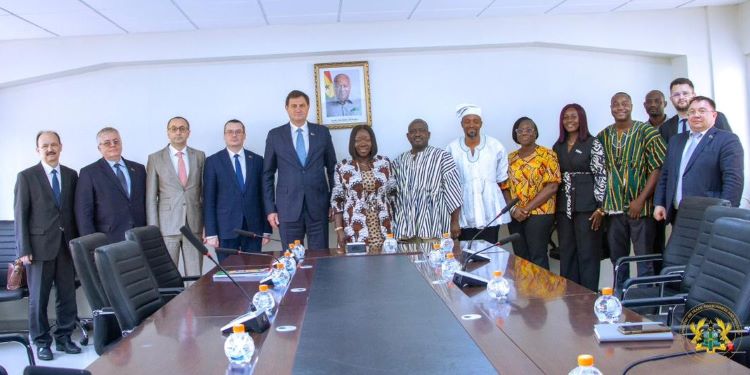
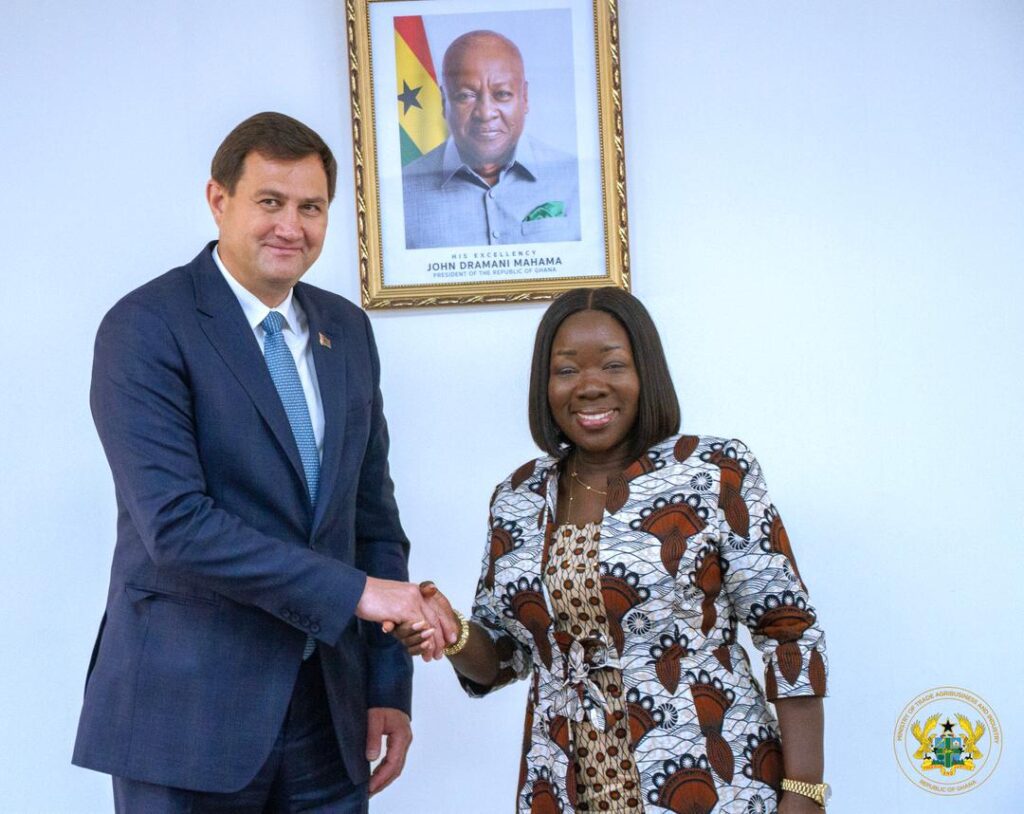
In a high-stakes diplomatic engagement aimed at accelerating the nation’s Industrialization drive, the Minister for Trade, Agribusiness and Industry, Hon. Elizabeth Ofosu-Adjare, hosted an eight-member high-level delegation from the Republic of Belarus in Accra to finalize a framework for deep-seated economic cooperation.
The meeting with the Belarusian delegation, led by Foreign Minister Ryzhenkov Maxim, signalled a major shift in Ghana’s procurement and production strategy, moving toward heavy-duty mechanization and local manufacturing as the Administration prepares for a landmark state visit by His Excellency President Mahama to Minsk in June.
According to the Ministry of Trade, Agribusiness and Industry (MoTAI), the discussions were not merely symbolic; they centered on a massive infusion of industrial capital and technical expertise.
“A major highlight of the discussions was the proposed supply of approximately 3,000 pieces of agricultural machinery and equipment including tractors and modern farming implements for ploughing, sowing, and harvesting aimed at boosting Ghana’s agricultural productivity and mechanization drive”
Ministry of Trade, Agribusiness and Industry
This influx of equipment is designed to be the backbone of the Agriculture Reset, ensuring that Ghanaian farmers have the mechanical power to transition from small-scale cultivation to large-scale, high-yield commercial production.
The Belarusian Foreign Minister emphasized that his country views Ghana as a primary strategic partner in Africa, particularly within the context of “Economic Diplomacy.” Belarus, known globally for its robust heavy machinery industry, is positioning itself to be the lead technical partner in Ghana’s quest for food security.
The supply of 3,000 pieces of machinery is viewed as a “transformative intervention,” that will reduce the physical drudgery of farming and significantly lower the cost of production for staple crops. However, the Administration is looking beyond simple equipment procurement.
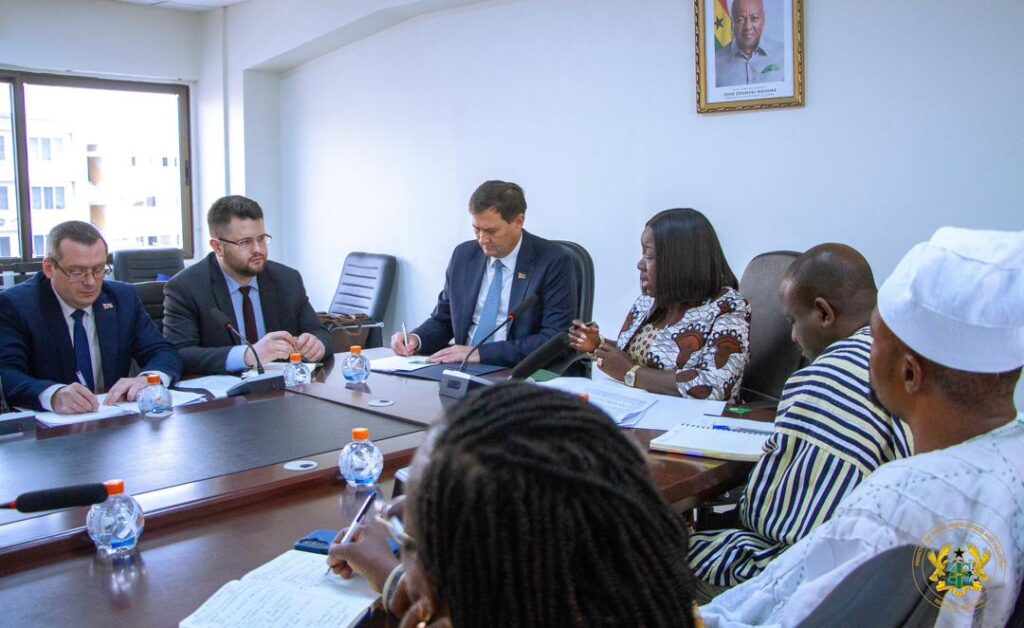
Hon. Elizabeth Ofosu-Adjare made it clear that the future of Ghana-Belarus relations must be rooted in domestic production, challenging the Belarusian delegation to move past the traditional “supplier-buyer” relationship and instead establish local assembly plants and manufacturing hubs.
By assembling these 3,000 units within Ghana, the state aims to create technical jobs for the youth and ensure a localized supply chain for spare parts and maintenance, thereby sustaining the mechanization drive for decades.
Value-Addition Expansion
A critical component of the meeting was the focus on the Industrialization of Ghana’s raw commodities.
“Hon. Elizabeth Ofosu-Adjare encouraged the Belarusian delegation to go beyond raw commodity trade by establishing processing factories in Ghana, particularly for cocoa products and milk powder production for export to Belarus and other markets”
Ministry of Trade, Agribusiness and Industry
This strategy is two-fold: it allows Belarus to secure a high-quality, steady supply of cocoa derivatives at competitive rates – bypassing the volatility of international middle-man markets – while simultaneously building Ghana’s capacity as a manufacturing hub.
The proposal for a milk powder production facility is particularly strategic as currently, West Africa remains a net importer of dairy products. By partnering with Belarus – a global leader in dairy technology – Ghana can begin to produce its own milk powder for both domestic consumption and export to the wider Eastern European market.
This “Factory-First” approach is the essence of the Administration’s trade policy, ensuring that the country no longer exports its jobs along with its raw materials.
“The Belarusian side also announced plans for a high-level state visit by His Excellency President Mahama to Belarus in June 2026, which is expected to provide a strong foundation for expanded collaboration across multiple sectors”
Ministry of Trade, Agribusiness and Industry
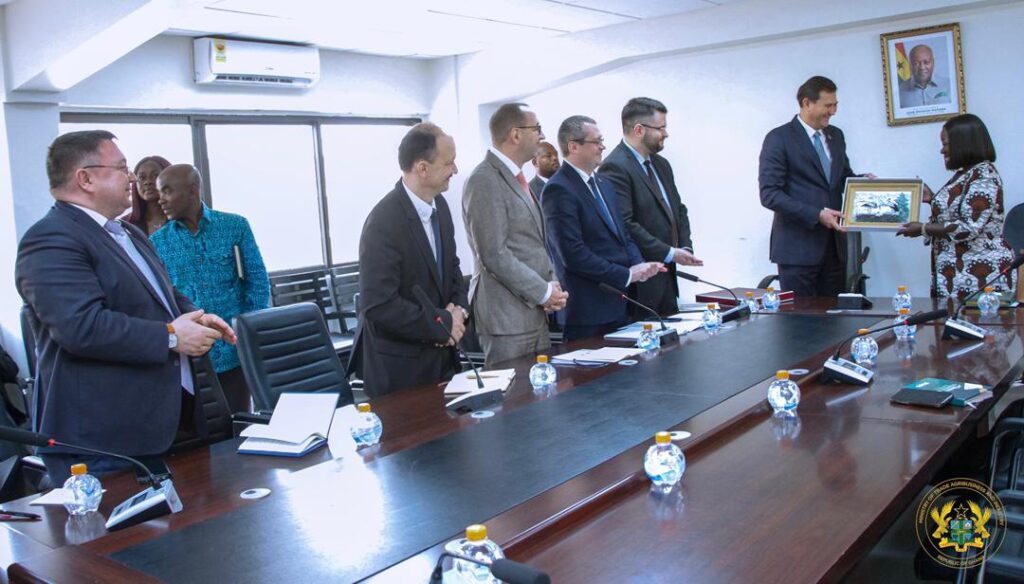
MoTAI revealed that to ensure the visit results in immediate economic action, both nations agreed to fast-track the drafting of several key Memoranda of Understanding (MoUs). These include the establishment of a Joint Trade and Economic Commission and critical legal frameworks for Investment Protection and the Avoidance of Double Taxation.
These agreements are designed to provide Belarusian investors with the legal certainty required to commit large-scale capital to the Ghanaian market.
Furthermore, the collaboration will extend to the Textiles and Garments industry, an area where Belarus possesses significant technical heritage. The Hon. Ofosu-Adjare highlighted Ghana’s readiness to attract investment into this sector, positioning the country as the “Garment Hub of the Atlantic,” under the favorable terms of the Free Zones and other industrial incentives.
Balanced and Resilient Trade Map
The Belarusian Foreign Minister, Ryzhenkov Maxim, noted that while they are eager to export machinery, they are equally interested in importing Ghanaian finished and semi-finished products.
There is a high domestic demand in Belarus for Ghanaian fruits, nuts, and cocoa derivatives. This focus on “Balanced Trade” ensures that the relationship is not predatory but symbiotic, allowing Ghanaian exporters to tap into a relatively underserved market in the Eurasian region.
By diversifying its trade partners to include nations like Belarus, Ghana is effectively de-risking its economy from over-reliance on traditional Western and Asian markets.
This “Multi-Aligned” economic strategy is a hallmark of the Administration’s 2026 foreign policy, seeking out specialized partners who can provide the specific industrial tools – like the 3,000 tractors – needed to jumpstart local productivity.
As the Ministry of Trade, Agribusiness and Industry, and the Belarusian delegation conclude this round of talks, the focus now shifts to the technical committees charged with finalizing the joint commission’s structure.
With 3,000 pieces of machinery on the horizon and a presidential visit in the works, the Ghana-Belarus alliance is poised to become a primary engine of the nation’s Agriculture and Industrialization goals for 2026 and beyond.
READ ALSO: GSE Composite Index Breaks New Milestone, Crosses 14,000 Mark