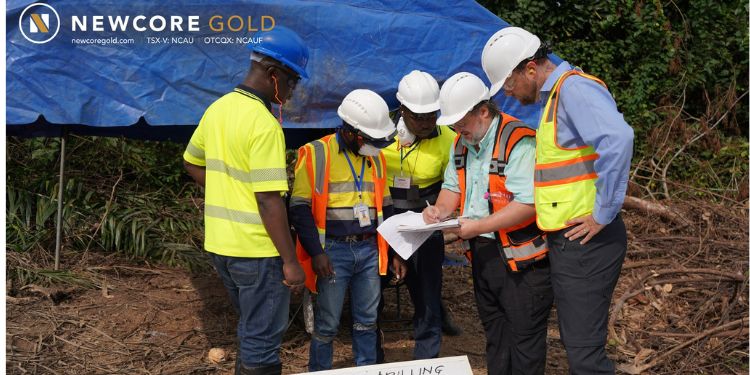
Newcore Gold Ltd has significantly bolstered its operational outlook by advancing a massive 45,000-metre drilling campaign at its flagship Enchi Gold Project in Ghana, aimed at transitioning from exploration to a robust production profile.
The programme, which is currently two-thirds complete, serves as the primary engine for the company’s dual-track strategy: converting existing resources into higher-confidence categories while aggressively testing for new, high-grade extensions at depth.
By systematically proving up the gold inventory, the Vancouver-based miner is laying the technical foundation required to support its forthcoming Pre-Feasibility Study (PFS) and ultimately de-risk the path toward a large-scale open-pit mining operation.
“With that additional capital, my expectation is that we’ll be able to expand our drill programme well beyond the 45,000 metres that we’ve announced so far. Our goal is to take that from 740,000 to 1.3 million ounces or more of indicated resources. We are back to pure resource growth and targeting some of the high-grade chutes that we’ve identified across the project.”
Luke Alexander, President and CEO of Newcore Gold Ltd
The expansion of this drilling initiative is underpinned by a recent capital injection of approximately $10.3 million, generated through the exercise of “in-the-money” warrants.
This financial liquidity allows Newcore to look beyond the initial 45,000-metre scope, potentially extending the drill bit’s reach to further delineate the Sefwi-Bibiani Gold Belt’s untapped potential.
With over 33,000 metres of results already processed, the company is shifting its tactical focus back to pure resource expansion. This involves targeting high-grade “feeder zones” that have historically defined multi-million-ounce deposits in the region, ensuring that the project’s mineralized footprint continues to grow both laterally and vertically.
Resource Conversion and the Path to Pre-Feasibility

A critical component of Newcore’s current success lies in its disciplined approach to “resource conversion.” Before a mining company can break ground on a production facility, it must demonstrate a high degree of geological certainty.
For Newcore, this meant dedicating the first 30,000 metres of the current programme to infill drilling. The objective was to migrate ounces from the “inferred” category—where geological confidence is lower—into the “indicated” category.
This transition is not merely a technicality; it is the “meaningful outcome for shareholders” that Luke Alexander emphasizes, as only indicated resources can be factored into the economic calculations of a Pre-Feasibility Study.
By aiming for a target of 1.3 million indicated ounces, Newcore is attempting to replicate and solidify the strong economics previously outlined in their Preliminary Economic Assessment (PEA).
The PFS, which is currently underway, will serve as the definitive blueprint for production, detailing the projected life-of-mine, processing throughput, and capital expenditure.
The ongoing drilling ensures that the data fed into this study is current and comprehensive, reducing the “investment risk” and providing a clearer picture of the Enchi Project’s ability to generate sustained cash flow in a high-gold-price environment.
Chasing High-Grade Feeder Zones at Depth

Beyond the near-surface oxide mineralization, the true “blue-sky” potential for Newcore Gold lies in the deeper primary structures of the Sefwi-Bibiani belt.
Recent results from the tail end of January have already teased the market with high-grade intercepts, including a headline-grabbing 147.5 grams per tonne (g/t) gold over one metre. These results suggest that the Enchi system is not just a broad, low-grade deposit but one hosted by “greenstone-hosted feeder zones” that can significantly enrich the overall grade profile of the mine.
Alexander points to the Toronto mine, a neighboring operation, as a geological analog. That mine currently operates at depths of 800 metres and has been explored down to 1.2 kilometres. Newcore is now “systematically stepping out” to find where their system follows this trend.
Identifying these high-grade chutes allows for a more flexible mining plan; should the company encounter these zones early in the production cycle, it could lead to a faster “payback period” by processing higher-grade ore through the mill in the initial years of operation.
Financial Fortification and Production Scalability

The injection of $10.3 million from warrant proceeds provides Newcore with a rare advantage in the junior mining sector: the ability to remain aggressive without returning to the equity markets for dilutive financing.
This “additional capital” ensures that the drilling momentum remains uninterrupted. In the mining industry, “the drill bit is the truth,” and the ability to continue drilling well beyond the 45,000-metre mark means that Newcore can continue to add value to the asset in real-time.
For the company’s production future, this scalability is vital. A larger resource base allows for a larger processing plant and a longer mine life, both of which improve the “Net Present Value” (NPV) of the project.
As the company continues to work through the assays currently in the lab and at the core shed, the market is watching closely to see if Enchi will evolve from a promising exploration project into Ghana’s next major gold producer.
READ ALSO: Court Clears Banks To Sell PBC Assets