
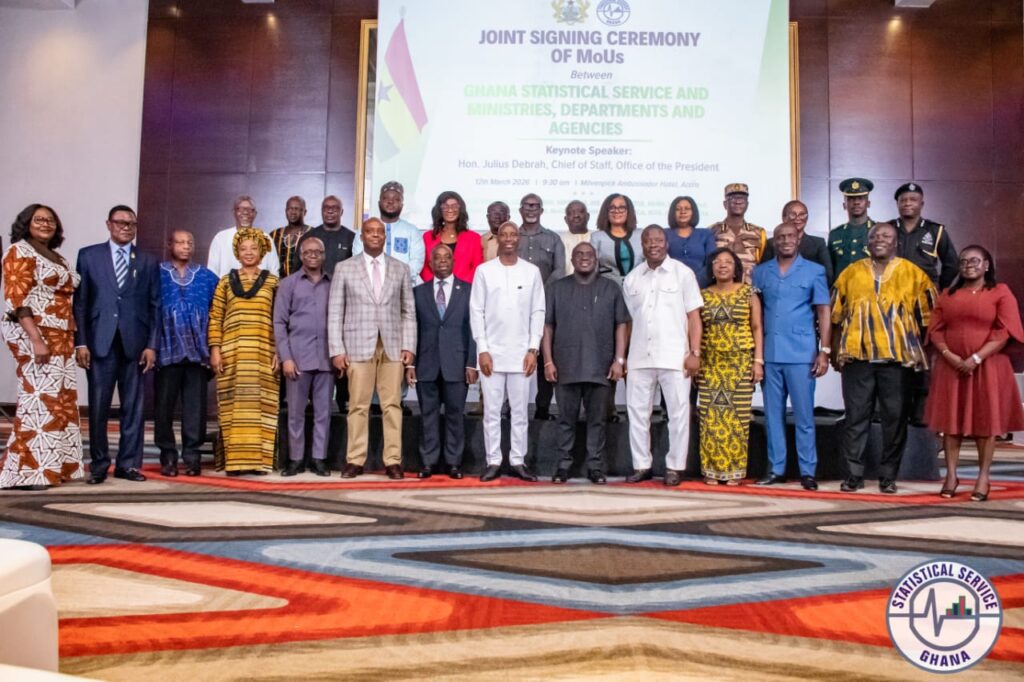
The Ghana Statistical Service has signed Memoranda of Understanding with 25 Ministries, Departments, and Agencies in a major step aimed at strengthening data-driven governance across the country.
The agreements are designed to improve collaboration within Ghana’s National Statistical System by enabling structured sharing of administrative data among key government institutions. Officials say the initiative will help address fragmentation in government data systems and support more informed policy decisions.
Government Statistician Alhassan Iddrisu described the development as a turning point in the country’s efforts to ensure that data generated within government institutions actively supports national planning and development.
According to him, the signing ceremony represents a shift from general commitments toward concrete actions that will allow institutions to work together in producing reliable national statistics.
“In my welcome remarks, I emphasised that the memoranda we are signing today move us from good intentions to intentional actions. This is more than a signing ceremony.
“It represents a fundamental shift from fragmented data systems to connected ones, from institutional silos to institutional collaboration, and from data as a byproduct of administration to data that actively informs national decisions.”
Government Statistician Alhassan Iddrisu
Integrating Administrative Data Across Government
The institutions that signed the memoranda manage some of the most significant administrative datasets within government. These datasets cover sectors such as education, social protection, economic development, public safety, infrastructure, natural resources, creative arts, and technology.

By formalising data sharing arrangements, the agreements aim to strengthen collaboration between the statistical service and these institutions, allowing for the integration of administrative data into the production of official national statistics.
Officials believe the initiative will enable the government to make more accurate and timely assessments of social and economic conditions across the country.
The improved coordination is also expected to reduce duplication in data collection activities among public institutions while improving the efficiency of the national statistical system.
Legal and Policy Framework for Data Sharing
The agreements are grounded in the Statistical Service Act, 2019 (Act 1003), which provides the legal foundation for the coordination and regulation of official statistics in Ghana.
Implementation will also be guided by the Data Quality Assurance Framework and the Code of Ethics and Practice for the National Statistical System, both of which outline standards for data quality, confidentiality, and responsible use of information.
In addition, the initiative aligns with the National Strategy for the Development of Statistics III, which seeks to strengthen Ghana’s statistical capacity and improve the availability of reliable data for policymaking.

Officials emphasised that these frameworks ensure that the exchange of administrative data across institutions is conducted responsibly while maintaining the integrity and confidentiality of sensitive information.
Implementation Begins Immediately
Implementation of the memoranda will begin immediately following the signing ceremony. The Ghana Statistical Service will work with the participating institutions to finalise detailed data sharing protocols and technical standards in the coming weeks.
These processes are expected to establish the operational mechanisms needed for seamless data exchange across government institutions. Dr Iddrisu expressed appreciation to the officials and partners who supported the initiative, noting that collaboration across institutions will be essential for the success of the programme.
He also acknowledged the role of development partners, academia, civil society organisations, and members of the governing board of the statistical service in strengthening Ghana’s national data ecosystem.
While describing the signing as an important milestone, he stressed that the effectiveness of the initiative will depend on sustained cooperation and commitment from all participating institutions. “The signing is only the first step,” he said. “The real work begins now.”
High Level Government Participation
The signing ceremony brought together several senior government officials, development partners, and representatives from academia and civil society organisations.
Chief of Staff Julius Debrah delivered the keynote address, highlighting the importance of reliable statistics in guiding national policy and development planning.
Also present were Deputy Minister for Finance Thomas Nyarko Ampem and Minister for Communication, Digital Technology and Innovation Samuel Nartey George.
Deputy Minister for Tourism, Arts and Culture Yussif Jajah attended the event alongside the United Nations Resident Coordinator Zia Choudhury and Head of Civil Service Evans Aggrey-Darkoh.

Members of the governing board of the Ghana Statistical Service were also present, including Mariama Awumbila and Butakor. The participation of these stakeholders reflects the growing recognition of the importance of data in shaping government policies and improving service delivery.
Officials believe that strengthening collaboration within the National Statistical System will help ensure that reliable and timely data becomes a central tool for guiding national development policies and improving governance outcomes.