Nigeria and U.S. have deepened their security alliance against rising militancy.
This cooperation includes the deployment of a multiple MQ-9 drones and approximately 200 U.S. military personnel tasked with training and intelligence support, reinforcing a partnership in addressing a rapidly evolving insurgency and the fight against Islamist militants across the north.
This alliance comes amid renewed violence linked to extremist groups affiliated with Islamic State and al Qaeda, which continue to exploit security gaps across the region. While Nigeria has battled insurgency for over 17 years primarily in the northeast recent developments indicate a troubling geographic expansion. Attacks in the northwest, coupled with persistent banditry and cross-border criminal networks, have heightened concerns that new fronts of instability are emerging.
Major General Samaila Uba, Director of Defence Information at Nigeria’s Defence Headquarters, confirmed that the U.S. was operating assets from Bauchi airfield in the northeast.
“This support builds on the newly established U.S.-Nigeria intelligence fusion cell, which continues to deliver actionable intelligence to our field commanders. Our U.S. partners remain in a strictly non-combat role, enabling operations led by Nigerian authorities.”
Major General Samaila Uba
A US defence official confirmed that the drones had been deployed alongside troops at the request of the Nigerians to collect intelligence, adding that “ we see this as a shared threat.”
Meanwhile, militants have intensified their attacks across Nigeria’s northwest, particularly in areas bordering Benin and Niger, raising alarm over the evolving nature of the threat.
What began as a long-standing banditry crisis driven largely by criminal networks engaged in kidnapping, cattle rustling, and village raids shows increasing signs of convergence with extremist ideology. Armed groups operating in these regions are becoming more organized, better armed, and in some cases adopting tactics and narratives associated with jihadist movements.
Nigeria’s Islamist Insurgency Remains One of Africa’s Most Enduring Conflicts
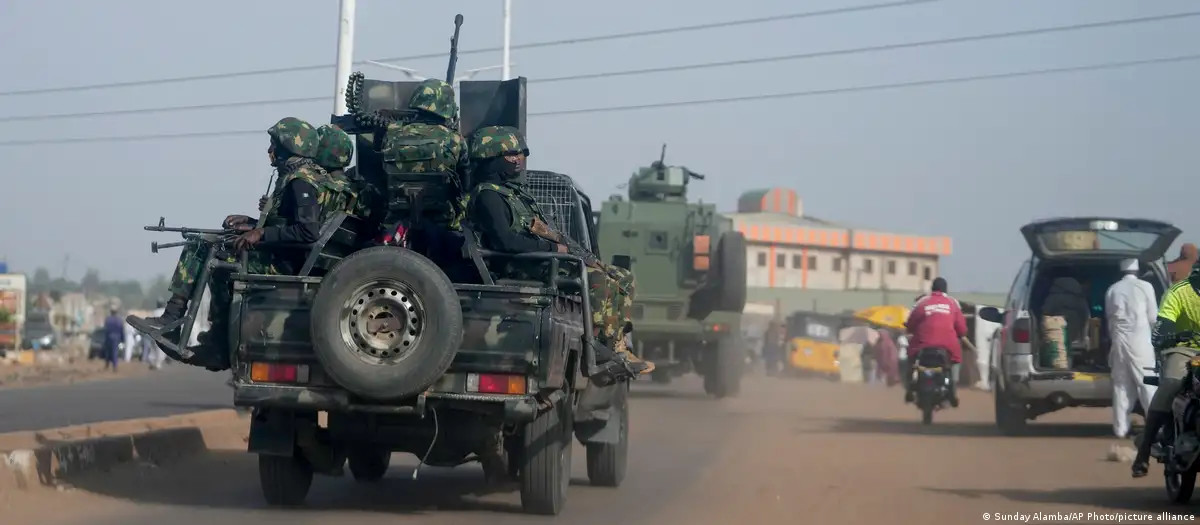
Nigeria’s Islamist insurgency, ongoing for approximately 17 years, remains one of Africa’s most persistent security challenges. The conflict began in 2009 with Boko Haram’s emergence in Maiduguri, Borno State, as the group rejected secular governance and called for an Islamic state.
After a major government crackdown resulted in the founder’s death and the dispersal of fighters from urban areas, the movement split into several factions. The most prominent is the Islamic State West Africa Province (ISWAP), which later pledged allegiance to the broader Islamic State network.
Despite ongoing military operations, Boko Haram and ISWAP continue to hold influence in parts of rural northeastern Nigeria. Their presence in remote terrain allows them to regroup, recruit, and launch periodic attacks on population centers.
Analysts describe this as a “dual control” situation where security forces control major towns and cities, while militants maintain influence in rural and inaccessible areas. This resilient pattern complicates efforts to dismantle insurgent networks.
Urban attacks remain strategically important for these groups. Maiduguri, the historical centre of Boko Haram’s emergence, continues to be a symbolic and operational target.
Attacks on the city challenge state authority, demonstrate operational capability, and reinforce militant narratives for recruitment and psychological impact. Even with limited territorial control, striking urban areas enables insurgents to maintain visibility and relevance.
The persistent volatility is indicated by recent events where one of the deadliest coordinated suicide bombs in Nigeria in recent memory occurred in Maiduguri, exposing ongoing shortcomings in intelligence and urban security cooperation.
At least 23 people were reported dead and 108 injured by a series of suspected suicide bombings in Maiduguri which also hit a post office, a popular weekly market and the University of Maiduguri Teaching Hospital.
According to a statement by the Borno Police, “preliminary investigation reveals that the incidents were carried out by suspected suicide bombers,” adding that an investigation was under way to establish the identity of the attackers.
In response to this renewed violence, President Bola Ahmed Tinubu further authorized additional military support, including equipment and reinforcements for security forces in the northeast. This decision continues the long-standing reliance on military solutions by successive Nigerian administrations.
Before the Maiduguri attacks, Nigerian forces reportedly intercepted several attempted strikes near the city, but the success of simultaneous urban attacks highlighted ongoing gaps in surveillance, intelligence coordination, and rapid response.
To add to that, Nigeria’s counterinsurgency strategy has also relied heavily on international cooperation. In addition to military training, logistical support, intelligence sharing, and limited bombing aid against rebel assets, the United States has a long history of security cooperation.
READ ALSO : British Army Begins Retirement of Iconic Land Rover Fleet