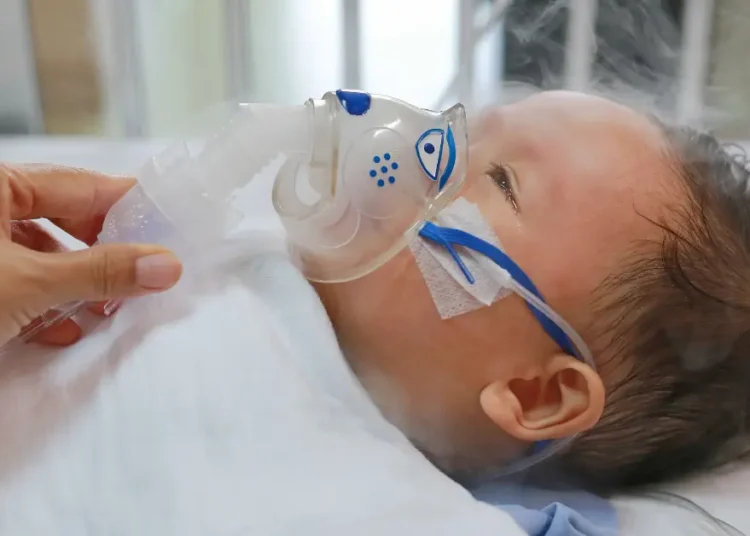
A major UK-led clinical study has found that surfactant therapy, a treatment routinely used to support premature babies with underdeveloped lungs, does not improve outcomes for infants receiving life support due to severe bronchiolitis.
The findings published in the Lancet Respiratory Medicine mark a significant development in paediatric respiratory care, challenging assumptions about whether therapies effective in neonatal medicine can be successfully adapted for viral lung infections in critically ill infants.
The study, known as the Bronchiolitis Endotracheal Surfactant Study (BESS), was funded by the UK Research and Innovation Medical Research Council, the National Institute for Health and Care Research, and Chiesi Farmaceutici SpA and was conducted across 15 children’s hospitals in England, Scotland, and Northern Ireland, and involved 232 critically ill infants requiring mechanical ventilation.
Researchers sought to determine whether surfactant could reduce the time these infants spent on ventilators a key indicator of recovery but found no measurable benefit.
Professor Calum Semple, the study’s lead from the University of Liverpool and Alder Hey Children’s NHS Foundation Trust, presented the study’s conclusions.
“The treatment was safe, but it didn’t make any difference to how long babies stayed on ventilators. We had hoped that surfactant might speed up recovery for these very sick babies, but the evidence doesn’t support this. While we continue to research better ways to care for these sick babies, I urge Mums-to-be to accept the offer of the RSV vaccine during pregnancy, which will protect their new born babies from severe bronchiolitis.”
Professor Calum Semple
Bronchiolitis is an acute lower respiratory tract infection that primarily affects infants under one year of age, particularly those under six months. It involves inflammation of the bronchioles, the smallest airways in the lungs leading to airway narrowing, increased mucus production, and impaired airflow.
This condition is most commonly caused by Respiratory Syncytial Virus (RSV), although other viruses such as rhinovirus, influenza, parainfluenza, and adenovirus can also contribute and leads to inflammation, swelling, and a build-up of mucus in the bronchioles, the tiny air passages in the lungs making it difficult for babies to breathe.
Per the findings, early symptoms typically resemble those of a common cold, including a runny nose, mild fever, and cough. However, in more severe cases, bronchiolitis can progress to cause rapid or laboured breathing, wheezing, and feeding difficulties.
Risk of infection is highest in infants because their airways are smaller and more easily obstructed, and because their immune systems are still developing. Premature birth, low birth weight, congenital heart disease, chronic lung disease, and exposure to tobacco smoke further increase susceptibility and the risk of severe disease.
The rationale for the BESS study was therefore grounded in physiological similarities between bronchiolitis and respiratory distress in premature infants, both of which are associated with reduced surfactant levels. This substance helps keep the lungs’ air sacs open and functioning properly.
In premature babies, surfactant therapy has long been established as a life-saving intervention.
This led researchers to investigate whether the same treatment could benefit infants with bronchiolitis.
However, the trial’s findings indicate that these similarities do not translate into clinical effectiveness. While surfactant levels may be reduced in bronchiolitis, the underlying disease process driven by viral infection, inflammation, and airway obstruction differs significantly from that of premature lung disease.
As a result, replacing surfactant alone does not address the primary causes of respiratory failure in these patients.
Key Implications of Study Findings for Healthcare
Reports indicate that there is currently no other treatment for bronchiolitis; as such, researchers advocate further studies to explore targeted treatments.
The findings provide clear guidance for health professionals that surfactant should no longer be considered a treatment option for ventilated infants with bronchiolitis. This clarity supports greater consistency in clinical practice, reducing variations in care and ensuring that treatment approaches are firmly grounded in robust scientific evidence.
Moreover, the results emphasize the pressing need to prioritize preventive measures. Bronchiolitis continues to be a leading cause of infant hospitalisation, placing a considerable burden on healthcare systems. In the absence of targeted therapeutic options, preventative measures become increasingly vital.

Among the most promising strategies is maternal vaccination against respiratory syncytial virus (RSV). Administering the vaccine during the later stages of pregnancy allows protective antibodies to pass from mother to child, offering crucial early-life immunity. “I urge Mums-to-be to accept the offer of the RSV vaccine during pregnancy, which will protect their newborn babies from severe bronchiolitis, ” Professor Semple added.
READ ALSO : Trump Gives Iran 48 Hours To Reopen Strait Of Hormuz