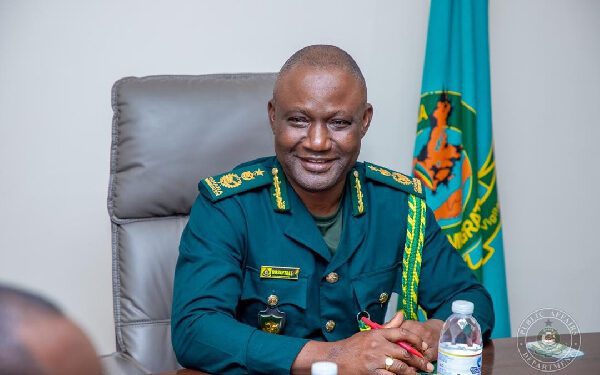
The Ghana Immigration Service (GIS) has recorded significant progress across its operations within the first year of Comptroller-General Samuel Basintale Amadu’s leadership, marking what officials describe as a new phase of institutional transformation.
Appointed in March 2025 by President John Dramani Mahama, the Comptroller-General was tasked with strengthening border security, improving operational efficiency, and leading wide-ranging reforms to modernise the Service.
One year on, the GIS reports measurable gains in revenue generation, enforcement, infrastructure development, and international cooperation.
A key highlight of the Service’s performance is its strong revenue growth, driven largely by reforms in visa and permit processing.
Over the past year, GIS generated more than GH¢546 million, supported by the issuance of 186,959 permits and visas, representing a 32.5 percent increase compared to the previous year.
Officials attribute this growth to ongoing investments in digitalisation, automation, and system upgrades, which have reduced processing times and improved transparency in service delivery.
The Service also managed over 2.8 million passenger movements across Ghana’s air, land, and sea entry points without major incidents, contributing to smooth travel experiences and supporting national initiatives such as tourism campaigns.
Border security remains a central focus of the Service’s transformation agenda, with intensified operations leading to significant enforcement outcomes.
Through coordinated efforts involving various departments and regional commands, the GIS intercepted a wide range of smuggled goods and illegal items. These included cocoa, narcotics such as Tramadol, suspected Indian hemp, ammunition, fuel, and other contraband.
In total, 909 individuals were intercepted at entry points and checkpoints, while a broader enforcement exercise involving over 7,200 inspections led to the arrest of 3,533 individuals for immigration-related offences.
These operations reflect growing effectiveness in tackling cross-border crime and disrupting illicit trade networks.
The Service has also strengthened its intelligence-gathering and legal enforcement capabilities. During the period under review, 666 intelligence requests were processed in collaboration with partner agencies, representing a steady increase in inter-agency cooperation.
GIS prosecuted 29 cases and secured 28 convictions, covering offences such as illegal entry, fraud, cybercrime, and schemes linked to networks like QNET.
At the same time, the Document Fraud Expertise Centre examined 932 suspected cases, with over a third confirmed as fraudulent. This highlights both the scale of document-related crimes and the Service’s improved ability to detect them.
Prioritized Training And Capacity Building
Recognising the importance of human capital, the GIS has prioritised training and capacity building.
More than 970 officers received specialised training both locally and internationally in areas including counter-terrorism, crisis management, and border security.
Additional initiatives included a three-month training programme in collaboration with the Youth Employment Agency and the National Ambulance Service, aimed at developing community-based medical first responders.
The Service also organised its first instructors’ conference at the Immigration Service Academy and Training Schools, bringing together local and international experts to review training systems and enhance instructional standards.
Further training programmes, including a Trainer of Trainers initiative supported by international partners, and specialised self-defence sessions such as Krav Maga, have been introduced to improve officer readiness and safety.
To support its growing operational demands, the GIS has embarked on infrastructure development projects across several regions, including Tema, Kumasi, Tamale, and Sekondi-Takoradi.
These projects are aimed at improving working conditions for officers, enhancing service delivery, and strengthening decentralised operations across the country.
The Service has also expanded its international engagements, working closely with organisations such as the International Organization for Migration to strengthen migration governance and community outreach.
Recent collaborations have included engagements with the United Nations Counter-Terrorism Centre, as well as study visits and exchanges with immigration authorities from Rwanda, Nigeria, and Sierra Leone.
These partnerships are expected to enhance knowledge sharing and support the development of more integrated border management systems.
Reform Agenda And Road Ahead
Looking ahead, the GIS is advancing a reform agenda focused on sustainability, innovation, and improved staff welfare.
A major initiative under this agenda is Project SECOBOR (Secure Our Borders), a public-private partnership designed to address gaps in logistics, surveillance, infrastructure, and officer welfare.
Additional proposals include the establishment of a private mutual health insurance scheme and a staff endowment fund to provide long-term support for personnel.
Officials say the past year has repositioned the Ghana Immigration Service as a more responsive, technology-driven, and intelligence-led institution.
While challenges remain in an increasingly complex global security environment, the progress made under Comptroller-General Amadu is seen as a strong foundation for future growth.
As Ghana continues to expand its economic and diplomatic footprint, the role of the GIS remains critical in safeguarding national security while facilitating safe and efficient movement across its borders.
READ ALSO: Trump Postpones Threatened Strikes On Iran’s Power Plants