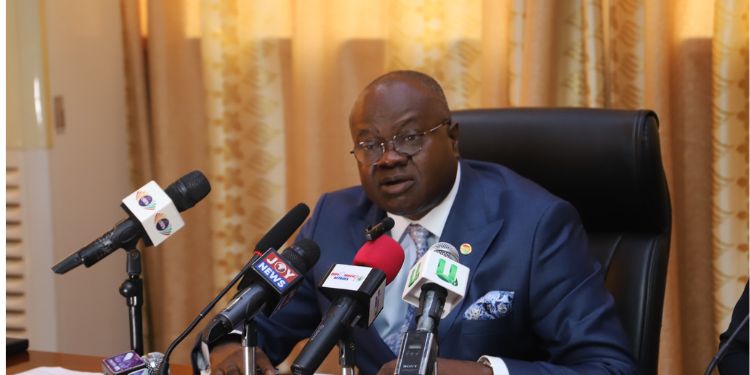
The Minority Caucus in Parliament through Hon. Kwaku Ampratwum-Sarpong, the Ranking Member on the Committee on Lands and Natural Resources, has raised a red flag over the potential acquisition of the Damang Gold Mine by Engineers & Planners (E&P), a company owned by Ibrahim Mahama, the brother of President John Dramani Mahama.
Speaking at a press briefing in Parliament, the lawmaker alleged that the bidding process for the $1 billion national asset is mired in a “structural conflict of interest” that undermines the integrity of Ghana’s extractive sector.
The Minority’s intervention comes as the 30-year lease held by Aboso Goldfields Limited is set to expire on April 18, 2026, triggering a transition that the opposition claims is being “arranged” rather than competitively selected.
“The person who has repeatedly provided the president with a 70 million dollar aircraft at his own expense cannot in the same breath be assessed as an arm’s length applicant for a billion dollar national asset by the officials who serve the president. The structural conflict makes a fair decision impossible, not merely difficult.”
Hon. Kwaku Ampratwum-Sarpong

The controversy centers on a perceived “benefit-giving relationship” between the President and his businessman brother, specifically concerning the President’s frequent use of a $70 million private aircraft owned by Ibrahim Mahama for official international travel.
According to the Minority, a single trip to South Korea incurred rental costs approaching $360,000 approximately 5.4 million Ghana Cedis which exceeds the 20,000 GHS gift threshold set in the President’s own May 2025 Code of Conduct by more than 270 times.
This financial entanglement, Ampratwum-Sarpong argued, creates an inescapable obligation that “corrupts the integrity of every state decision” regarding E&P’s business interests, particularly its aggressive bid to take over the Damang Mine.
The Anatomy of a “Constitutional Defect”

The Minority contends that the entire chain of command responsible for awarding the Damang lease from the Sector Minister to the Minerals Commission operates under authority that flows directly from the Executive.
Hon. Ampratwum-Sarpong questioned whether any “reasonable, honest, independent person” in the decision-making chain would feel truly free to decide against the President’s brother.
He described the situation as a “constitutional defect,” noting that Article 257(6) of the 1992 Constitution vests all minerals in the President’s trust for the people of Ghana, not for “a president’s family” or “a party.”
The opposition claims that E&P has already begun “pre-bid mobilization,” deploying 30 Caterpillar dump trucks and securing a $205 million financing facility from Standard Bank, suggesting the company has been “told it will win.”
E&P’s Informational Edge and Technical Dominance

Engineers & Planners has served as the primary mining contractor at Damang for approximately 25 years, a position the Minority argued has granted the firm a “privileged” and “unfair” informational advantage.
Between 2015 and 2025, E&P entered into contracts at the site valued at nearly $470 million, allowing them to accumulate exhaustive knowledge of the mine’s geology, workforce, and equipment.
While the government claims a competitive process has been triggered under LI 2176, the Minority labels this a “reactive attempt at cover” following sustained public pressure.
They are now demanding the disclosure of evaluation criteria and a full list of the tender committee members to ensure no former E&P consultants are overseeing the bid.
Mining Sanctity and the Risk of State Capture

The potential handover of the Damang Mine to a state-linked indigenous firm raises critical questions about the “sanctity” of Ghana’s mining environment and its appeal to global investors.
Critics argue that if the acquisition is perceived as a product of political proximity rather than technical merit, it could signal a shift toward “resource nationalism” that prioritizes “family monopoly” over transparent competition.
Such a move threatens to erode the regulatory predictability that has historically made Ghana a top-tier mining destination.
To maintain mining sanctity, the Minority insists that any winning bid must be put before Parliament for ratification under Article 268(1), warning that they will not accept a “winner being arranged” behind closed doors.
READ ALSO: UK Tightens Sentencing Rules for National Security Offenders