
The Minister for Food and Agriculture, Hon. Eric Opoku, has detailed a multi-layered national strategy to achieve total tomato sovereignty and mitigate the immediate impact on consumers and market prices, following the recent export ban by authorities in Burkina Faso.
Addressing the local supply impasse, the Minister revealed that Ghana’s historical reliance on Burkinabe imports – averaging a 300,000-metric-ton gap annually – has reached a critical turning point, with the Ministry deploying a combination of high-yield seed technology, the activation of dormant irrigation schemes, and a nationwide “backyard garden,” campaign.
The objective of these initiatives, under the flagship Feed Ghana Programme, is to move beyond land expansion and focus on yield intensification, aiming to bridge Ghana’s national tomato demand of 805,000 metric tons entirely through domestic production.
“In Burkina Faso per hectare production is 18 metric tons, but in Ghana per hectare production is just 8 tons… if we want to solve the problem it is not about increasing the size of the land under cultivation it is about developing the variety that will maximize the output for us”
Hon. Eric Opoku, Minister for Food and Agriculture
The Minister’s technical assessment explained this stark productivity disparity that has long disadvantaged Ghanaian farmers, where with approximately 139,000 hectares under cultivation across various seasons, the total output still fails to meet national requirements. Hon. Opoku emphasized that the solution beyond “developing variety,” lies in creating the infrastructure to support all-year-round farming.
To close the yield gap, the Ministry of Food and Agriculture (MoFA) has entered into a strategic coordination agreement with the West Africa Centre for Crop Improvement (WACCI) at the University of Ghana, Legon.
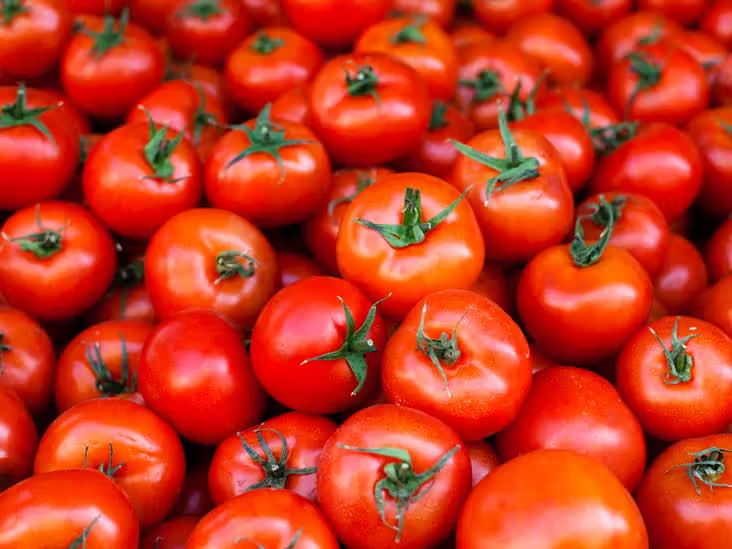
Hon. Opoku announced that WACCI will lead a consortium of research agencies to produce a climate-resilient seed variety capable of yielding at least 15 metric tons per hectare under Ghana’s diverse ecologies. This scientific intervention is expected to deliver results within the coming months, providing farmers with the “right seed to compete with regional neighbors.”
Parallel to the seed rollout, the MoFA is addressing the devastating 30 percent post-harvest loss rate that currently accounts for 153,000 tons of wasted produce annually, with a strategy that involves the “vegetable development project,” anchored on the pillars of seed, irrigation, and marketing.
The Minister noted that bringing buyers directly to the farm gate through organized clusters will eliminate the middleman friction that often leads to produce rotting in the fields. This logistical overhaul is already being piloted in the Ahafo and Brekum West regions, where 60-hectare irrigation blocks are being mechanized to ensure constant production.
Irrigation and Industrial Processing
A major component of the emergency response involves the immediate reclamation of land under the “Bono Irrigation Scheme.” According to Hon. Opoku, following high-level discussions, the scheme’s management has agreed to pivot 500 hectares of land from rice back to tomato cultivation.
This move was secured by the Ministry’s introduction of guaranteed buyers to the farmers, providing the market assurance necessary for them to switch crops. Similarly, 100 hectares are being activated in Akumadan, with farmers already mobilizing for immediate planting.
In the five northern regions, the government is drilling 250 boreholes to provide the groundwater necessary for dry-season vegetable farming – a critical move to break the seasonal shortage cycle that typically drives prices up when the rains fail.

Furthermore, the Minister noted that a partnership with “Farm Mate” near the Legon bypass has resulted in the establishment of a processing center that produces tomato puree – a long-life alternative to fresh paste.
This facility, which manages its own 200-acre farm, will begin harvesting next week, providing a direct farmers market for fresh produce and processed goods to stabilize the Accra market.
Nationwide Institutional Farming
MoFA has also committed to the massive procurement and distribution of inputs to sustain this industrial push, including 13 metric tons of improved tomato seeds, 69,000 metric tons of fertilizers, and over 883,000 liters of plant protection products.
These inputs are being made available to individual smallholders, commercial farmers, and state institutions alike. Hon. Eric Opoku noted that the Mahama-led administration is determined to use this impasse as a catalyst to end the “tomato importation problem,” once and for all.
Institutional participation is also being scaled up significantly. Under the Feed Ghana framework, 413 secondary schools have been registered to begin tomato production on campus.
Churches and other civil society agencies have also registered to join the production space, turning the agricultural crisis into a national mobilization effort. By feeding themselves, these institutions will reduce the overall market demand, easing the pressure on supply chains.
Perhaps the most direct call to action from the Minister was the intensification of the Backyard Garden campaign. Hon. Eric Opoku urged every Ghanaian – including media professionals, ministers, and civil servants – to utilize their fertile domestic soil to grow organic tomatoes.

He argued that if every household supplements its feeding with home-grown vegetables, the cumulative impact on national food security and household savings would be transformative. Hon opoku added that the Ministry is prepared to supply seeds to any household owner interested in joining the movement.
“This organic supplement strategy is designed to reduce the shortage anxiety that often leads to price gouging in the markets,” the Minister said, reassuring the public that while the Burkina Faso ban is a challenge, the “situation is not alarming,” because the projects started last year have already established a foundation.
From 85 pilot communities last year, the Ministry is scaling up to 40,000 hectares of land under the collaborative Farm Mate and Feed Ghana frameworks.
Hon. Eric Opoku concluded by emphasizing that the Ministry is providing the leadership, but the success of the strategy depends on a collective responsibility. He called on the media to help disseminate the technical advice and encourage participation in the Feed Ghana initiatives.
The transition to 15-ton-per-hectare yields and the elimination of the 153,000-ton post-harvest waste would, by the Minister’s calculations, move Ghana well beyond self-sufficiency and into a position of being a net exporter.
The Ministry’s approach is not just a response to a trade dispute; it is a long-term plan to ensure that Ghana never again finds itself at the mercy of a neighbor’s export policy by building a resilient vegetable sector that can withstand regional shocks.
READ ALSO: Minerals Sovereignty Does Not Repel Investment – Sophia Akuffo