
In a swift response to a sudden regional supply shock following an immediate suspension of all fresh tomato exports by the Burkinabè government, the Ministry of Trade, Agribusiness and Industry (MoTAI) announced that it has initiated diplomatic engagements with authorities in Burkina Faso.
The directive on the ban took effect on March 16, 2026. Led by Hon. Elizabeth Ofosu-Adjare, the Ghanaian government is moving to secure a “mutually beneficial,” resolution that addresses Burkina Faso’s domestic industrial needs while safeguarding Ghana’s seasonal food security.
“The engagement with the Burkina Faso counterparts will seek to address concerns surrounding the ban and chart a mutually beneficial way forward for both countries. The government reiterates its commitment to working with stakeholders to boost local tomato production”
Ministry of Trade, Agribusiness and Industry
For the government, this ban represents a double-edged challenge. While it creates immediate pressure on domestic market prices during the current lean season, it also serves as a powerful validation of the “Feed Ghana” and “Feed the Industry” agendas.
By prioritizing its own domestic processing plants, Burkina Faso is executing the exact same value-addition strategy that Ghana has championed under its industrialization mandate. The Trade Ministry’s engagement is therefore focused on charting a transition that allows both nations to coexist as agro-industrial partners rather than merely raw-commodity traders.
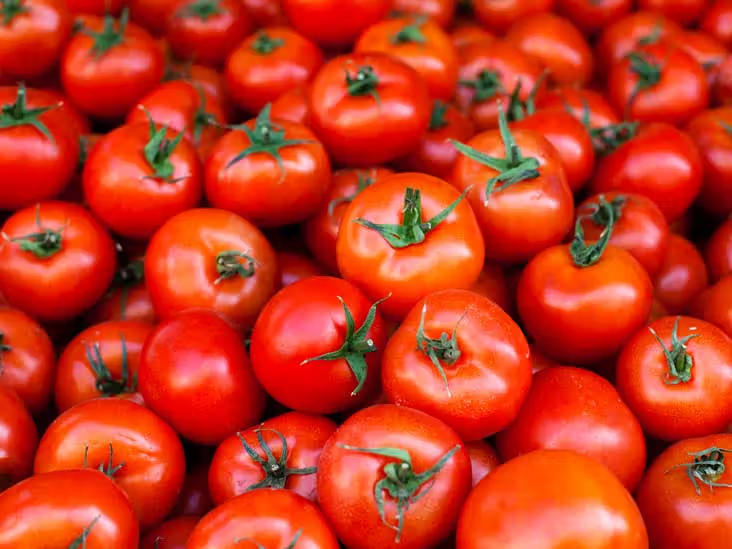
The timing of the Burkinabè directive has sent immediate ripples through Ghana’s major trading hubs, including Makola, Agbogbloshie, and the Kumasi Racecourse Market.
Ghana traditionally faces a domestic harvest gap between December and May, a period during which the nation relies heavily on imports from the northern corridor to meet its 800,000 metric tonne annual demand. With local fields currently bare, the sudden closure of the formal export channel has sparked fears of a price surge among traders and consumers.
In response, the MoTAI issued a strong call for calm among tomato traders and transporters. The Public Relations and Communication Unit of MoTAI emphasized that the government is not merely observing the crisis but is actively working with relevant state institutions to “stabilize supply in the short term.”
This includes exploring alternative sourcing and enhancing the logistics for the limited domestic volumes currently available through irrigation schemes in the Upper East Region.
The Long-Term Shield
The Ministry’s communique made it clear that the only permanent solution to such regional shocks is the full realization of the Feed Ghana Programme, with the government doubling down on its commitment to increasing domestic output to meet 100% of national demand.
Under the leadership of President Dramani Mahama, the government is accelerating investments in year-round irrigation infrastructure and high-yield seed technology to ensure that the December to May gap is permanently closed by Ghanaian farmers.
According to MoTAI, this crisis is being treated as a “catalyst for change,” rather than just a diplomatic hurdle, with the government pushing for the establishment of more domestic tomato processing facilities that align agribusiness with industrialization.
The goal is to replicate the very model Burkina Faso is now protecting – ensuring that Ghanaian tomatoes are processed into paste and sauces right here in Ghana, creating jobs and reducing the $2 billion annual food import bill.
The upcoming discussions with Burkinabè officials is expected to be framed within the broader context of the AfCFTA and regional trade protocols. While sovereign nations have the right to protect their industrial feedstock, the Ministry of Trade is seeking a “phased approach,” or a “special dispensation,” for existing contracts.
This follows the two-week window granted by Burkina Faso for operators with valid permits to complete pending transactions – a grace period that expires around March 30.
MoTAI noted that it is also working closely with the Ghana National Tomato Traders and Transporters Association (GNTTTA) to ensure that the “red zone,” security concerns in northern Burkina Faso – which had already slowed trade in February – are integrated into the diplomatic dialogue.
The objective is a comprehensive trade corridor agreement that provides both security for traders and raw material certainty for the processing plants of both nations.

As the diplomatic team prepares for the mission to Ouagadougou, the Ministry of Trade, Agribusiness and Industry remains optimistic, but the tomato tensions are a stark reminder of the necessity of agricultural self-sufficiency.
Hon. Elizabeth Ofosu-Adjare’s team is not just fighting to reopen a border; they are fighting to build a Ghana that no longer needs to look across its borders for its daily bread.
While the immediate focus is on an amicable resolution to restore trade flows, the strategic victory will be found in the irrigation projects and processing plants currently rising across Ghana’s vegetable belt.
The message from the Ministry is resolute: we will engage our neighbors as partners, but we will build our future as a self-reliant industrial power.
READ ALSO: Minority Rejects Revised Lithium Lease Agreement over Lack of ‘Value Addition Clause’