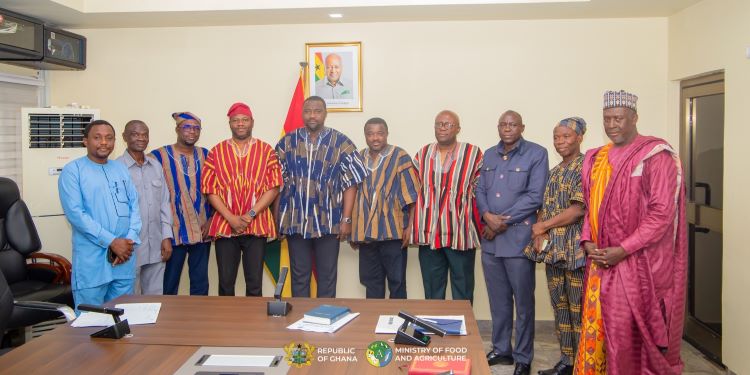
In a move that signals a technical tightening of Ghana’s agricultural supply chain, the Deputy Minister for Food and Agriculture, Hon. John Dumelo, has inaugurated the nine-member governing board of the Grains and Legumes Development Authority (GLDA).
Acting on behalf of the sector Minister Hon. Eric Opoku, Hon. Dumelo’s mandate to the new board – chaired by Dr. Azumyarm Asako Joseph was to stabilize the national seed system, eliminate the deficit in high-quality foundation seeds, and provide the raw material security necessary for the administration’s food security goals.
“Your board is a key pillar in the Ministry of Food and Agriculture’s efforts to enhance food security. You are expected to ensure the availability of quality grains at affordable prices while supporting farmers to maximise productivity”
Hon. John Dumelo, Deputy Minister for Food and Agriculture
With grains and legumes representing the fundamental caloric and industrial base of the Ghanaian economy, the inauguration of the GLDA board was not a mere ceremonial appointment, but a critical infrastructure play.
From poultry feed to industrial flour and household staples, the entire value chain is currently hostage to seed quality and availability, and activating the GLDA’s top-tier leadership attempts to move the country from a position of “import-dependency” to “seed-sovereignty.”
Hon. Dumelo explained that this ensures that the genetic blueprint of Ghana’s food supply is managed by a capable institutional framework as the strategic significance of the GLDA lies in its role as a bridge.

The Executive Secretary of the GLDA Assanaba Imoro added that the Authority’s primary mandate is the production of foundation seeds, including the elite seeds derived directly from research institutions – such as the CSIR-Crops Research Institute – which are then multiplied and distributed to the private sector and registered farmers for the production of certified seeds.
Without this multiplication, the breakthroughs made by Ghanaian scientists never reach the factory floor or the farmer’s field at scale. The new board – which includes technical heavyweights like Dr. Solomon Gyan Ansah and Lordson Sammor-Duah – was therefore tasked with creating a quality seal for the national seed system.
They were reminded to establish a consistent, high-volume supply of uniform grain by professionalizing the GLDA and making the agribusiness sector an investor-friendly landscape capable of turning Ghana’s Agricultural fortunes around.
Industrial Feedstock
Hon. John Dumelo emphasized that the strategic development of agribusiness in 2026 will depend on the GLDA not functioning in a vacuum. He reminded everyone present that ensuring that foundation seeds are “affordable,” will lower the entry barrier for smallholder farmers to enter the formal industrial supply chain.
According to the Deputy Minister of Agriculture, the grain sector, powered by high-yielding, climate-resilient foundation seeds, allows for two or even three planting cycles per year in areas with irrigation.

This continuous supply of raw material is the only way to sustain a 24-hour manufacturing cycle in the food and beverage industry, making the GLDA board’s mandate to enhance agricultural productivity a direct order to increase the velocity of agriculture – the speed at which Ghana can turn soil and water into industrial wealth.
The composition of the board – including members like Mohammed Issifu Pangabu, Donald A. Awintoma Adabre, and Awuni Anaahu – reflects a mix of regional representation and technical expertise.
This diversity is essential for an Authority that must operate across Ghana’s varied ecological zones, from the northern grain belts to the southern legume-producing plains. The inclusion of the Executive Secretary, Assanaba Imoro, on the board ensures that the day-to-day operational realities of seed production are directly integrated into high-level policy making.
The swearing-in ceremony, where board members pledged to “uphold, preserve, protect, and defend the Constitution,” underscored the gravity of their mission. In an era of global supply chain volatility and the weaponization of food exports, the GLDA is a national security asset.
Its ability to maintain a strategic reserve of foundation seeds is what stands between Ghana and the next global grain shortage. For the GDLA, the board is now the “custodian of the seed,” tasked with ensuring that the biological capital of the nation remains in Ghanaian hands and in Ghana’s interest.
It was noted that if the GLDA can provide a steady supply of affordable, high-performing foundation seeds, it will naturally drive out the low-quality, uncertified seeds that currently hamper national productivity – a cleanse necessary for a modernized agricultural sector.

The inauguration of the GLDA board has ushered in the institutional architecture for Ghana’s agricultural modernization. With the Tree Crops Development Authority (TCDA) managing the long-term industrial crops and the GLDA managing the foundational grains and legumes, the Ministry of Food and Agriculture is propelling a dual-engine strategy for growth.
Under the strategic chair of Dr. Azumyarm Asako Joseph, the GLDA will be expected to translate this board inauguration into tangible, high-quality seeds in the hands of Ghanaian farmers that will reinforce the country’s food supply, and build an industrial agricultural powerhouse unlike any other.
READ ALSO: Police Step Up Security Ahead of Easter Festivities