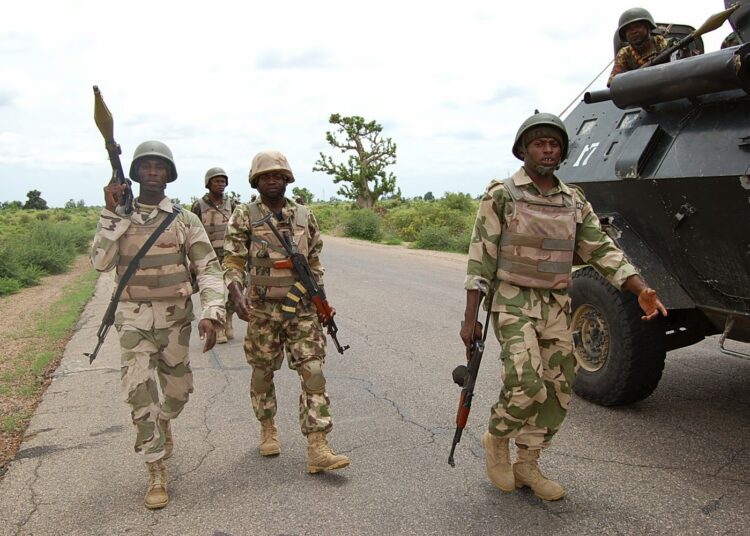
Nigerian troops have rescued some worshippers abducted during Easter services in Kaduna state following a deadly attack on churches that left several people dead.
The operation, carried out in the village of Ariko roughly 100 kilometres north of Abuja, saw soldiers engage armed attackers in a gunfight, forcing them to retreat and abandon dozens of hostages.
This marks a significant intervention amid escalating insecurity in the region, where religious gatherings have increasingly become targets for violent raids.
According to reports, the attack took place during the Easter celebrations, a period typically marked by heightened religious activity across Nigeria. Gunmen stormed multiple churches, targeting both Catholic and Evangelical congregations despite a nationwide security alert that had prompted increased deployments around places of worship.
Initial reports from the Nigerian Security Forces confirmed at least five fatalities, though local church leaders indicated the death toll may be higher. The attack emphasize ongoing vulnerabilities in rural communities across Kaduna State, where security forces face persistent challenges in preventing coordinated assaults by heavily armed groups.
Caleb Bawa Ma’aji, head of the Christian Association of Nigeria in Kaduna, indicated that seven worshippers passed away, describing the incident as “deeply tragic.” He condemned the targeting of religious congregations and called for strengthened security measures to protect civilians during major religious observances. This reflects growing concern among faith leaders and local communities over repeated attacks on places of worship in the region.
This incident forms part of a broader pattern of violence in Northwestern Nigeria, where mass abductions and raids have become increasingly frequent. In January, more than 170 churchgoers were kidnapped during services in Kaduna, with some later escaping and others released following negotiations. These recurring incidents highlight the operational capacity of armed groups and their continued reliance on kidnapping as a tactic for financial gain, often through ransom demands.
The region is heavily affected by armed groups commonly referred to as bandits, who conduct raids on villages, ambush travellers, and abduct civilians. While their activities are largely financially motivated, security analysts have raised concerns about potential overlaps or cooperation with jihadist organisations operating in northeastern Nigeria.
However, in the latest attack, the military did not specify the identity of the perpetrators, referring to them broadly as “terrorists,” leaving uncertainty over the exact nature of the group involved. Efforts to stabilise the region have intensified in recent months, with the Nigerian military increasing operations across multiple states.
Despite these measures, violence has persisted, drawing international scrutiny. US President, Donald Trump, had previously claimed that Christians in Nigeria are facing a “genocide,” a characterization that remains widely disputed by analysts and officials, who point to the complex mix of criminal, ethnic, and regional dynamics driving the conflict.
Escalating Insecurity and Military Response Across Northwestern Nigeria

Northwestern and central Nigeria have emerged as epicenters of insecurity, with states such as Kaduna and Zamfara State experiencing repeated waves of kidnappings and violent raids. These attacks are typically characterised by their speed, coordination, and targeting of vulnerable populations, including students, farmers, and worshippers.
The reliance on mass abduction as a revenue stream has made such operations both lucrative and difficult to deter, particularly in remote areas where security presence is limited.In a parallel development, reports indicate that at least 65 suspected bandits were killed during a separate military offensive in Zamfara state.
This operation, conducted in a different area from a previously reported mass kidnapping, reflects a broader effort by the Nigerian military to apply sustained pressure on armed groups through targeted strikes. Such offensives are often intelligence-led and aim to disrupt the operational networks of bandit groups, including their camps and supply routes.
However, the persistence of attacks suggests that military action alone may be insufficient to fully address the crisis. Structural challenges including difficult terrain, limited infrastructure, and the fluid movement of armed groups across state boundaries continue to hinder enforcement efforts.
Furthermore, the potential intersection between criminal banditry and extremist ideologies may also be a critical factor. While most bandit groups are primarily motivated by profit, concerns remain that prolonged instability could create opportunities for jihadist organisations to expand influence or forge tactical alliances.
The Nigerian government has sought to reassure the public through increased troop deployments and periodic security alerts, particularly during major events such as Easter. Yet the Kaduna attack demonstrates that even heightened vigilance may not fully prevent determined attacks.
The Tinubu led government are therefore under increasing pressure to increase community-based security programs, improve fast response procedures, and boost intelligence capabilities to stem this tide.
READ ALSO : Starmer Pledges to Stand Firmly with British People