The government has announced plans to begin the rollout of its free primary healthcare policy in 150 underserved districts across the country, marking the first phase of a broader national strategy to improve access to essential health services.
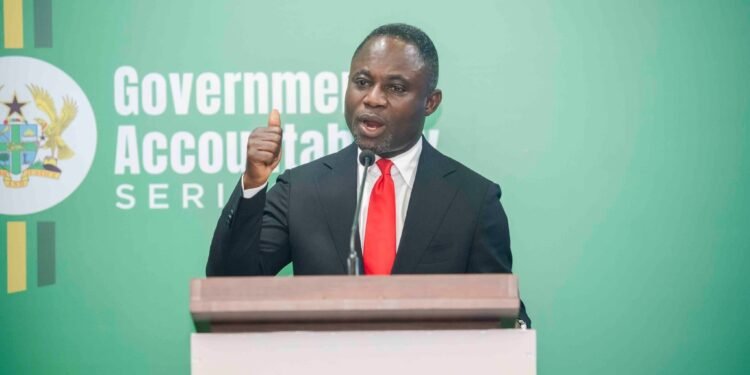
Minister for Health, Hon. Kwabena Mintah Akandoh, disclosed the implementation plan at the Government Accountability Series held at the Jubilee House, ahead of the official launch scheduled for April 15, 2026.
He explained that the phased rollout is designed to ensure efficiency, sustainability, and continuous improvement as the programme expands nationwide.
“This policy has not been rushed. It has been carefully designed over the past year and refined through extensive consultations with key stakeholders.”
Minister for Health, Kwabena Mintah Akandoh
According to the Minister, the development of the policy involved broad consultations with a range of stakeholders, including the Ghana Medical Association, members of parliament, development partners, and representatives from the media.
The Juaboso Member of Parliament further noted that these engagements were critical in shaping a policy that reflects the needs of the population while ensuring practical implementation.
The inclusive approach, he said, underscores the government’s commitment to delivering a programme that is both effective and responsive. “We have engaged widely and taken on board diverse perspectives,” he said, adding that the policy is intended to serve the entire nation.
First Phased Focus on Underserved Districts
The first phase of the rollout will prioritize districts identified as underserved, with each region contributing selected areas based on need. Out of Ghana’s 261 districts, 150 will be included in this initial stage.
The Minister emphasized that this targeted approach is aimed at addressing disparities in healthcare access, particularly in communities where infrastructure and service delivery remain limited.
By focusing on these districts, the government hopes to close gaps in primary healthcare provision and ensure that vulnerable populations receive timely and affordable care.
The phased rollout is expected to run from 2026 to 2028, with nationwide coverage as the ultimate goal. The Minister explained that implementing the policy in stages allows for continuous learning and adjustment.
“We have to roll it out in phases so that we can learn from any shortcomings and improve along the way. This approach will help us maintain quality and sustainability.”
Minister for Health, Kwabena Mintah Akandoh
Health policy experts have often highlighted the importance of phased implementation in large scale programmes, noting that it reduces the risk of systemic failures and allows for real time problem solving.

Preparations Ahead of National Launch
Ahead of the official launch, which will be led by John Dramani Mahama, the government says significant groundwork has already been completed to support the rollout.
The Minister revealed that service delivery points have been mapped across the selected districts, ensuring that healthcare facilities are properly identified and equipped to handle patient needs. In addition, referral systems have been defined to ensure that patients can be efficiently transferred to higher levels of care when necessary.
“These are concrete steps to ensure that the policy is not only announced but delivered effectively,” he said. The focus on operational readiness reflects lessons learned from previous healthcare initiatives, where implementation challenges sometimes hindered outcomes.
The free primary healthcare policy is expected to transform the way basic health services are delivered in Ghana. By removing cost barriers at the primary level, the government aims to encourage early health seeking behavior and reduce the burden of advanced disease conditions.
For many communities, particularly in rural and underserved areas, the policy could significantly improve access to care. Patients who previously delayed treatment due to cost concerns may now be more likely to seek medical attention at the early stages of illness.
The Minister stressed that the success of the policy will depend not only on funding but also on effective coordination across the health system.
National Vision for Universal Coverage
The rollout of free primary healthcare forms part of Ghana’s broader ambition to achieve universal health coverage. By expanding access in phases, the government aims to build a system that ensures all citizens can receive the care they need without financial hardship.
While the initial focus is on 150 districts, the long term objective is to extend the programme to all parts of the country by 2028. Officials say this gradual expansion will help consolidate gains and ensure that the system remains resilient.

The policy is also expected to complement existing health initiatives, strengthening the overall structure of healthcare delivery in Ghana. As the launch date approaches, attention will turn to how effectively the policy is implemented on the ground.
The phased approach provides an opportunity to test systems, identify gaps, and refine processes before scaling up. For government, the challenge will be to maintain momentum while ensuring that resources are used efficiently. For citizens, the rollout represents a potential shift toward more accessible and affordable healthcare.
The Minister expressed confidence in the country’s readiness to embark on this new phase of healthcare reform. “We are ready for implementation,” he said, signaling the government’s commitment to delivering on its promise.
READ ALSO: Medikal and Kwadwo Sheldon Bury Hatchet Ahead of TGMA Night