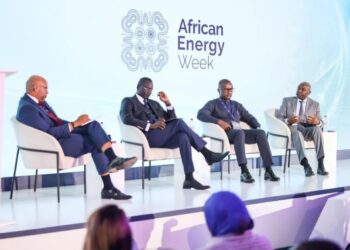
Professor. Fred Dzanku, a development economist and a renowned researcher at the Institute of Statistical, Social and Economic Research (ISSER-UG), has challenged the conventional wisdom that global crude oil volatility is the primary driver of Ghana’s domestic fuel price surges.
While international market fluctuations often dominate public discourse, Prof. Dzanku in an interview with The Vaultz News asserts that historical data reveals a more complex reality where the local currency’s performance plays a far more critical role in determining what Ghanaians pay at the pump.
This perspective shifts the focus from global supply chains to the internal health of the national economy.
“Historically, fuel prices in Ghana don’t necessarily jump because of spikes in crude oil prices. They often jump because the cedi weakens. While a projected 17% increase may look unusual, it still isn’t explained by crude oil alone.”
Professor. Fred Dzanku

The Associate Professor argued that while a projected 17% increase in fuel prices might appear unusual or extreme to the average consumer, it cannot be justified by examining crude oil prices in isolation.
In a landscape where energy costs dictate the pace of inflation and general living standards, the “exchange rate remains the dominant driver” of these pricing shifts.
This suggests that even when global oil markets remain relatively stable or experience minor upticks, a fragile cedi can trigger significant domestic price hikes that far outweigh the impact of the raw commodity’s cost.
Currency Depreciation as a Pricing Catalyst

In a detailed breakdown of the pricing mechanism, it becomes evident why a weak cedi exerts such a heavy toll on the energy sector.
Because Ghana is a net importer of refined petroleum products, Bulk Oil Distribution Companies (BDCs) must source United States Dollars to settle their international obligations.
When the cedi loses value against the greenback, the cost of acquiring these products rises instantly, regardless of whether the global price per barrel has moved.
Prof. Dzanku indicates that this “transmission of shocks” is almost instantaneous, creating a ripple effect that hits the consumer before global market corrections can occur.
The researcher highlights that the recent projected 17% hike a figure that has sparked concern across various sectors is a classic example of this currency-led inflation.
In many instances, even when crude prices experience a “downward trend,” the local price fails to follow suit if the cedi is simultaneously losing ground.
This disconnect creates a “price floor” that remains artificially high, as the cost of the currency used for the transaction becomes the more expensive variable in the equation.
Structural Vulnerabilities in Local Energy Markets

Addressing the broader economic implications, Prof. Dzanku notes that the focus on crude oil often masks the “structural vulnerabilities” of the Ghanaian economy.
If the underlying fundamentals of the cedi are not strengthened, fuel prices will continue to be volatile, acting as a “dominant drive” for broader economic instability.
He maintains that while the government often points to geopolitical tensions or OPEC+ decisions as the culprit for high costs, the data frequently points back to the domestic foreign exchange market.
The impact of this dependency is profound, as fuel serves as a “universal input” for the Ghanaian economy.
A jump in fuel prices, driven by currency depreciation, quickly feeds into transport fares and food inflation.
Re-evaluating the Global Narrative

Ultimately, his assertion serves as a corrective to the simplified narrative that international oil spikes are the sole enemy of the Ghanaian motorist.
By identifying the exchange rate as the “dominant drive,” Prof. Dzanku provides a framework for understanding why local prices often remain high even when global markets cool.
The current market dynamics suggest that until the cedi finds its footing, “crude oil alone” will never be enough to explain the recurring shocks at the filling stations.
This assertion also underscores the urgency of diversifying the energy mix to reduce the heavy reliance on imported fuels.
As long as the nation’s mobility is tied to a commodity priced in a foreign currency, the economy remains a hostage to exchange rate volatility.
Prof. Dzanku’s intervention calls for a “cautious wait-and-see attitude” regarding recent stability claims, emphasizing that true resilience is built on the strength of the currency rather than the luck of global commodity cycles.
READ ALSO: Dr. Otokunor Inspects Massive Nobi Farms Project, Validates Rice Hub