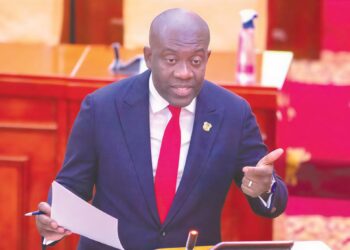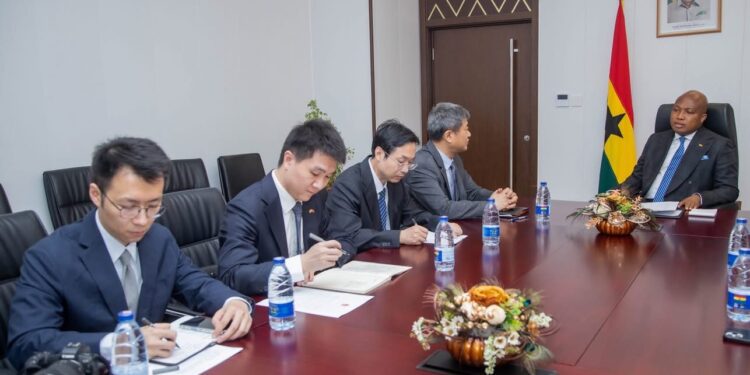
Ghana’s Foreign Affairs Minister Samuel Okudzeto Ablakwa has formally expressed the country’s gratitude to China, Cuba, Saudi Arabia, Kuwait, Qatar and the United Arab Emirates for voting in favour of the landmark Ghana-led resolution at the United Nations that declared the transatlantic slave trade the gravest crime against humanity.
In a statement Tuesday, April 14, Minister Ablakwa said he had received envoys from the supporting nations at the Ministry of Foreign Affairs, describing the engagements as an opportunity to personally convey Ghana’s appreciation for their backing of a resolution he described as a significant diplomatic achievement for the country.
The meetings came in the wake of the UN General Assembly’s adoption of the resolution on March 25, 2026 the International Day of Remembrance of the Victims of Slavery and the Transatlantic Slave Trade which passed with 123 votes in favour, three against, and 52 abstentions. Argentina, Israel and the United States were the three nations that voted against it, while all 27 European Union member states and the United Kingdom were among those that abstained.
The resolution, formally titled the Declaration of the Trafficking of Enslaved Africans and Racialized Chattel Enslavement of Africans as the Gravest Crime Against Humanity, was championed by President John Dramani
Mahama on behalf of the 54-member African Group, the largest regional bloc at the United Nations.
Speaking ahead of the vote at a high-level event on reparatory justice held in New York on March 24, President Mahama framed the resolution as a matter of historical truth and moral conscience.



“Today, we come
John Mahama
together in solemn solidarity to affirm truth and pursue a route to healing and reparative justice. The adoption of this resolution serves as a safeguard against forgetting. Let it be recorded that when history beckoned, we did what was right for the memory of the millions who suffered the indignity of slavery.”
The resolution went beyond symbolic recognition. It called on UN member nations to pursue reparatory justice, including formal apologies, financial compensation, restitution, and the return of cultural artifacts including artworks, monuments, museum pieces and national archives to their countries of origin without charge. It also urged member states to engage in talks on systemic reforms to address racism and structural discrimination rooted in the legacy of enslavement. The passage of the resolution was met with applause in the General Assembly Hall, with diplomats cheering as the result was announced a rare show of emotion in the typically formal setting of the world body.
Among those who met with Minister Ablakwa were China’s new Ambassador to Ghana, H.E. Cong Song, and Cuba’s Ambassador to Ghana, H.E. Julio Enrique Pujol Torres. Diplomats from the Gulf states were also part of the engagements, reflecting the broad cross-regional support Ghana received for the resolution.
The Gulf state representatives included H.E. Dr. Abdulla Murad Sulaiman Al Mandoos, Ambassador of the United Arab Emirates to Ghana; H.E. Khalid Bin Jabor Saif Jasser Al-Mesallam, Ambassador of the State of Qatar to Ghana; H.E. Sultan Abdulrahman Al-Dakhel, Ambassador of the Kingdom of Saudi Arabia to Ghana; and Husain Alebrahim, Chargé d’Affaires of Kuwait. The diversity of the countries represented spanning East Asia, the Caribbean and the Gulf region underscored
the wide international coalition that rallied behind Ghana’s push to have the transatlantic slave trade formally recognised at the highest level of global diplomacy.
Ghana Reaffirms Non-Alignment Foreign Policy
Beyond the expressions of gratitude, Minister Ablakwa used the occasion to reaffirm Ghana’s broader foreign policy posture. He stated that Ghana would continue to pursue a skillful and strategic foreign policy of non-alignment one that fosters friendship with all countries and maintains enmity towards none.
The statement was seen as a deliberate signal that Ghana’s diplomatic engagement on the slavery resolution was not driven by alignment with any particular geopolitical bloc, but rather by a principled commitment to historical justice and reparatory action for the African continent and its diaspora.Ghana’s resolution built on the country’s longstanding legacy as a gateway of African remembrance and reconciliation from its Year of Return initiatives to its sustained advocacy at the United Nations on issues of racial justice. With the resolution now passed and diplomatic appreciation formally expressed, Ghana has positioned itself firmly at the centre of a global conversation that shows no signs of slowing down.