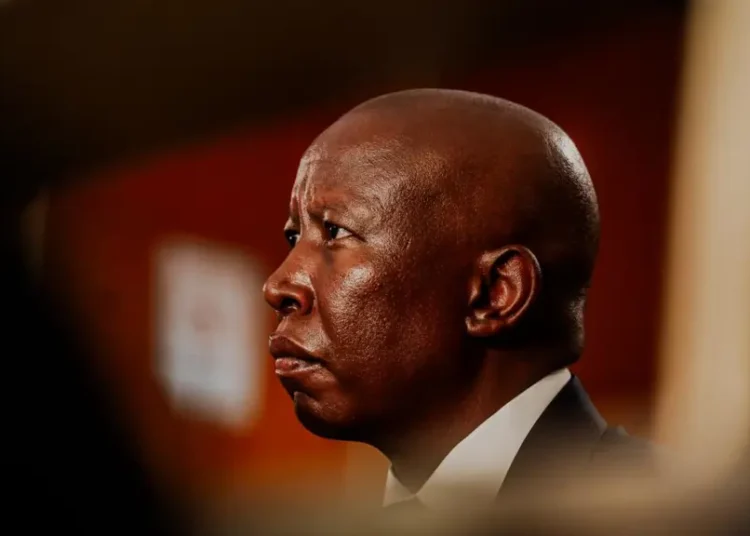
South African opposition leader Julius Malema has been granted leave to appeal his five-year prison sentence in a landmark firearm case, temporarily halting the enforcement of the ruling and ensuring that the Economic Freedom Fighters (EFF) leader will remain free while the matter proceeds to a higher court.
This decision comes just hours after the East London Magistrate’s Court in KuGompo City handed down the custodial sentence, following Malema’s conviction on multiple firearm-related charges tied to a controversial 2018 political rally in the Eastern Cape.
The case centres on widely circulated footage showing Malema firing a rifle into the air during the EFF’s fifth anniversary celebrations at Sisa Dukashe Stadium in Mdantsane, an incident that has remained politically and legally contentious for years.
Julius Malema was convicted in October 2025 on five counts, including unlawful possession of a firearm and ammunition, reckless endangerment, and unlawful discharge of a firearm in a public space. Prosecutors argued that the conduct demonstrated deliberate disregard for public safety in a densely populated setting, while the defence insisted the act was celebratory and not intended to cause harm.
The court ultimately rejected the defence’s interpretation, concluding that the evidence supported a finding of unlawful and reckless behaviour.
Delivering sentence, Magistrate Twanet Olivier emphasised the importance of accountability, particularly for public officials whose actions carry broader societal influence. She rejected arguments that the incident was spontaneous or symbolic, instead characterising it as a serious breach of firearm regulations in a public environment.
Prosecutors had reportedly pushed for a harsher sentence of up to 15 years, citing the need to deter similar conduct by influential political figures.
However, shortly after sentencing, Malema’s legal team immediately applied for leave to appeal both the conviction and sentence. While the court did not grant leave to appeal the conviction, it approved the appeal against sentencing, effectively suspending the prison term pending review by a higher court.
Under South African constitutional provisions, a sentence exceeding 12 months without the option of a fine can disqualify a sitting Member of Parliament once all appeal avenues are exhausted.
If the five-year sentence is ultimately upheld, Malema could be barred from serving in parliament for an extended period, a development that would reshape both his political career and the internal structure of the EFF.
Malema’s Supporters Show Solidarity
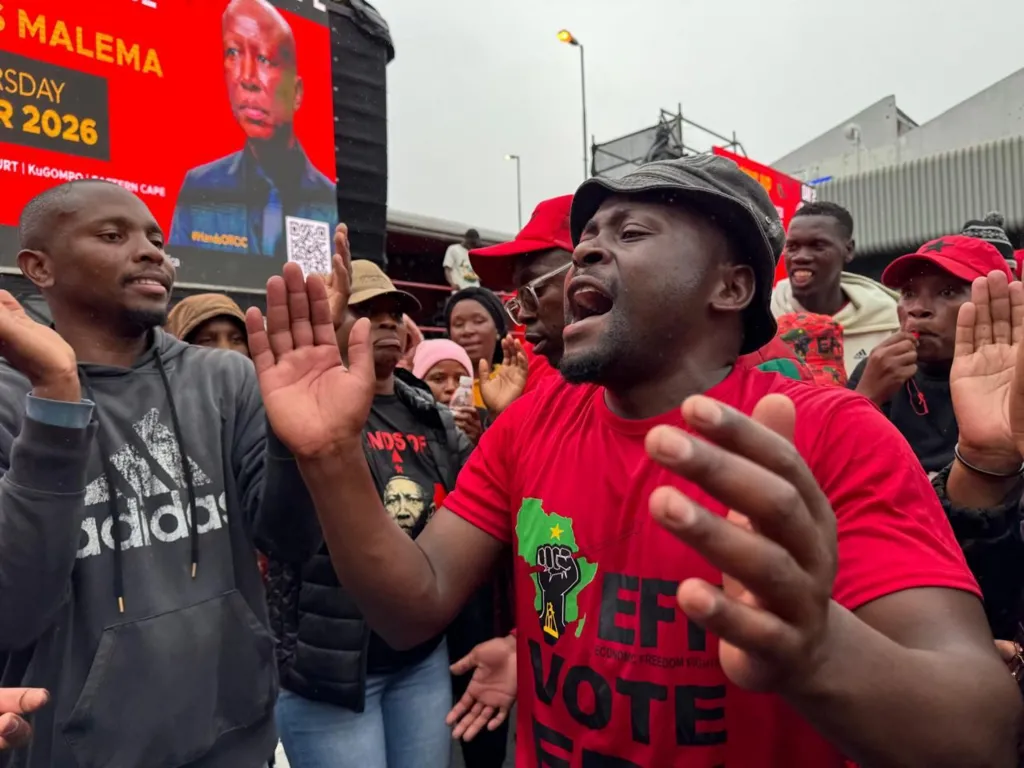
Meanwhile, Hundreds of supporters of Economic Freedom Fighters (EFF) leader Julius Malema gathered outside the East London Magistrate’s Court in KuGompo City, staging a powerful display of solidarity.
The courthouse precinct quickly became a focal point of political energy as the crowd swelled throughout the day. Supporters, many dressed in the EFF’s signature red regalia, sang revolutionary songs, chanted slogans, and waved party flags, turning the area into a highly charged scene of loyalty and defiance.
Julius Maleama, widely known for his outspoken and radical left-wing politics, continues to command a strong and dedicated support base across South Africa. His followers used the gathering to show solidarity with their leader, rejecting the ruling and framing the court process as politically motivated.
Security forces were deployed in large numbers as tensions rose outside the court, with police forming barricades to manage the growing crowd and prevent clashes. While the situation remained largely under control, there were moments of heightened emotion as supporters reacted to the sentencing.
The mood shifted sharply when news emerged that Malema had been granted leave to appeal the sentence. Supporters erupted in celebration, with many breaking into chants in isiXhosa, shouting “sigoduka naye,” meaning “we are leaving with him today.”
Malema’s political history continues to shape the intensity of reactions surrounding him. He was once head of the African National Congress Youth League before being expelled from the ruling party after a fallout with then-president Jacob Zuma. He later went on to establish the Economic Freedom Fighters, a party built on radical economic transformation policies, including calls for land expropriation and wealth redistribution.
Under his leadership, the EFF has grown into South Africa’s fourth-largest political party, steadily eroding the ANC’s dominance in recent elections. His outspoken style and confrontational rhetoric have made him both a highly influential and deeply divisive figure in national politics.
Julius Malema has previously described imprisonment as a “badge of honour,” insisting after his conviction last year that he would not be intimidated by legal consequences and would continue challenging the ruling through higher courts, including the Constitutional Court.
READ ALSO : Senate Rejects Resolutions To Block Arms Sales To Israel