
The Confédération Africaine de Football (CAF) has announced a major structural shift in the organization of its youth competitions, unveiling a new festival-style format set to debut at the TotalEnergies CAF U-17 Africa Cup of Nations (AFCON) Morocco 2026.
The tournament, scheduled to run from May 13 to June 2, 2026, will see all participating teams based within a centralized environment, combining matches, training sessions, and team operations in one integrated setting.
CAF believes this approach will significantly enhance the overall tournament experience for players, officials, and fans. According to the governing body, “the approach is designed to create a vibrant tournament atmosphere while enhancing operational efficiency, ensuring consistency in delivery and supporting long-term player development across multiple editions.”
The move reflects a broader strategy to modernize youth competitions across the continent and align them with global best practices. All matches, except for the opening game, semi-finals, and final, will be played at the Mohammed VI Football Complex in Morocco.
The state-of-the-art facility is expected to serve as the central hub of the competition, providing world-class infrastructure to support the new format.
Group Stage Draw Sets Up Fierce Competition
The final draw for the tournament, conducted earlier this month, has already set the stage for a highly competitive group phase. Hosts and defending champions Morocco headline Group A, where they will face Tunisia, Egypt, and Ethiopia in what promises to be a tightly contested group.
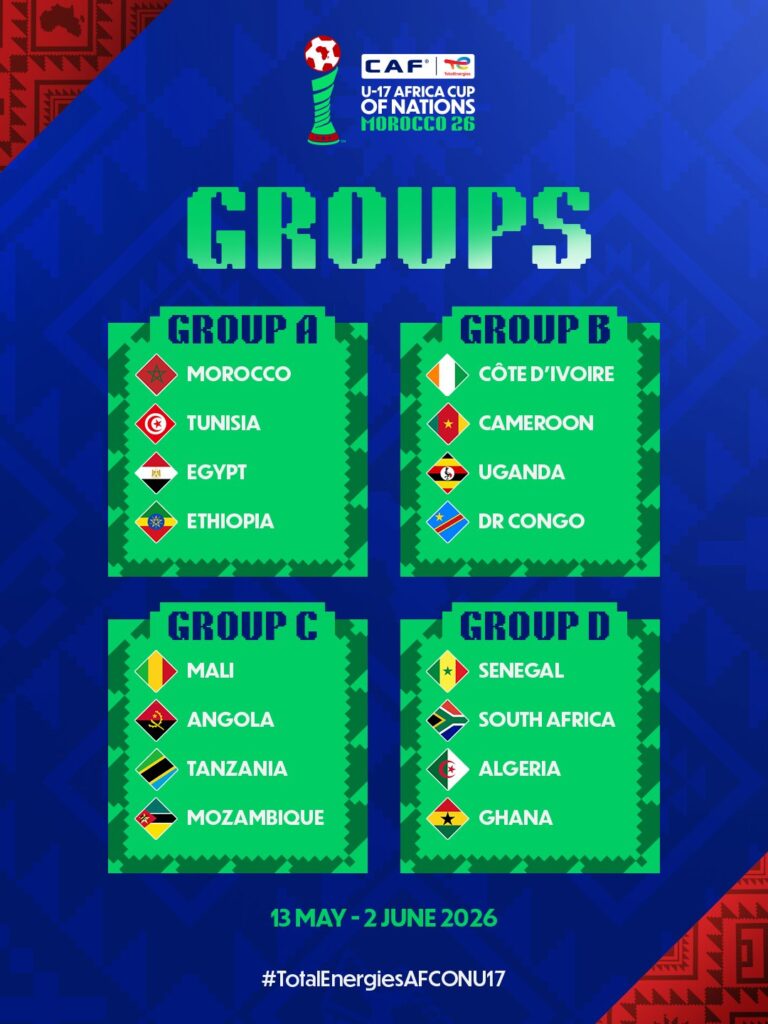
Group B features former champions Côte d’Ivoire and Cameroon, alongside Uganda and debutants DR Congo. In Group C, last year’s runners-up Mali will take on Angola, Mozambique, and Tanzania, representing both Southern and East African regions.
Group D presents one of the most intriguing line-ups, with Senegal drawn against South Africa, Algeria, and Ghana. For Ghana, this tournament represents another opportunity for the Black Starlets to reassert themselves on the continental stage after years of inconsistent performances at this level.
Once a dominant force in African youth football, the Black Starlets have struggled to replicate their past success in recent editions. Their inclusion in a challenging Group D means they will need to be at their best from the outset.
Facing physically strong and tactically disciplined sides like Senegal and Algeria, as well as an experienced South African team, Ghana’s young talents will be tested both technically and mentally.
The new festival-style format could, however, work in their favour. With all teams operating in a centralized environment, factors such as travel fatigue and logistical disruptions are minimized, allowing players to focus fully on performance and development.
For a side like Ghana that traditionally thrives on cohesion and structured preparation, this could be a crucial advantage. Beyond continental glory, the stakes are even higher this year due to qualification for the FIFA U-17 World Cup Qatar 2026.

CAF has confirmed that the eight quarter-finalists will automatically secure their spots at the global tournament. Additionally, teams that finish third in their groups will compete in play-off matches to determine the final two qualification places.
This means a total of 10 African nations will represent the continent at the expanded 48-team World Cup, maintaining Africa’s strong presence on the global stage. Qualification for the World Cup for the Black Starlets alone would mark a significant step forward in rebuilding their reputation as a powerhouse in youth football.
CAF’s introduction of the festival-style format signals a deliberate shift toward player-centered development and tournament efficiency. If successful, it could redefine how youth competitions are staged across Africa, offering a more immersive and professionally managed environment for emerging talent.
READ ALSO: Ghana Will Defend Citizens Abroad Without Compromise, Okudzeto Assures