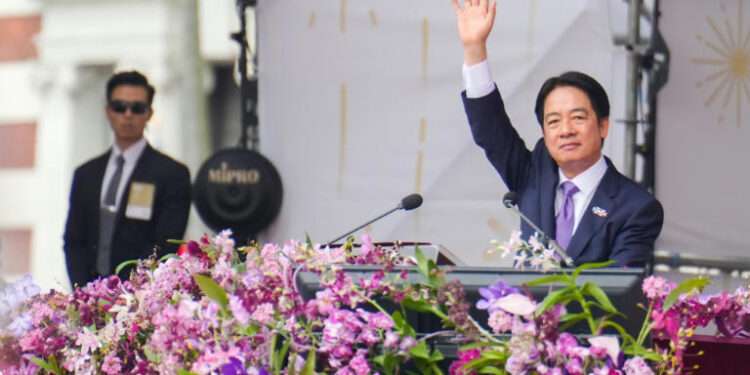
Taiwan President Lai Ching-te has disclosed the achievements of his trip to Eswatini.
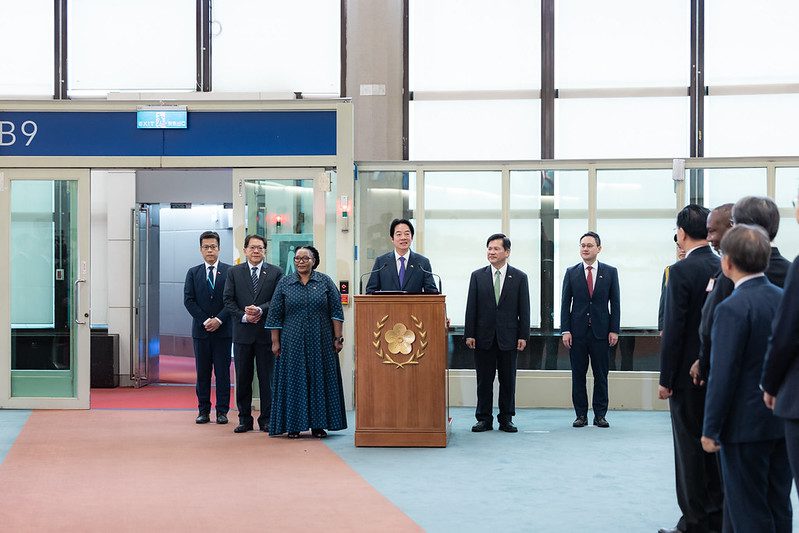
Upon his arrival in Taiwan after the conclusion of his state visit to the African Kingdom, Lai made the disclosure in remarks at Taoyuan International Airport.
Dean of the Diplomatic Corps and Saint Lucia Ambassador Robert Kennedy Lewis was present at the airport to welcome the President.
In his remarks, President Lai disclosed the positive results of Taiwan and Eswatini’s collaboration that he witnessed in areas such as energy, industry, agriculture, smart healthcare, women’s empowerment, and cultural and educational exchanges.
He asserted that such cooperation not only symbolizes the depth of the friendship between Taiwan and Eswatini spanning over half a century, but also highlights Taiwan’s commitment to working with international partners for greater security, prosperity, and progress.
He expressed gratitude to His Majesty King Mswati III, the government of Eswatini, and all the nation’s people. “Thank you for your heartfelt, warm, and steadfast support,” he said, adding that although Taiwan and Eswatini are geographically separated by thousands of kilometers, “the friendship and trust between our peoples are stronger than ever.”
“Standing beside me is Deputy Prime Minister Thulisile Dladla, who has personally traveled with us across vast distances to ensure my and the delegation’s smooth journey. I would also like to express our sincerest appreciation to her once again. Deputy Prime Minister Dladla, your thoughtful and detailed arrangements truly reflect Eswatini’s exceptional hospitality.”
Lai Ching-te
Lai’s government says China tried to block his trip to Eswatini. Lai was supposed to travel to the country, one of Taiwan’s 12 remaining diplomatic partners last month, but had to cancel the initial trip owing to Chinese pressure, Taiwan’s government said. According to the government, China pressured three countries to revoke flight permits, denying Lai transit through their airspace. China did not confirm whether or not they had pressured the countries, but thanked them for their support for Beijing’s one-China principle.
Nonetheless, Lai rescheduled the trip, arriving in Eswatini on May 2, where he discussed cooperation on economic, agricultural, cultural and educational ties.
China claims self-ruled Taiwan as part of its territory, to be retaken by force if necessary, and prohibits countries it has diplomatic relations with from maintaining formal ties with Taipei. In practice, Taiwan is self-ruled.
However, it faces increasing pressure from China on all fronts. China’s military sends fighter jets and navy vessels towards Taiwan on a near-daily basis, while also pressuring countries to cut their diplomatic relations with the island through a mixture of economic incentives and pressure.
Lai noted that some media have characterized the state visit as a “breakthrough” amid external interference. “In truth, however, visits between heads of state are very natural – as natural as visits between friends, and are a basic right of every country,” he said.
He stressed that the external pressure the trip temporarily experienced has, on the contrary, allowed the international community to see Taiwan’s firm determination and strong will to engage with the world. “It has also underscored that upholding a rules-based international order and protecting global peace and stability from any efforts to undermine them have become a pressing issue that demands immediate attention from the international community,” he added.
President Lai emphasized that the world is shared by all, and Taiwan is part of that world. He asserted that the people of Taiwan have the right to engage with the world and will not be deterred by pressure.
A Demonstration Of Taiwan’s Willingness To Participate In International Community
Moreover, the Taiwanese President said that this visit not only deepens the two nations’ diplomatic ties spanning over half a century, but also demonstrates Taiwan’s resolve to work with like-minded nations to uphold the international order, further underscoring Taiwan’s willingness to participate in and contribute more to the international community.
“Rather, the peace-loving and freedom-loving people of Taiwan will continue to uphold the principles of justice and reason. We will continue to participate in the international community and make our contributions in a stable and responsible manner. In the spirit of mutual assistance for mutual benefits, we will work with people in every corner of the world to build a better future for all.”
Lai Ching-te
He thanked Taiwan’s “like-minded friends and allies” for their support in the success of this mission. “A more stable global order requires more of this type of close cooperation,” he said, “We will keep pushing forward.”
READ ALSO: Zelenskyy Discusses PURL Initiative On European Political Community Summit Sidelines