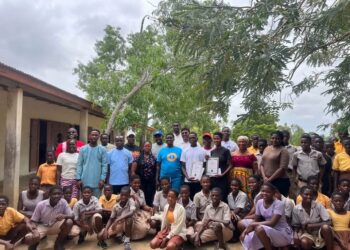

The focus of Ghana’s fisheries policy is shifting away from the Atlantic coast and moving toward the vital freshwater arteries that sustain millions of households, as the Minister for Fisheries and Aquaculture Development, Hon. Emelia Arthur, officially commences a high-stakes, six-day working tour of inland fisheries communities today.
This nationwide exercise is to map the current state of the inland subsector and align government policy with the realities of the freshwater value chain. Moving beyond its Accra headquarters, the Ministry of Fisheries and Aquaculture Development (MoFAD) is seeking to gather “ground truth data that will define the upcoming Inland Fisheries Conference.”
“The exercise is intended to strengthen engagement with stakeholders, assess key facilities, and obtain firsthand information on the state of the inland fisheries subsector. Insights gathered will contribute to shaping discussions at the forthcoming conference”
Ministry of Fisheries and Aquaculture Development
Inland fishing, centered largely around the Volta Lake basin and its various tributaries, has historically operated in the shadow of the more visible marine sector. However, as global seafood demand rises and maritime stocks face increasing pressure, the economic potential of Ghana’s rivers, lakes, and aquaculture projects has become a priority for national food security.
Hon. Elizabeth Arthur’s tour, covering the Greater Accra, Volta, Oti, Bono East, Savanna, and Ashanti Regions, is a recognition that the “Blue Economy” is just as much about freshwater resources as it is about the sea.
The primary objective of this six-day circuit is the collection of firsthand information regarding infrastructure deficits and operational bottlenecks. The Ministry’s Public Relations Unit has clarified that this data is essential for the construction of a more responsive regulatory framework.

For too long, fisheries policy has been criticized for being Accra-centric, failing to account for the unique challenges faced by inland fishers, such as lake safety, illegal gear usage in freshwater environments, and the lack of specialized landing sites. Through these facilities inspections across six regions, Hon. Arthur is establishing a baseline for investment.
Whether it is cold storage facilities in the Volta Region or transport logistics in the Oti Region, the tour aims to identify where government intervention can have the highest impact. This evidence-based approach is intended to ensure that when the Inland Fisheries Conference convenes, the participants are debating facts rather than assumptions.
The Strategic Hub
While the tour covers a vast geographic area, the strategic planning session in Techiman stands out as the anchor of the mission.
Located in the Bono East Region, Techiman is a critical commercial node for the distribution of fish across the middle and northern belts of the country, and holding a planning session here acknowledges the importance of the trade and distribution segment of the value chain. It is not enough to catch fish; the system must ensure they reach the market efficiently.
The Techiman session is expected to bring together regional directors and local industry leaders to discuss the Techiman model of fish trade. The goal is to determine how the Ministry can support the formalization of these markets, improve sanitary standards, and reduce post-harvest losses.
For the inland subsector to grow, the infrastructure in trade hubs like Techiman must be as robust as the infrastructure at the landing sites.
A significant portion of the tour will also be dedicated to the physical inspection of landing sites and aquaculture projects. In the Savanna and Ashanti Regions, the focus will fall on the expansion of cage farming and the integration of modern aquaculture techniques into existing water bodies.

These regions have shown immense potential for boosting national fish production, but they require consistent government support in the form of fingerlings, high-quality feed, and technical training.
“Stakeholders and the general public are encouraged to take part in the engagements,” MoFAD stated, adding that the Minister’s visit to these infrastructure sites provides a rare opportunity for local operators to demonstrate their challenges directly to the decision-makers, and moves the conversation from abstract reports to physical evidence.
If a cold store is non-functional or a landing site is eroded, the Fisheries Minister will see it firsthand. According to the Ministry, this level of direct oversight is a prerequisite for any meaningful reform of the subsector’s physical assets.
An Informed Future
The ultimate goal of Hon. Emelia Arthur’s tour is to foster a sense of shared ownership between the Ministry and the fishing communities. MoFAD’s invitation to the general public and stakeholders to participate in the engagements signals that the era of top-down mandates is over.
The new direction is one of informed policy – where the laws governing the lake are written by those who understand its rhythms. As the tour progresses from the coastal lagoons of Greater Accra to the vast reaches of the Savanna Region, the Ministry is essentially building a new narrative for Ghana’s inland waters.
It is a narrative of untapped potential and renewed commitment. Regarded as the kind of field work required for a successful policy reset, the findings from this week will become the foundational text for the next decade of fisheries management in Ghana.
The conclusion of the tour on May 11 will mark the beginning of a new phase for MoFAD, as the notes taken in the Volta basin and the resolutions made in Techiman will be synthesized into the agenda for the Inland Fisheries Conference.

By the time Hon. Emelia Arthur returns to Accra, the Ministry will have a clearer picture of the investments needed to transform the inland subsector from a subsistence activity into a modern, industrial contributor to the national economy.
For the fishers of the Oti, Volta, and Bono East regions, the MoFAD is no longer just watching from the shore; it is getting in the boat with them.
READ ALSO: Vice President Backs DACF Funding Strategy Reform