
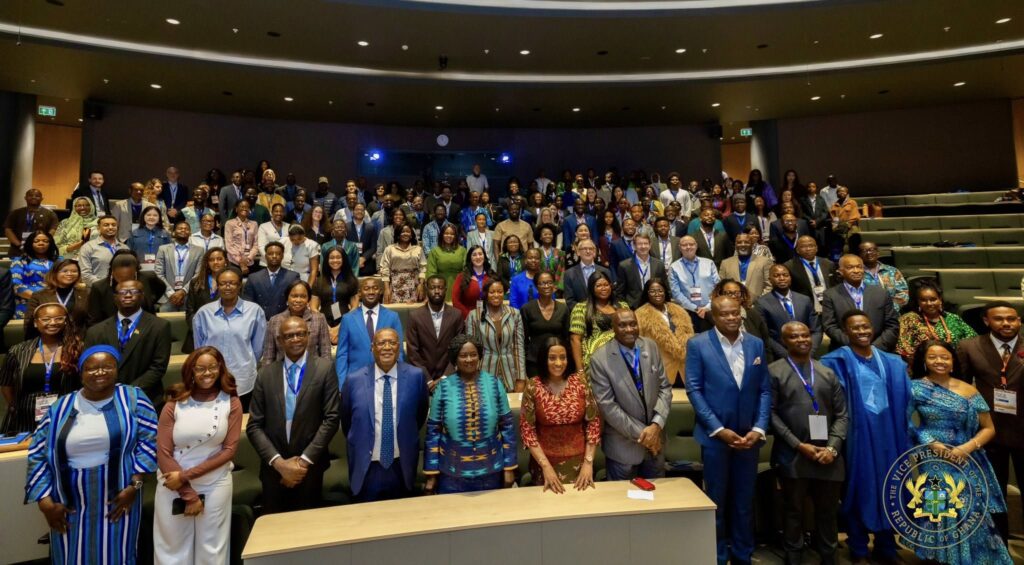
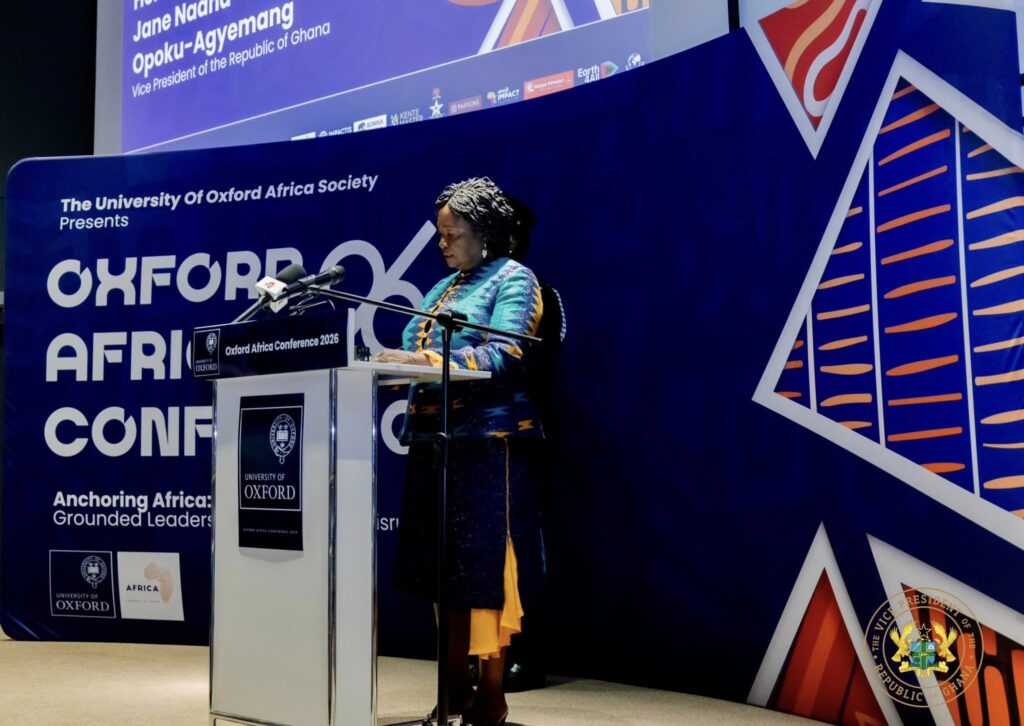
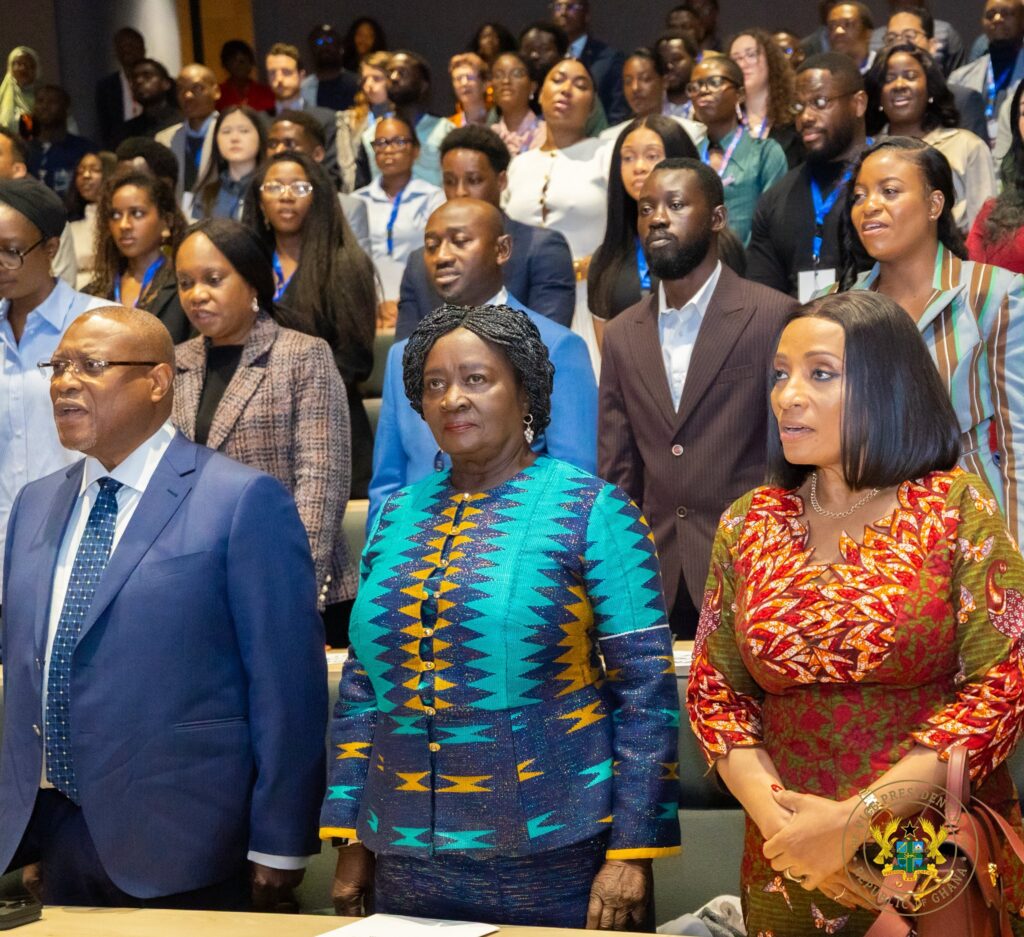
Vice President Professor Naana Jane Opoku-Agyemang has presented Ghana’s 24-Hour Economy policy and the proposed Women’s Development Bank at the 16th Oxford Africa Conference as the primary structural frameworks required to scale commercial opportunities and formalize underserved markets across the continent.
Delivering the keynote address before an international delegation of fund managers, institutional investors, and global academics, the Vice President decoupled continental growth from speculative market cycles, pointing instead to disciplined, people-centered operational metrics.
The address positioned Ghana’s fiscal and industrial reforms as a benchmark for institutional asset management and long-term capital preservation amidst global macroeconomic disruptions, by establishing these domestic economic tools as scalable models.
“The Vice President described the 24-Hour Economy policy and the proposed Women’s Development Bank as deliberate efforts to expand opportunity and integrate underserved populations, especially women, into the formal economy. She noted that empowering women with access to finance, skills, and tools remains central to inclusive growth across the continent”
The Presidency
The deployment of the 24-Hour Economy model is a profound shift in capital asset utilization and industrial productivity.
From a corporate and structural perspective, transitioning manufacturing and commercial operations to a continuous, multi-shift schedule optimizes fixed costs, accelerates inventory turnover, and dramatically increases labor efficiency without requiring immediate capital expenditure on new physical infrastructure.
When integrated with the strategic rollout of the proposed Women’s Development Bank, these frameworks systematically dismantle the structural credit market failures that have historically restricted female-led enterprises from accessing formal commercial credit.
Prof. Opoku-Agyemang explained that the bank is to serve as a sovereign vehicle converting informal market liquidity into institutionalized corporate capital, introducing specialized financial instruments, targeted risk-mitigation tools, and structured capacity-building.
A secondary pillar of the business architecture she presented at the conference focused on the aggressive reorganization of trade balances, specifically through the eradication of raw primary commodity export dependencies. The corporate business case for Ghana’s ongoing macroeconomic reforms is anchored tightly in localized value addition.
For example, by moving up the agricultural value chain into advanced domestic cocoa processing, the state retains critical profit margins and cash flows that are traditionally exported to external secondary processors.
According to the Vice President, this industrial conversion reduces national vulnerability to international commodity price shocks, strengthens current account balances, and generates highly predictable revenue streams for state-backed and private enterprises alike.
Private equity and institutional capital require this baseline of structural predictability before committing to long-term infrastructure and industrial processing networks. By shifting from a passive supplier of raw inputs to an active exporter of refined consumer and industrial products, the economy builds a sustainable defense against foreign exchange volatility.
This architectural shift ensures that domestic employment opportunities are directly tied to high-value industrial outputs, creating a more resilient corporate ecosystem that can absorb external inflationary pressures.
AfCFTA Integration and Technological Risk
On the macro-regional scale, the African Continental Free Trade Area (AfCFTA) serves as the primary regulatory and logistical engine to scale cross-border commerce, unify consumer markets, and establish frictionless supply chains. However, Prof. Opoku-Agyemang emphasized that physical trade integration must be explicitly backed by absolute digital and data sovereignty.
For corporate entities operating across the continent, complete reliance on external technology infrastructure introduces severe operational and security risks, particularly concerning corporate intellectual property, consumer data privacy, and cross-border financial transactions.
“Touching on Africa’s future in technology and trade, she pointed to the transformative potential of the African Continental Free Trade Area, while stressing the urgency for Africa to lead in critical areas such as artificial intelligence, digital infrastructure, energy transition and data sovereignty”
The Presidency
According to the Vice President, this ensures that the massive commercial value and behavioral data generated within the AfCFTA marketplace are captured, analyzed, and reinvested within the continent rather than leaked to offshore monopolies.
Furthermore, integrating these digital networks with localized energy transition frameworks provides the reliable power generation necessary to sustain high-tech industries and automated manufacturing zones.
Prof. Opoku-Agyemang added that the commercial feasibility and financial scalability of these large-scale economic interventions depend on the systematic mitigation of sovereign and operational risks through ethical governance, as institutional investors and corporate partners prioritize jurisdictions that demonstrate transparent regulatory frameworks, predictable contract enforcement, and administrative discipline.
The Vice President’s presentation re-established that Africa’s long-term competitiveness in the global market will not be dictated by the scale of external disruptions, but by the internal rigor of its state execution mechanisms.
She linked corporate governance standards to the management of public institutions as a way to establish a stable, de-risked environment capable of attracting high-quality foreign direct investment (FDI) into critical infrastructure, commercial agriculture, and energy sectors.
This disciplined approach to statecraft converts public policy from an abstract legislative exercise into a practical, market-driven mechanism that stabilizes the broader macroeconomic environment while tangibly upgrading the standard of living for the populace.
“She concluded that Africa’s transformation will be defined not only by the scale of global disruption, but by the continent’s collective resolve to organise, lead and deliver results through ethical governance, strong institutions and policies that tangibly improve the lives of its people”
The Presidency
READ ALSO: Young and Old Voters Back Ato Forson, Haruna Iddrisu – Poll