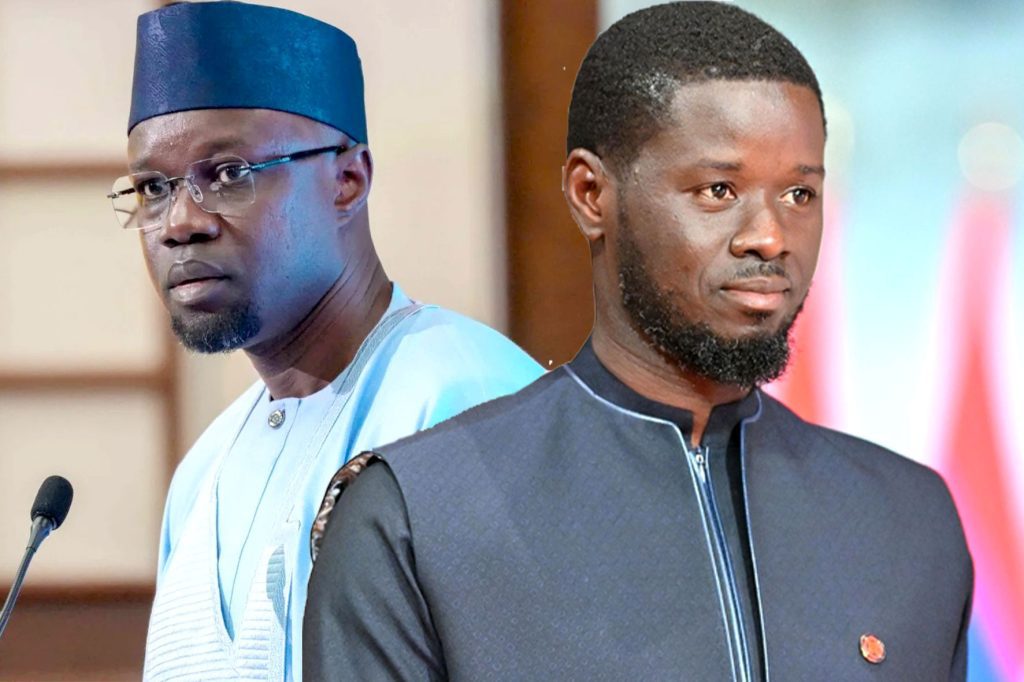
Senegalese President Bassirou Diomaye Faye has dismissed Prime Minister Ousmane Sonko and dissolved the government, marking a dramatic turn in the political relationship between the two leaders whose alliance propelled them to power in 2024.
The decision, announced through a statement carried by state media, removes all ministers from office and leaves the outgoing administration responsible only for routine government affairs until a new government is formed.
Oumar Samba Ba, Secretary-General of the Presidency, confirmed that the entire cabinet had been dismissed.
The move comes after months of growing tensions between Faye and Sonko, once close political allies who emerged as symbols of change during Senegal’s turbulent 2024 election period. Their partnership had been central to the rise of the Pastef political movement, which swept to power after years of opposition to former President Macky Sall’s administration.
Ousmane Sonko, a popular and outspoken political figure with a strong following among young voters, was unable to contest the 2024 presidential election because of a defamation conviction. Instead, he threw his support behind Faye, who went on to win the presidency with 54% of the vote after the pair were released from prison just days before the rescheduled election.
Following his victory, Faye appointed Sonko as Prime Minister, creating what many observers viewed as an unusual power-sharing arrangement at the top of government.
However, differences between the two leaders increasingly surfaced over economic policy and the direction of the administration.
In a brief reaction posted on social media after his dismissal, Sonko appeared calm about the development. “I will sleep with a light heart in the Keur Gorgui neighbourhood,” he stated.
Power Struggle in Senegal Threatens Economic Reforms and IMF Negotiations
The political rupture comes at a sensitive moment for Senegal’s economy. The country is facing mounting financial pressures after the International Monetary Fund suspended its $1.8 billion lending programme following the discovery of previously misreported debt figures.
The revelation significantly altered the country’s fiscal outlook, with Senegal’s debt burden now estimated at 132% of gross domestic product by the end of 2024. The suspension of IMF support has complicated government efforts to stabilize public finances and restore investor confidence.
Analysts warn that the dismissal of Sonko could create further uncertainty around negotiations with the IMF, which are widely regarded as essential for addressing Senegal’s growing economic challenges.
Earlier on Friday, before the announcement of Sonko’s removal, Finance Minister Cheikh Diba told lawmakers that Senegal expected to resume discussions with the IMF during the week beginning June 8. He expressed hope that key areas of disagreement could be resolved by the end of June.
Diba also highlighted mounting fiscal risks linked to energy costs, warning parliament that fuel subsidies could exceed their 2026 budget allocation by as much as 1.15 trillion CFA francs, equivalent to approximately $2 billion, if global oil prices rise to $115 per barrel.
According to Diba, Sonko had rejected proposals to increase domestic fuel prices despite growing pressure on public finances. The disagreement underscored broader divisions within the government over how to respond to the country’s economic difficulties.
Sonko had also publicly opposed any restructuring of Senegal’s debt, estimated at roughly $13 billion, arguing against measures he believes the IMF is encouraging. Faye, by contrast, has remained more reserved in public discussions surrounding the issue.
The political fallout has intensified speculation about Sonko’s future role in Senegalese politics. Long regarded as one of the country’s most influential opposition figures, Sonko built his reputation through criticism of corruption, economic inequality and foreign influence in Senegal’s affairs.
Before coming to power, Sonko and Faye were both imprisoned amid political tensions surrounding the delayed 2024 election. Their release shortly before the vote helped transform them into powerful symbols of political change.
Despite his removal from government, Sonko retains significant influence through the ruling Pastef party, which dominates the National Assembly. That parliamentary strength could present challenges for President Faye as he seeks to govern and implement reforms needed to secure renewed IMF support.
Signs of a widening divide had emerged months earlier. In March, Sonko suggested he would be prepared to withdraw from Pastef and return to the opposition if Faye abandoned the party’s political programme, fuelling speculation that tensions between the two men had become increasingly difficult to contain.
For now, Senegal enters a new period of political uncertainty as President Faye prepares to form a new government while simultaneously confronting economic challenges, IMF negotiations and questions about the future relationship between the country’s two most prominent political figures.
READ ALSO: GNPC Promotes Ghana’s Upstream Oil Investment Potential At OTC 2026