
Hon. Elizabeth Ofosu-Adjare, the Minister for Trade, Agribusiness and Industry, has outlined a sweeping structural overhaul of Ghana’s macro-commercial framework, presenting a comprehensive blueprint for state-backed industrialization, deep legal deregulation, and trade-led wealth creation at the Ghana-UK Investment Summit in London.
Speaking before an international delegation of institutional investors, diaspora leaders, and sovereign representatives, the Minister – who also serves as the Member of Parliament for Techiman North – framed the ongoing economic reforms as a rapid, high-impact component of the broader “reset agenda” under the administration of President John Dramani Mahama.
Within a 16-month execution window, the government has moved to consolidate industrial policy and commercial regulation under a newly realigned ministry, explicitly configured to eliminate administrative bureaucracies, lower the systemic cost of doing business, and trigger an unprecedented expansion in domestic manufacturing capacity.
“In 16 months, this government… has done what many said would take years. And this resonates through what my other colleagues and other speakers have highlighted earlier.
“The Ministry of Trade, Agribusiness, and Industry (MoTAI) has been aligned to lead comprehensive reforms to reduce the cost of doing business, attract investors, rejuvenate manufacturing, and address administrative bureaucracies for a thriving sector”
Hon. Elizabeth Ofosu-Adjare, Minister for Trade, Agribusiness and Industry
This realigned focus has transformed Ghana’s approach to secondary asset creation, signaling a decisive shift away from the export of raw primary commodities toward localized industrial processing.
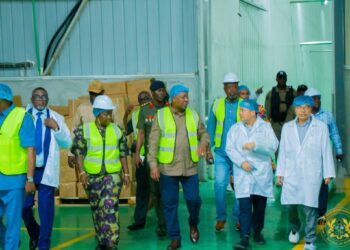
According to Ministry data, the expansion is materializing across several high-value manufacturing verticals, “including food processing, ceramics, engineering, beverages, steel, cement, garments, textiles, pharmaceuticals, and automotive assembly.”

The state has normalized a schedule of infrastructure delivery where the executive branch commissions new industrial facilities on a quarterly basis, establishing Ghana as the preferred manufacturing and value-addition hub within the West African sub-region.
This manufacturing push is structurally reinforced by deliberate, targeted state policies that enhance the domestic patronage of made-in-Ghana products, thereby expanding the base of local competition and building strong production networks capable of feeding into global supply chains.
The fiscal outcomes of this structural pivot toward value-added processing are already reflecting on the national balance sheet, particularly within the non-traditional export (NTE) sector. In 2025, Ghana’s non-traditional exports achieved a historic record, hitting a total valuation of $5 billion, which represents a sharp 30.7% surge over performance metrics from previous years.
Hon. Ofosu-Adjare noted that this macroeconomic expansion was overwhelmingly driven by the sub-category of processed and semi-processed foods, which contributed $3.09 billion to the total export value – marking an aggressive 52.78% increase from the fiscal baseline established in 2024.
To sustain this export momentum and enhance the cross-border liquidity profile of local enterprises, the ministry executed an essential regulatory intervention in partnership with the central bank, successfully extending the statutory window for the preparation and repatriation of export proceeds, doubling the timeline from 60 days to 120 days.
This policy adjustment grants private sector exporters significantly greater breathing room to manage foreign exchange cycles, secure trade financing, and optimize corporate treasury positions in the international marketplace.
To feed these expanding processing lines, MoTAI is systematically redirecting state capital and technical support toward the foundational layers of the domestic supply chain, prioritizing large-scale capital deployment into the domestic cultivation of high-quality raw materials that remain in high demand across the continent.
Central to this strategy is the rapid expansion of commercial contract farming, a model established to create direct, predictable links between agrarian production zones and urban industrial complexes, fully supporting the national accelerated development program.

Dismantling Foreign Entry Barriers
To lower the barriers for inbound international capital looking to participate in this industrial transformation, Hon. Ofosu-Adjare noted that Ghana has initiated a radical restructuring of its investment laws.
The central pillar of this legal overhaul is the passage of the Ghana Investment Promotion Authority Bill, which transitions the state’s primary investment vehicle into a fully empowered statutory authority. The Minister detailed the definitive legislative steps taken to remove the regulatory hurdles that previously restricted foreign direct investment:
“We have moved decisively to build the policy environment that investors require, including removing minimum capital requirements for joint ventures and foreign enterprises, introducing industry-specific incentives, establishing an investor-driven mechanism, and codifying protection against expropriation with guaranteed free transfer of capital and unambiguous access to international arbitration”
Hon. Elizabeth Ofosu-Adjare, Minister for Trade, Agribusiness and Industry
The structural transformation of the economy is scheduled to accelerate significantly through the second half of this year, as the Ministry finalizes the operational drafts for a series of comprehensive, sector-specific policies scheduled for legislative passage before the close of 2026.
The Trade Minister highlighted how these targeted legal frameworks will explicitly govern agribusiness operations, pharmaceutical manufacturing, garment and textile production, and automotive and component assembly lines.
Crucially, these upcoming legislative instruments will establish the legal architectures required to govern Special Economic Zones (SEZs) across the country. These designated geographic zones will bundle industry-specific tax incentives, streamlined customs processing, and dedicated utility infrastructure to minimize operational overheads for manufacturing firms.

In inviting the global investor community and the Ghanaian diaspora to participate directly in this restructured domestic market, Hon. Ofosu-Adjare emphasized that the state’s primary focus has transitioned from abstract policy design to providing an extraordinarily transparent, highly competitive, and legally secure environment for capital deployment.
READ ALSO: Ebola Vaccines Under Development as Outbreak Fears Mount