For a second day in a row, US and Iran have exchange strikes across Middle East.
Iran again claimed attacks on United States military bases in Bahrain, Kuwait and Jordan, and targeted two vessels in the Strait of Hormuz in retaliation for renewed waves of US attacks on the country.
The Islamic Revolutionary Guard Corps (IRGC) said it launched drone strikes on Bahrain’s Sheikh Isa airbase and Kuwait’s Ali Al Salem and Ahmad Al-Jaber airbases early on Thursday.
It disclosed that the Al-Azraq airbase in Jordan was also hit with 12 ballistic missiles, targeting the US military’s F-35, F-15, and F-16 fighter jets, as well as key facilities used by US forces at the Al-Azraq airbase and control centre in Jordan.
It added that two oil tankers that attempted “to illegally pass through” the Strait of Hormuz were also hit. Bahrain activated air raid sirens twice, while Kuwait said its air defence systems were “intercepting hostile aerial targets.” Kuwait said that it had temporarily closed its airspace and diverted flights to different routes due to the Iranian attacks.
The IRGC said the strikes were in response to the US’s “repeated violations” of an April ceasefire and declared the Strait of Hormuz “closed until further notice.” It said that all traffic in the waterway, including oil tankers and commercial vessels, would be shot at.
The attacks came after the US’s Central Command (CENTCOM) announced renewed strikes on “multiple targets” inside Iran. The military said that the strikes were at President Donald Trump’s “direction.”

CENTCOM said in an update on X that it had completed a wave of “self-defense strikes” on Iranian military surveillance capabilities, communication systems, and air defense sites across Iran. It announced an end to the strikes four hours after they began at 22:15 GMT on Wednesday.
CENTCOM said in its update that US forces “fired precision munitions on Iranian targets that posed a threat to US forces and international commercial ships transiting regional waters” in “response to Iran’s unwarranted and continued aggression.” “US forces remain vigilant, lethal, and ready,” it added.
Iranian state media reported multiple explosions on the islands of Qeshm and Kish and in the cities of Bandar Abbas and Sirik along the Strait of Hormuz.
In response, Iran launched a round of strikes targeting US military assets in countries across the region.
The U.S attack came hours after President Donald Trump vowed U.S forces would hit Iran “hard”, and that Tehran had taken “too long to make a deal” to permanently end the war.

Secretary of Defense Pete Hegseth confirmed late Wednesday that the United States is launching strikes on “key facilities” in Iran, framing the attacks as part of the ongoing negotiations for a permanent ceasefire.
His remarks echoed the escalating rhetoric of Republican President Donald Trump, who warned earlier that Iran would “have to pay the price” for taking too long with the negotiations. “ CENTCOM – Central Command – will be busy tonight because President Trump said we will be hitting Iran hard, and we will be,” Hegseth said. He explained that he had just reviewed the plans for Wednesday night’s attack with Admiral Bradley Cooper, CENTCOM’s Commander.
The latest exchange came a day after the two sides traded tit-for-tat strikes, triggered by the downing of a US Apache helicopter in the Strait of Hormuz. Washington blamed Tehran for the incident and said that the two pilots were rescued uninjured.
Guterres Warns Of Widening Middle East Crisis
Meanwhile, UN Secretary-General Antonio Guterres warned that the Middle East is being pulled into a deepening crisis, with far-reaching consequences.
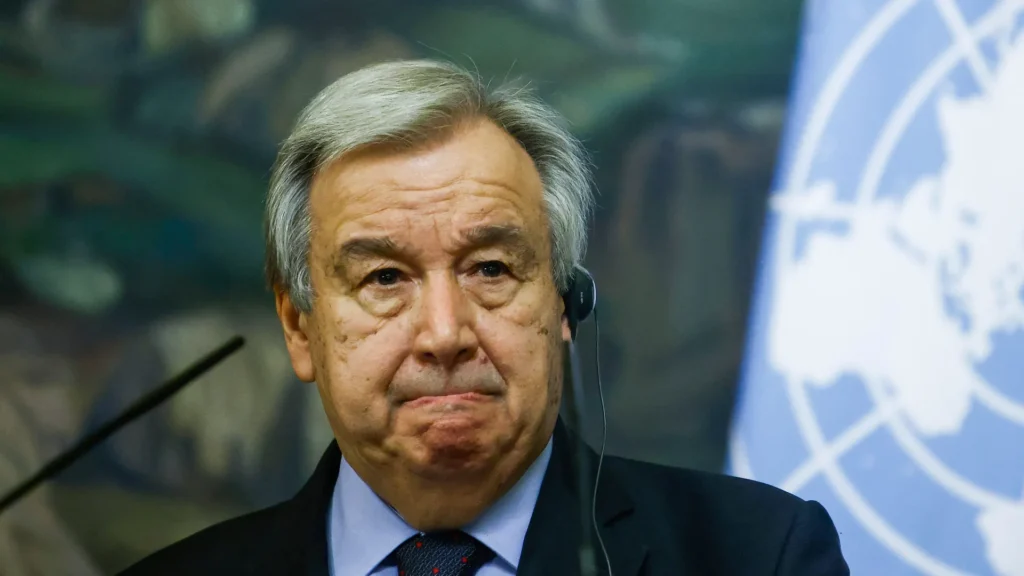
He said in a post on X that this week has brought wider attacks and further deterioration “where the ceasefire is more like a lesser-fire.” He added, “We should not minimize the risks of lesser fire becoming full fire.”
“All parties must work towards a diplomatic settlement. No more attacks. No more excuses.”
Antonio Guterres
Progress towards a peace deal also remains slow. The two sides are engaged in indirect talks aimed at securing an interim agreement that would halt hostilities, while deferring Iran’s nuclear programme to future negotiations.
However, sticking points remain, with Iran demanding the release of frozen assets and relief from sanctions. Complicating matters further is Israel’s intensifying campaign in Lebanon against the Iranian-backed Hezbollah.
READ ALSO: Infantino Defends US Visa Policies, WC Faces Scrutiny Over Travel Restrictions