UNAIDS has warned that decades of progress in the global fight against HIV are now under serious threat, as sharp funding cuts, shrinking civic space and increasing criminalisation of marginalised communities converge to create what the agency describes as the most severe disruption in the HIV response since the epidemic began.
A new report released by UNAIDS report paints a stark picture of a global health response at a crossroads, where scientific advances and decades of public health gains are being undermined by declining international aid, weakened prevention systems and a rollback of human rights protections that have long been central to effective HIV control.
According to Winnie Byanyima, Executive Director of UNAIDS, the situation represents an unprecedented challenge to global health efforts.
“There’s no question that this is the most serious disruption in the HIV response since the world came together to fight this disease.
“The funding cuts, combined with the reduction in civic space and the further criminalization of marginalized populations have come together to create the biggest storm the HIV response has ever seen.”
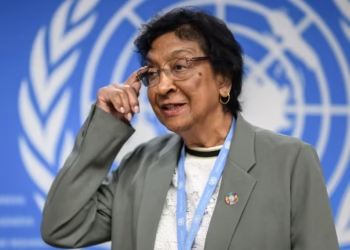
Winnie Byanyima
According to the report, global development assistance fell by 23% in 2025 the steepest decline on record triggering widespread disruption across HIV prevention and treatment programmes, particularly in low-income countries heavily dependent on external funding.
The effects have been significant and immediate. Between 2024 and 2025, financing for condoms was cut by more than 90% in certain settings, while HIV testing programs fell by 22% in high-burden nations.
In the meantime, 62 countries that reported to UNAIDS saw a 38% decline in the use of PrEP, a daily preventive medication.
Despite the decline in prevention programs, significant progress has been made in the global HIV response. Since 2010, the number of AIDS-related deaths has decreased by 56%, while the number of new infections has decreased by 43%. Approximately 32.1 million people, or 78% of those living with HIV, are currently receiving treatment.
However, UNAIDS cautions that these gains remain fragile. Nearly nine million people are still not on treatment, and in regions such as Western and Central Africa, where up to 90 per cent of HIV programmes depend on external funding, any disruption risks triggering a resurgence in deaths and new infections.
The report also draws attention to glaring geographical disparities, pointing out that although certain regions of the world are still making progress, infection rates are rising in others. Since 2010, new HIV infections have increased in Latin America, the Middle East and North Africa, and Eastern Europe and Central Asia.
One of the most alarming trends remains the persistent vulnerability of young people in sub-Saharan Africa, where approximately 3,000 adolescent girls and young women acquire HIV every week.
Community-led organisations, which have long been acknowledged as the foundation of successful HIV response tactics, are now severely strained. Significant financial cuts and service interruptions are being reported by these organisations, which offer vital services to important populations such as sex workers, men who have sex with men, injecting drug users, and victims of gender-based violence.
Moreover, a recent multi-country study conducted in 47 nations revealed a 50% decline in community support services, an 82% reduction in assistance for sex workers, and an 85% decline in support for males who have sex with men.
UNAIDS cautions that deteriorating community systems compromise impacted communities’ access, reach, and trust.
UNAIDS Calls for Political Action as Human Rights Rollbacks Complicate HIV Response
In addition to funding concerns, UNAIDS has also raised alarm over the dangerous rollback in human rights protections, which is further undermining efforts to control the epidemic.
The UNAIDS report notes that criminalisation of marginalised groups has increased for the first time since global tracking began, with new laws introduced in multiple countries targeting same-sex relationships and increasing penalties for affected communities.
UNAIDS warns that fear of arrest or discrimination discourages people from seeking testing and treatment, allowing the virus to spread unchecked.
“Diseases spread fastest where human rights are weakest. The rollback on human rights and civic space is not accidental it is organized, it is political, it has real public health consequences and dire HIV outcomes.”
Winnie Byanyima
Despite these challenges, the report identifies potential pathways forward. Domestic financing for HIV responses has increased significantly over the past decade, rising from 28%in 2010 to 52% in 2024.
More than 54 countries have recently committed to increasing domestic investment, although many face severe fiscal constraints linked to debt burdens and economic pressures.
Moreover, UNAIDS also highlights encouraging developments in integration and innovation. More than a quarter of countries have incorporated HIV services into broader health systems, including links with cervical cancer screening programmes in over 80 countries.
Technological advances also offer hope. By March 2026, more than 6,000 people in five sub-Saharan African countries were accessing lenacapavir, a long-acting HIV prevention medicine.
However, UNAIDS estimates that 20 million people still require access to preventive treatment, underscoring the scale of unmet need.
In order to ensure that 40 million people receive antiretroviral treatment, increase 20 million people’s access to preventive medication, and ensure stigma-free services for all impacted groups, the agency has asked for a reinvigorated global commitment.
UNAIDS insists that the goal of ending AIDS remains achievable but only if political will matches scientific capability.
READ ALSO: Government Assures Decisive Review of Akosombo Substation Fire Findings