Mediators Pakistan and Qatar have said that “encouraging progress” had been made in the US-Iran talks held in Switzerland. They added that the just concluded talks between the US and Iran were “positive and constructive.”
Pakistan and Qatar said in a joint statement that the US and Iran agreed to establish a High Level Committee to provide “political oversight on the mediation.” They added in the statement that negotiators reporting to the committee will lead groups focused on nuclear issues, sanctions, and other means to implement the US-Iran agreement.
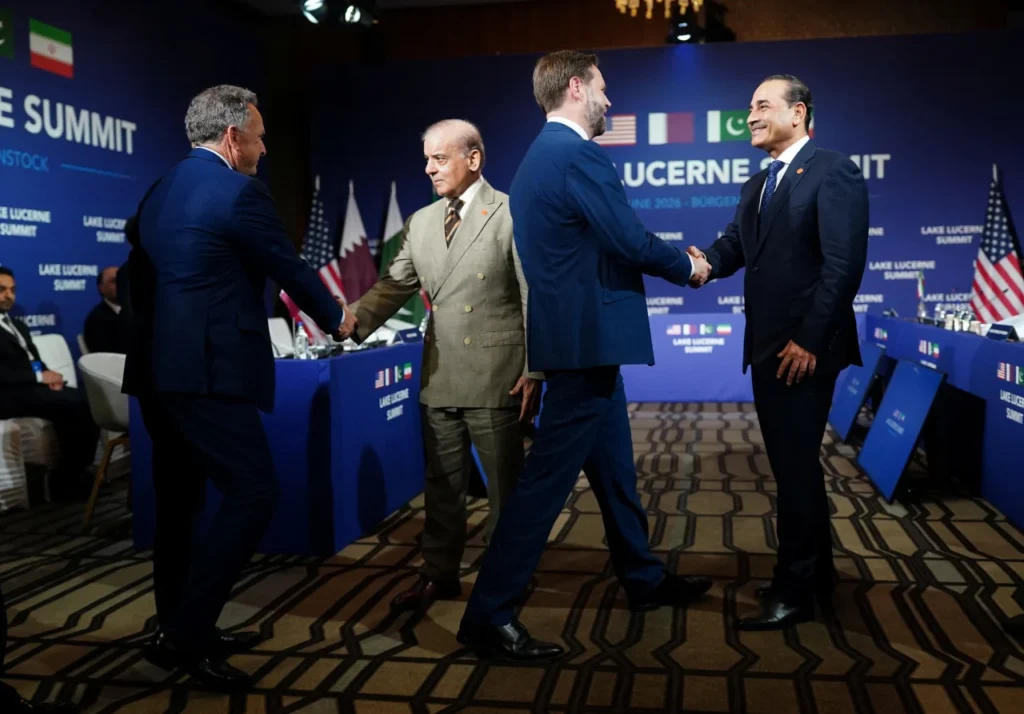
Also, the statement said that the committee has “agreed upon a roadmap towards reaching a final deal within 60 days,” adding that technical talks will continue for the rest of this week in Switzerland “on all issues.”
Pakistan and Qatar, the mediators in the talks, thanked the US and Iran for their “ongoing commitment to diplomacy and a peaceful resolution to the conflict” and promised that they “will continue to do their utmost to ensure that the negotiations continue to be conducted in a constructive atmosphere with the aim of reaching a final deal.”
The progress made in the talks comes as a surprising outcome after a long stretch of uncertainty. According to an Iranian source, talks had stalled after President Donald Trump took aim at Iran in an interview with a news agency. Trump threatened to resume bombing Iran and take over the Strait of Hormuz, saying “If they don’t make a deal, we’ll collect tolls.” Iranian foreign ministry Spokesperson Esmaeil Baghaei said that Iran initially refused to continue after Trump’s threats were aired, according to state media.
Not long after the talks began, Trump also wrote on Truth Social that “Iran must immediately stop their highly paid PROXIES in Lebanon from causing trouble”, referring to Hezbollah. “If they don’t, we’ll hit Iran very hard again, just like we did last week, only harder”, he said.
Iran’s Speaker Mohammad Bagher Ghalibaf, who led the Iranian delegation, responded on X that “we don’t count on the American threats”, adding, “Don’t they think to themselves that if their threats had any effect, they wouldn’t have reached the point of desperation they are in today?”
However, after talks in Switzerland ended, Qatar and Pakistan said that Iran and the US had formed a “line of communication” to manage incidents in the Strait of Hormuz, raising hopes that stability for the oil trade chokepoint lies ahead. The line has been created to “avoid incidents and miscommunication with the aim of safe passage for commercial vessels” for the 60-day period outlined in the US-Iran agreement.
According to the memorandum, Iran will use its “best efforts” to ensure “safe passage of commercial vessels with no charge” from the Persian Gulf to the Sea of Oman, and vice versa.
Iran’s Foreign Minister Abbas Araghchi also said sanctions on his country’s oil had been waived and some of its assets frozen abroad had been released. He added that “a major reconstruction and development plan for Iran has been launched.”

“De-confliction Cell” Involving Lebanon
Moreover, the mediators disclosed in their statement that the US and Iran agreed to create a “de-confliction cell” involving Lebanon and facilitated by Qatar and Pakistan, to ensure the end of military operations in Lebanon.
Aragchi said the “first real test” will be the effectiveness of that effort. Fighting between Israel and Iran-backed militant group Hezbollah in Lebanon has continued despite the ceasefire agreement.
Separately, the Head of the Islamic Revolutionary Guard Corps’s Quds Force, Esmail Qaani warned Israel to leave southern Lebanon or face a repeat of its unconditional withdrawal from the country in 2000. According to a state-run TV, Esmail Qaani said in a post on social media that if Israel persisted in its “aggression and occupation,” it would be kicked out in “humiliation and defeat.”
“If you do not withdraw from southern Lebanon on your own feet, the epic of the year 2000 will be repeated once again, the same year you fled this land in disgrace. The choice is yours.”
Esmail Qaani
Liberation Day is celebrated every May 25 in Lebanon to mark the withdrawal of Israeli soldiers from the south of the country in 2000, after 22 years of occupation.
Meanwhile, Israeli Prime Minister Benjamin Netanyahu says Israel will remain in a security zone in southern Lebanon for as long as it deems necessary. The Israeli-established buffer zone spans about 602 square kilometres (230 square miles), about 6% of Lebanon’s land area.
READ ALSO: Energy Ministry, BPA Inspects Ongoing Power and Renewable Energy Projects at Bui and Yendi