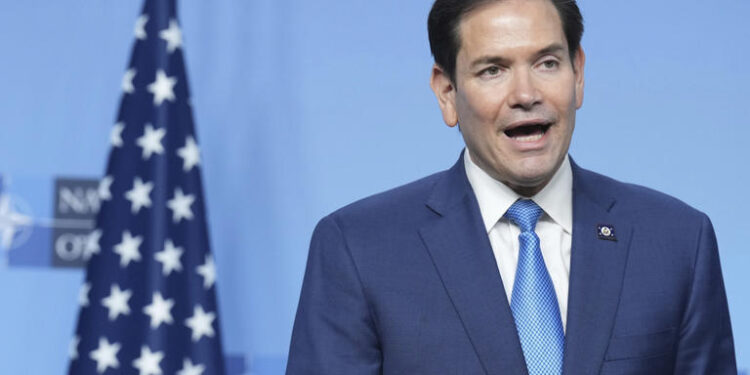
US Secretary of State Marco Rubio has asserted that negotiating and maintaining a ceasefire in Lebanon will be kept separate from any deal with Iran.
Rubio said this in remarks to reporters when he landed in Abu Dhabi, UAE his first stop on the tour of Gulf nations.He is set to meet Emirati officials tonight before travelling to Kuwait and then Bahrain for a GCC meeting tomorrow.
In the initial talks in Switzerland, marking the start of a 60-day window to reach a permanent deal to end the war, Iran and the US agreed to create a “de-confliction cell” to address the fighting in Lebanon between Israel and the Iranian-backed militant group Hezbollah.
“That process is separate. It’s separate because Lebanon is a sovereign country. It has a government, and when it comes to Lebanon and what’s happening inside of Lebanon, we’re going to negotiate and deal directly with the Lebanese government.
“There’s an Iranian issue with regards to Lebanon, and that is their support and sponsorship of Hezbollah. And so that factor will be discussed as part of our conversations with the Iranians. But as far as the future of Lebanon, the future of Lebanon belongs to the Lebanese people through their sovereign, elected government. And that’s who we’re going to be working with.”
Marco Rubio
Mediators Pakistan and Qatar said the “de-confliction cell” would include the Lebanese government and “ensure the adherence of the termination of military operations in Lebanon.” However, Israeli Prime Minister Benjamin said yesterday that his military still has “full freedom of action” to thwart any threats.
Neither Israel nor Hezbollah is a signatory to the US-Iran deal. Netanyahu has vowed to keep his forces in southern Lebanon until all threats to Israel are eliminated. Hezbollah has refused to halt attacks unless Israel commits to withdrawing.
Rubio and US Vice President JD Vance spoke with Lebanese President Joseph Aoun on the phone today, discussing, among other things, the implementation of a ceasefire monitoring body, the Lebanese president’s office posted on X.
The Lebanese President’s office said that Rubio and Vance told Aoun that studies are currently under way for the formation of such a body. The phone call came after Israeli soldiers shot and killed two in southern Lebanon – an attack that Hezbollah said violated the ceasefire agreement. On Telegram, Israel Defense Forces said its soldiers had struck “armed terrorists” that posed an immediate threat to Israeli soldiers but Hezbollah said that the soldiers had fired upon civilians.
Meanwhile, Israel and Lebanon began a fifth round of talks today in Washington, with Lebanese officials insisting that face-to-face negotiations with Israel are the only way to secure an end to the war that began 2 March, when the Iran-backed Hezbollah fired at Israel in support of Iran and triggered Israeli air and ground attacks that have killed more than 4,000 people and displaced at least 1.2 million.
Four rounds of Lebanese-Israeli talks since April have failed to produce a durable ceasefire, though the longest lull in fighting came after Iran and the US agreed to a memorandum of understanding that halted fighting on all fronts.
Earlier, Aoun had warned that Lebanon would “accept nothing less than an end to the Israeli occupation” in southern Lebanon. He added that a new round of US-backed talks with Israel, beginning today in Washington DC, could be decisive for the conflict between Israel and Lebanon.
Rubio Asserts Opening Of Strait of Hormuz
Moreover, Rubio told reporters after landing in Abu Dhabi that the Strait of Hormuz must be opened for safe and free passage.
“It’s an international waterway. No country is allowed to charge tolls or fees on an international waterway. That’s existing international law.”
Marco Rubio
The US has said that negotiators have discussed “mechanisms” to ensure that the Strait of Hormuz, a key waterway for oil transit that Iran effectively blocked during the war, remains open. Ship traffic is increasing but questions remain about who controls the strait.
The International Maritime Organization, a United Nations agency, announced Tuesday that a plan is underway to evacuate 11,000 stranded seafarers through the strait, the narrow mouth of the Persian Gulf through which a fifth of all oil and natural gas traded before the war.
According to the Secretary-General of the International Maritime Organization, Arsenio Dominguez, the plan to evacuate thousands of seafarers is being done in cooperation with Iran, Oman, all other coastal states in the region, the United States and the maritime industry.
READ ALSO: GHS, Ghana Red Cross Deploy 2,300 Health Workers Under REACH Initiative