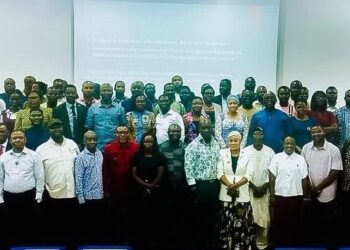

The fourth edition of the prestigious Ghana Business League Awards 2026 convened an elite assembly of corporate captains, institutional framework architects, and private sector pioneers at the Kempinski Hotel Gold Coast City in Accra.
Against a geopolitical backdrop of shifting global trade configurations and localized macroeconomic stabilization efforts, the high-profile gathering served as a vital barometer for measuring the resilience and productivity of the state’s commercial engine.
The presence of the Ghana Investment Promotion Centre (GIPC), the state’s primary statutory agency mandated to attract and sustain direct capital inflows, added profound institutional weight to the evening’s proceedings, joining business leaders and frontline trade stakeholders at this landmark event.
“Delivering remarks on behalf of the Chief Executive Officer of GIPC, Mr Simon Madjie, the Head of Legal Division, Mrs Naa Lamle Orleans-Lindsay, highlighted the critical role of the private sector in driving innovation, job creation, investment and national transformation”
Ghana Investment Promotion Centre
Organized by Maven Communications, the annual awards scheme has firmly established itself as a definitive corporate benchmark within the West African sub-region, and the Centre signaled its ongoing alignment with independent corporate evaluation mechanisms that highlight industrial and operational merit.
According to the GIPC, the event was calibrated to audit, identify, and publicly honor exceptional corporate citizens whose localized operations feed into the nation’s broader developmental indices, focusing its spotlight across the critical pillars of manufacturing, logistics supply chains, and the broader service sectors.

The platform offers a clear, multi-dimensional view of national economic productivity. Industrial observers noted that such platforms are indispensable for cultivating an ecosystem of healthy corporate competitiveness, motivating market actors to elevate their corporate governance, optimize operational efficiencies, and pursue continuous value addition within domestic borders.
This clear institutional recognition underscored the growing consensus that the modernization of primary production lines and logistics channels directly impacts the country’s broader macroeconomic baseline, providing a reliable buffer against volatile international market shifts.
Engine of National Transformation
The highlight of the GIPC’s engagement at the awards ceremony occurred during the delivery of the keynote regulatory address, as Mrs. Naa Lamle Orleans-Lindsay, delivered a detailed breakdown of Ghana’s sovereign industrial strategy.
The presentation provided essential clarity on how the government intends to harness private sector velocity to meet long-term public developmental milestones by framing the conversation around legal security and institutional facilitation, bridging the gap between state regulatory expectations and private operational realities.
The GIPC leadership deconstructed the specific socio-economic metrics that elevate private enterprise from mere commercial operations to essential instruments of national advancement. Mrs. Orleans-Lindsay emphasized that sustained market-led innovation, structured domestic job creation, and continuous capital accumulation are the real drivers behind the Ghanaian economy.
For the Centre, a resilient corporate sector does not simply generate isolated corporate profits; it upgrades the sovereign human capital baseline, expands the domestic tax net, and introduces high-value technical capabilities that insulate the local market from external economic shocks.

A major focus of the GIPC’s policy disclosure centered on the practical frameworks that insulate investments from bureaucratic gridlocks and systemic uncertainties. As global capital markets grow increasingly risk-averse, the assurances offered by Mrs. Orleans-Lindsay served as a primary tie-breaker for multi-national corporations seeking long-term entry points into emerging markets.
The Head of the Legal Division utilized the platform to formally re-verify the center’s dedication to maintaining a highly predictable, legally secure, and operationally fluid commercial environment for all registered enterprises, citing a review of internal regulatory pathways that ensure investment registration, compliance tracking, and dispute mitigation procedures are optimized.
With the GIPC’s objective being to drastically lower the cost of doing business within the republic, effectively transforming traditional regulatory check-points into functional service centers that assist corporate entities throughout their operational lifecycle, it guaranteed a transparent legal landscape that enforces rigid protections for capital assets.
The ongoing cultivation of this supportive institutional climate is to foster long-term corporate loyalty, showing existing market operators that the government is invested in their commercial survival, operational expansion, and regional competitiveness.
Concluding her address, Mrs. Orleans-Lindsay shifted the focus toward a broader continental perspective, aligning localized business successes with macro-opportunities emerging under contemporary African trade frameworks.
With the competition to attract elite manufacturing and service conglomerates intensifying significantly across key regional economies, the Centre’s strategy is deliberately tailored to also leverage Ghana’s established democratic stability, geographical advantages, and legal frameworks to capture a dominant share of inbound continental investments.

To transform this sovereign ambition into visible economic output, the GIPC highlighted the absolute necessity of building deep, unyielding partnerships with localized business associations, event organizers, and corporate stakeholders, recognizing that public-sector campaigns must be backed by the real-world success stories of companies operating on the ground.
READ ALSO: Floods, Droughts to Hit African Banks Harder- Fitch Ratings