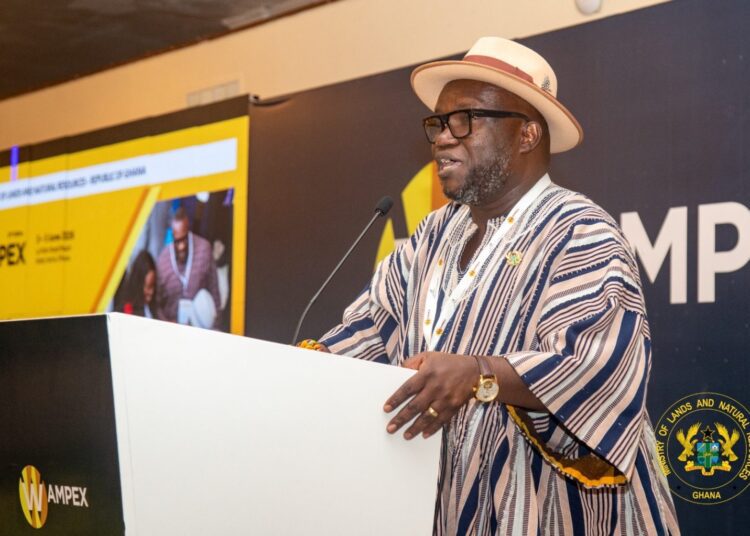
Ing. Kenneth Ashigbey, the Chief Executive Officer of the Ghana Chamber of Mines, has called for an urgent alignment of the nation’s trade, financial, and mineral policies to transform the mining sector from an isolated extraction industry into a comprehensive economic driver.
Speaking at the Mining for Development Forum (MDF) under the theme “Strategic Mining: Value Retention and Development,” Ashigbey explained that Ghana can no longer view mineral extraction in a vacuum if it truly desires sustainable economic transformation.
He emphasized that for the country to maximize value retention, the central bank and trade ministries must construct deliberate frameworks that support local procurement, protect domestic capital, and create a seamless environment where mining resources directly stimulate secondary and tertiary sectors of the economy.
“But when you’re going to do this, there has to be synergies, not only in mining, not only in your trade policy, it even goes to your finance policy. How does Bank of Ghana do it in such a way that when you export these talents, they are able to then bring their monies back in and they know that they will be able to get some interest on that? Because if you don’t make that attractive, then you don’t get to benefit from that.”
Ing. Kenneth Ashigbey
Ing. Ashigbey noted that achieving true national development requires looking at the entire mining value chain and designing policies with a clear “end game” in mind.

He argued that Ghana’s historic and current development frameworks ranging from Kwame Nkrumah’s industrialized plans to recent initiatives like the “Ghana Beyond Aid” agenda and the proposed “24-hour economy” must be intentionally synchronized with the extractive sector.
To reverse Ghana’s vulnerability as an import-dependent nation, Ashigbey asserted that the state must leverage the vast financial resources and consistent demand generated by large-scale mining operations to anchor domestic agriculture and industrial manufacturing.
Leveraging Mining as an Anchor for Agro-Industrialization
To effectively utilize the extractive sector as an economic catalyst, Ghana must strategically position its mining companies as guaranteed “anchor clients” for domestic industries.
Under developmental pillars such as the “Grow24” initiative, the primary challenge has always been identifying sustainable, well-funded demand to back agricultural industrialization.
The mining industry represents a massive, cash-backed consumer base that can absorb locally manufactured goods, provided the right trade policies are enforced.
A prime example lies in the production of activated carbon; a critical material used extensively in gold processing to recover gold from cyanide solutions.
Currently, Ghana imports significant quantities of this material, yet the raw components such as coconut shells and palm wastes are abundant locally.
By deliberately developing domestic palm and coconut plantations to feed processing plants, Ghana can create a robust agro-industrial value chain.
Furthermore, because geology is not limited to borders and spans across the entire West African sub-region, a highly developed Ghanaian activated carbon industry would not only serve local mines but could also position the country as a primary exporter to neighboring gold-producing nations.
The ‘Build, Borrow, and Buy’ Framework for Human Capital
A core component of Ashigbey’s blueprint for value retention involves a systematic approach to human resource development through what he terms the “build, borrow, and buy” framework.
For decades, African nations have struggled with the reality of foreign multinationals dominating the technical and highly lucrative nodes of the mining value chain.

To correct this imbalance, Ghana must clearly identify which technical elements and engineering solutions local professionals can build independently, where strategic partnerships are required to borrow expertise, and when it remains economically viable to buy external services.
By prioritizing the “build” aspect, the country can intentionally cultivate a elite class of local engineers, geologists, and mineral economists capable of managing complex modern operations.
This intentional human capital development increases domestic productivity and changes the narrative from merely hosting mines to exporting high-value intellectual labor.
As these highly skilled Ghanaian mining talents are deployed to manage operations across the continent, they become a vital source of diaspora knowledge and financial inflows, effectively turning human expertise into a major export commodity.
Harmonizing Fiscal Regulations and Value Retention
The true success of exporting local talent and retaining mining wealth hinges directly on progressive monetary policies managed by central authorities.
If the Bank of Ghana fails to create attractive, flexible financial instruments, local experts earning foreign exchange abroad will choose to keep their capital in offshore accounts, depriving the home economy of vital liquidity.
Ing. Ashigbey insists that financial regulators must establish competitive frameworks, offering attractive interest rates and seamless repatriation mechanisms that incentivize citizens to reinvest their earnings back into Ghana’s banking system.
When fiscal regimes, trade directives, and mining codes operate in silos, the state loses significant portions of its mineral wealth to capital flight and import leakages.
Conversely, an integrated approach ensures that the billions of dollars circulating within the extractive sector remain within the local economy to fund infrastructure, stabilize the national currency, and fuel cross-sector growth.
By building these cross-sector synergies, Ghana can successfully pivot away from its historical role as a raw material exporter and finally achieve its long-term developmental agenda.
READ ALSO: President Mahama Signals Transformation Through Tema Industrial Park