Namibia and China have agreed to deepen their long-standing strategic partnership by expanding cooperation in energy, critical minerals, agriculture, infrastructure and technology, marking a significant step in efforts by the Southern African nation to attract investment and accelerate economic transformation.
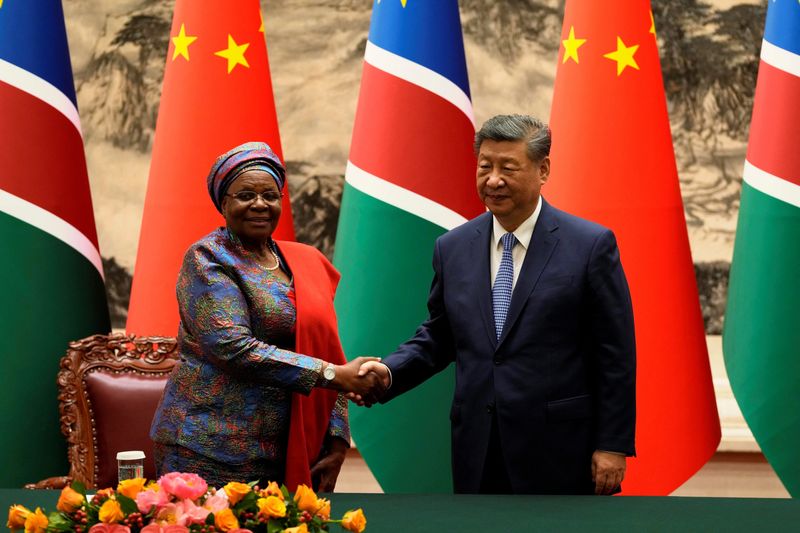
The agreements were reached in Beijing during talks between Chinese President Xi Jinping and Namibian President Netumbo Nandi-Ndaitwah, who is on a seven-day state visit aimed at strengthening bilateral ties and securing investment to support her government’s ambitious development agenda.
President Nandi-Ndaitwah’s first state visit outside Africa since taking office in 2025 highlights the importance both countries place on a relationship that has slowly grown over several decades. Namibia is looking for more foreign investment to help create jobs, encourage industrial growth, and diversify an economy that is still highly reliant on mining while dealing with high unemployment and inequality.
During the high-level meeting, China and Namibia inked eight cooperation papers, including green mineral deals and a framework for broader economic collaboration. The agreements are anticipated to strengthen collaboration in sectors deemed crucial to Namibia’s long-term development, especially as the country positions itself as an emerging energy producer and global supplier of minerals required for the clean energy transition.
According to a statement released after the meeting, Beijing pledged to expand cooperation in infrastructure construction, energy, mining, agriculture, education, science, technology and youth development.
The agreements also place renewed emphasis on developing Namibia’s abundant deposits of uranium, lithium and rare earth minerals, commodities that have become increasingly important as global demand for electric vehicles, renewable energy technologies and advanced manufacturing continues to rise.
“China is willing to deepen cooperation with Namibia in infrastructure construction, energy, minerals, agriculture, education, youth, and science and technology,” according to a Chinese government statement issued after the meetings.
It added that, “both sides recognise the strategic value of critical minerals and agreed to strengthen cooperation in the development of key minerals such as uranium, lithium and rare earths.”
Importantly, the agreement goes beyond resource extraction. Both governments stressed the need to promote local processing industries, facilitate technology transfer and strengthen skills development, reflecting a growing push by African resource-producing nations to retain greater value from their natural resources rather than exporting raw materials.
Speaking during the meeting, President Nandi-Ndaitwah reaffirmed her government’s commitment to strengthening relations with Beijing and noted that her delegation included dozens of Namibian business leaders eager to explore new commercial partnerships.
President Xi welcomed the visit, calling it as a symbol of the two countries’ close relationship.
“Your decision to make China your first state visit outside of Africa after assuming the presidency demonstrates the importance you attach to this significant relationship, for which I express my appreciation.”
Xi Jinping
For Namibia, the partnership comes at a pivotal moment. The country is increasingly attracting global attention following major offshore oil discoveries that could reshape its economy over the next decade.
International energy companies Shell and TotalEnergies have announced discoveries estimated at around 2.6 billion barrels of crude oil, raising expectations that Namibia could become Africa’s fourth-largest oil producer by 2030 if commercial production proceeds as planned.
The prospect of becoming a significant energy exporter has heightened international competition for investment opportunities in Namibia, particularly from countries seeking secure supplies of both fossil fuels and critical minerals needed for future industrial development.
The leaders’ meeting also highlighted China’s continuing engagement with Africa through investment, infrastructure financing and industrial cooperation, even as competition for influence on the continent intensifies among major global powers.
Namibia Attracts Investors With Critical Minerals and Oil
The agreements reached in Beijing reflect broader geopolitical and economic trends that are reshaping Africa’s role in the global economy.
Namibia possesses some of the world’s most sought-after mineral resources, particularly uranium, lithium and rare earth elements, all of which are essential for manufacturing batteries, renewable energy technologies, electronics and advanced defence systems. As countries race to secure reliable supplies of these critical materials, Namibia’s strategic importance has grown considerably.
China has already established itself as one of Namibia’s most significant economic partners. According to the International Monetary Fund, China purchases approximately one-quarter of Namibia’s total exports, making it the country’s largest single export destination. Of the roughly US$1.3 billion worth of Namibian products exported to China last year, uranium accounted for about 85 percent, underscoring the importance of the mining sector to bilateral trade.
Chinese investment has also become deeply embedded in Namibia’s extractive industries. Data from the American Enterprise Institute indicate that Chinese companies have invested approximately US$4.2 billion in Namibia, with nearly all of that capital directed towards the country’s metals sector.
The latest agreements suggest that both governments intend to expand that relationship beyond mining by increasing cooperation in infrastructure, agriculture, education and scientific innovation.