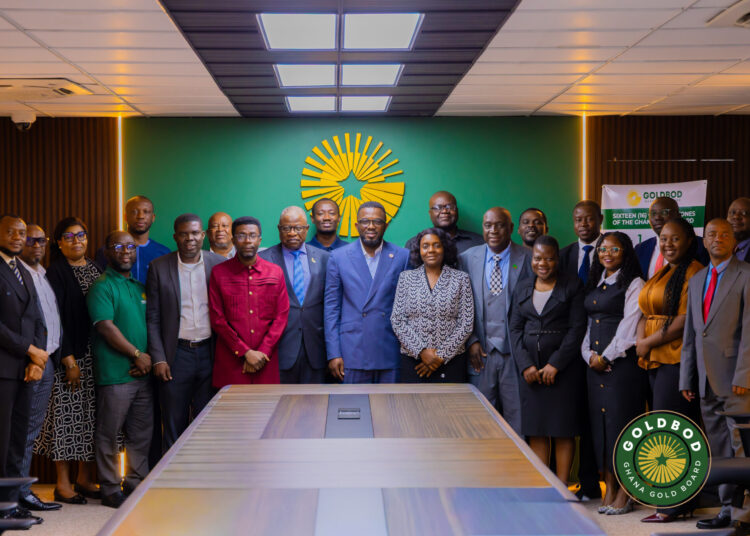
A high-level delegation from the Republic of Zambia has paid a working visit to the Ghana Gold Board (GoldBod) to understudy Ghana’s gold trading framework and gain insights into the institution’s operations, achievements, and ongoing reforms aimed at formalizing the country’s gold sector.
The vital fact-finding mission serves to support Zambia’s urgent domestic efforts to establish a structured gold trading system following the discovery of commercially viable gold deposits in several parts of the country.
“She [Zambia High Commission in Ghana] explained that although Zambia has traditionally been known as a major copper-producing nation, recent geological surveys have identified significant gold deposits in several parts of the country, prompting Government to establish a dedicated framework for regulating and developing the emerging gold sector. She said Zambia was particularly interested in learning from Ghana’s experience in formalising artisanal and small-scale mining and developing an efficient gold trading system that promotes transparency, responsible sourcing and national economic growth.”
Ghana Gold Board (GoldBod)
Welcomed at the GoldBod headquarters in Accra by Deputy Chief Executive Officer Richard Nunekpeku, Esq., the delegation’s visit followed an official state request transmitted through Ghana’s Ministry of Foreign Affairs and Regional Integration.
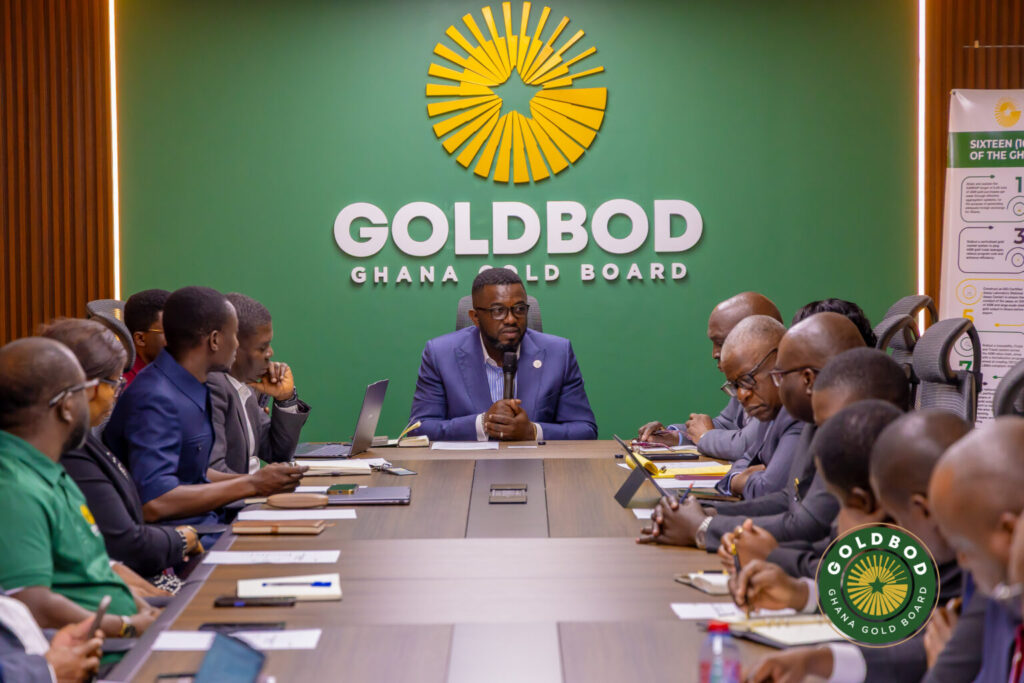
During the comprehensive engagement, GoldBod shared its experience in implementing the landmark Ghana Gold Board Act, 2025 (Act 1140), detailing its core mandate to generate foreign exchange, accumulate national gold reserves for the central bank, and formalize the country’s artisanal and small-scale mining (ASM) sector through an innovative four-tier licensing regime.
Legal Foundations and Regulatory Reforms at GoldBod
The delegation, which comprised high-ranking officials from the Zambia Ministry of Mines and Minerals Development, the Ministry of Finance and National Planning, and the Ministry of Justice, expressed great interest in the governance structures that sustain Ghana’s mineral sector.
Mr. Nunekpeku explained that GoldBod’s governance framework is specifically designed to maximize the developmental return of Ghana’s gold resources while enhancing compliance across the supply chain.
Central to this system is the four-tier licensing regime, which provides a structured approach to regulating trading activities while drastically improving transparency, accountability, and compliance from the mining pit to the export terminal.

Furthermore, the delegation was briefed on the strategic implementation of the Ghana Accelerated National Reserve Accumulation Programme (GANRAP), under which GoldBod is legally mandated to purchase up to 30 percent of the gold output of large-scale mining companies to strengthen the Bank of Ghana’s reserves.
To deepen their operational understanding, the visitors attended technical presentations delivered by directors from GoldBod’s Legal, Responsible Mining and Sustainability, Compliance, Technical, and Finance Directorates, which covered traceability, financial management, and institutional governance.
Macroeconomic Transformation Through Local Gold Refining
A critical highlight of the engagement was Ghana’s ongoing transition from a raw gold exporter to a competitive value-added gold economy, a strategic shift that holds immense relevance for Zambia’s emerging sector.
Historically, exporting unrefined gold has deprived African nations of significant economic margins, including refining premiums, processing jobs, and valuable by-products such as silver.

By establishing solid partnerships and signing landmark agreements with the Gold Coast Refinery and the Royal Ghana Gold Refinery, the Ghanaian government has successfully localized the refining process.
This strategic drive secures direct financial savings by eliminating offshore processing fees while simultaneously enabling the central bank to purchase high-purity, locally refined gold to stabilize the national currency.
Furthermore, local refining stimulates significant job creation in metallurgical engineering, security, and logistics, transforming the gold industry from a simple extractive channel into an industrial engine.
The introduction of GoldBod Jewellery Limited further advances this domestic value-retention agenda, converting refined gold into commercial jewelry to foster local craftsmanship and retain secondary wealth within the borders of the national economy.
Forging a United African Model for Mineral Governance
The collaborative exchange between these two nations underscores a broader continental movement toward sovereign mineral governance and resource-driven economic independence.

Representing a major copper-producing powerhouse now entering the gold landscape, the Zambian delegation described the technical engagement as an “eye-opener” that provides practical, tested benchmarks for their own upcoming regulatory framework.
By studying Ghana’s formalization of artisanal and small-scale mining and its structured trading mechanisms, Zambia is positioned to avoid the historical pitfalls of unregulated mining and immediately implement a system focused on transparency and responsible sourcing.
READ ALSO: CAGD Debunks GHC11 Billion Accra-Kumasi Expressway Spending Claims