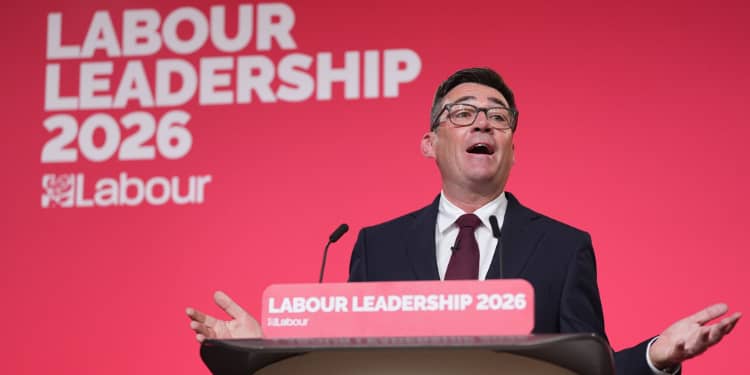
Andy Burnham has officially assumed the leadership of Britain’s Labour Party, using his first major address to outline a bold political vision centred on rebuilding public trust, devolving power away from Westminster and restoring a “distinctively Labour” identity ahead of his expected appointment as the United Kingdom’s next prime minister.
Addressing party members and supporters in London, Burnham declared that Labour would chart its own course rather than imitate political rivals, promising to reject attempts to “out-Green the Greens” or “out-Reform Reform” while focusing instead on policies rooted in Labour’s traditional values of economic fairness, regional empowerment and social justice.
His election as Labour leader follows overwhelming support from the party’s parliamentary ranks and affiliated trade unions, securing the backing of 349 Labour MPs and affiliated organisations. The endorsement effectively paved the way for an uncontested leadership transition after Keir Starmer announced his resignation.
Although Burnham has now been confirmed as Labour leader, he is expected to formally become Britain’s next Prime Minister on Monday after Keir Starmer recommends him to King Charles III to form a new government.
In his first speech as leader, Burnham struck a tone of optimism while acknowledging the scale of the challenges facing both the party and the country.
He argued that Britain had reached a decisive political moment and that Labour had a responsibility to restore confidence in government after years of economic uncertainty, regional inequality and increasingly polarised political debate.
“We are united, we put the power that comes from unity at the service of people and places who have been waiting too long for politics to let them hope again.”
Andy Burnham
Describing himself as ready to assume the country’s highest political office, Burnham added, “It is a proud moment. It is one for which I am ready. I am ready, ready to lead and to build on the foundation laid by one person more than any other.”
Despite having emerged as the figure who ultimately succeeded Keir Starmer, Burnham paid warm tribute to the outgoing Labour leader, praising his role in rebuilding the party following one of the most difficult periods in its modern history.
“Today we thank Keir for his service to our party and our country,” Burnham told delegates, crediting Starmer with leading Labour from its worst electoral defeat to what he described as one of the party’s greatest victories.
The incoming prime minister also sought to reassure supporters that his leadership would prioritise unity rather than internal divisions, warning that Labour could not afford the factionalism that has periodically undermined the party.
“We won’t beat Britain’s new right if we are consumed by infighting and pulling in different directions. That is and always has been an indulgence that falls heaviest on the people who need Labour most.”
Burnham also promised to eliminate Labour’s “insidious briefing culture,” arguing that discipline and collective purpose would become defining features of his leadership.
Throughout his speech, Burnham repeatedly emphasised that voters wanted practical solutions rather than political point-scoring.
Reflecting on his successful parliamentary by-election campaign in Makerfield, Burnham argued that honesty with voters had helped rebuild trust.
“In Makerfield, I decided to make a break with this. I said we hadn’t been good enough. I told people what I would do to fix it. You know what? People started to listen again. They gave us a fair hearing. As the great British public always do. And then another chance.”
Andy Burnham
Burnham Vows Regional Growth and a New Era of Politics
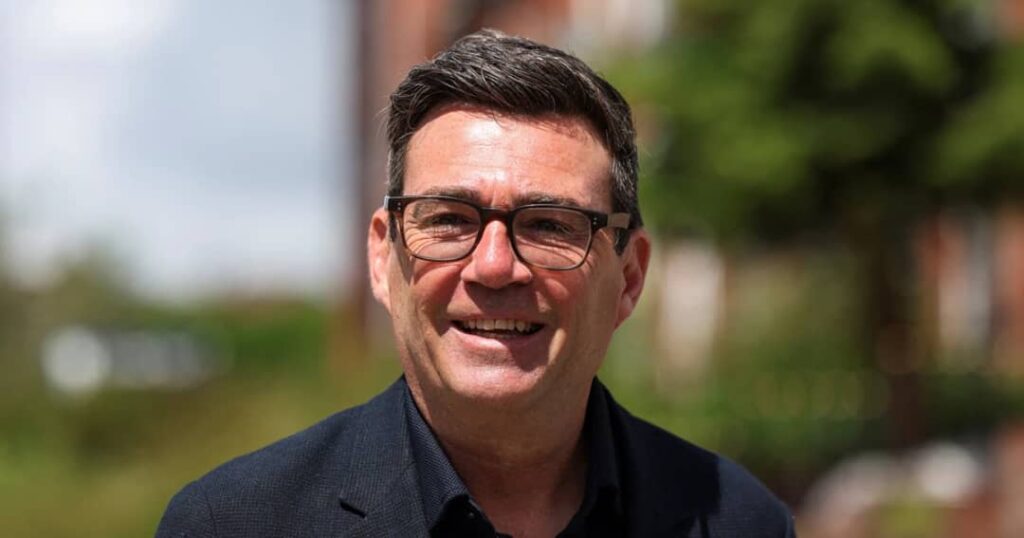
Central to Burnham’s leadership platform is a commitment to reshape Britain’s political and economic system by transferring greater decision-making powers from Westminster to local communities.
He argued that successive governments had concentrated political authority in London while allowing essential public services and infrastructure to become increasingly detached from local accountability.
“I am clear Britain took a series of wrong turns in the 1980s. Political power was centralised and economic power was privatised.”
Andy Burnham
According to Burnham, decades of centralisation have weakened communities across the United Kingdom by reducing local control over housing, transport, energy and other essential services.
He contended that the resulting concentration of wealth and decision-making power had contributed to the decline of many industrial towns and high streets while limiting opportunities for regional economic growth.
As part of his programme, Burnham pledged to pursue a significant expansion of devolution, promising to return decision-making powers to cities, towns and regions throughout England while strengthening local government across the wider United Kingdom.
“We will take power back from Westminster and Whitehall and give it to the place where you live.”
Andy Burnham
He cited plans already being developed in the Liverpool City Region to return the Merseyrail network to public ownership by 2028 as an example of how devolved authorities could deliver better outcomes for local communities.
Burnham also sought to position Labour as a pro-business party capable of combining economic growth with social investment.
“I will be a pro-business leader of the Labour Party as I was a pro-business mayor of Greater Manchester.”
Andy Burnham
He added that future economic policy would focus on reindustrialisation, supporting investment across Britain’s regions and creating greater parity between academic and technical education to ensure young people had multiple pathways into skilled employment.
The Labour leader also promised to reduce the increasingly confrontational tone of British politics, arguing that governments should concentrate on solving problems rather than exploiting partisan divisions.
“We may find our political discourse in this country becomes that little bit less toxic, and we should be working to achieve that too.”
Andy Burnham
Burnham stressed that cooperation with other political parties would remain possible where national interests aligned, but insisted Labour would do so from a position of ideological confidence rather than political imitation.
“My third change is our political direction. Yes, we will work with other parties where we can, but doing so from the clarity of knowing exactly where we stand. As your leader, I will set a direction that is distinctively Labour.”
Andy Burnham
He concluded by promising to remain closely connected to ordinary voters despite moving into Downing Street, highlighting that his leadership style would continue to be shaped by conversations in football stadiums, cafés, pubs and high streets rather than the political bubble of Westminster.
Burnham added that he intends to spend the coming weeks travelling across England, Scotland, Wales and Northern Ireland, reinforcing his pledge to serve every community equally as he prepares to lead the country through a defining period for Britain’s future.
READ ALSO: Epic First Look Unveils Star-Studded ‘Children of Blood & Bone’ Adaptation