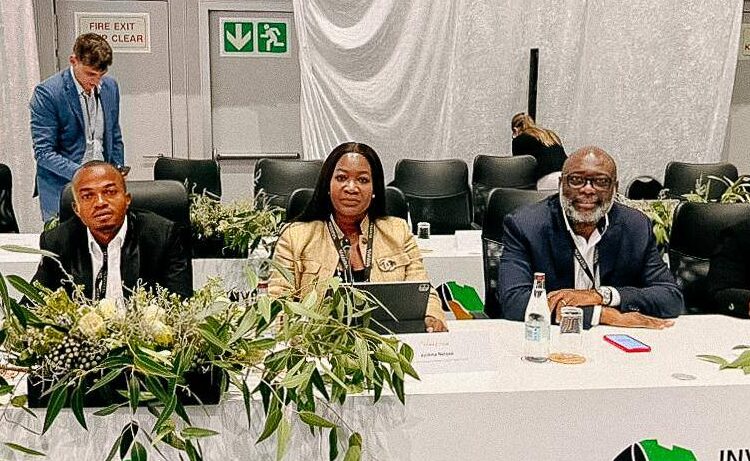
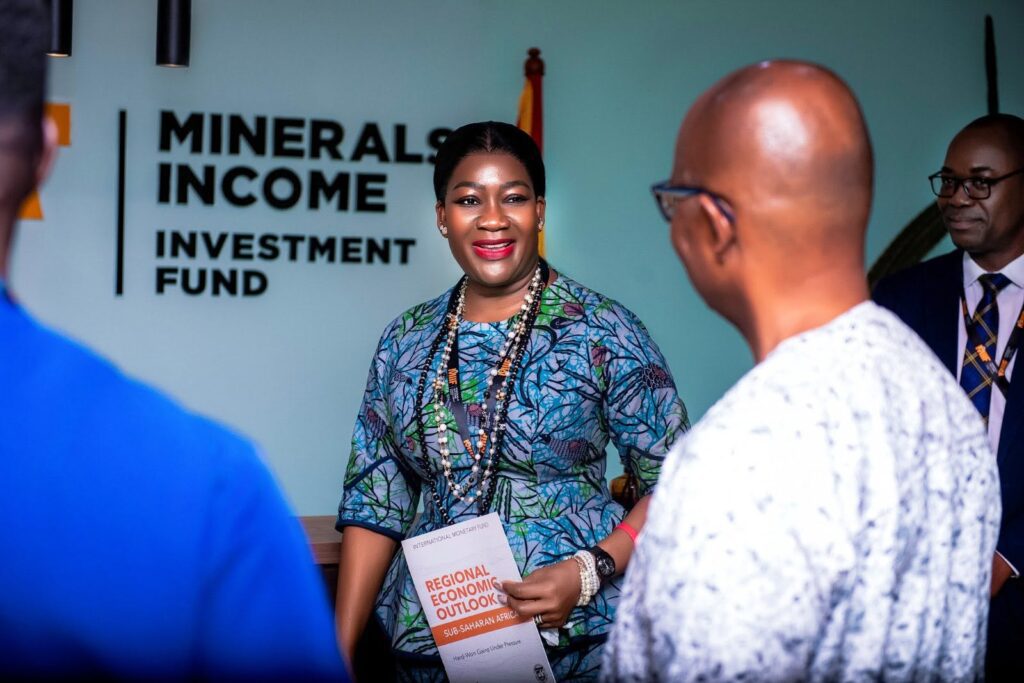
Chief Executive Officer of the Minerals Income Investment Fund (MIIF), Mrs. Justina Nelson, has expressed optimism about the remainder of the year despite emerging Gold moderation and operational Risks that threaten Second Half Inflows
She cited resilient gold production and the continued application of the sliding-scale royalty mechanism, and sustained compliance and monitoring efforts as reasons for confidence.
Speaking on the fund’s financial results, Mrs. Nelson highlighted that Ghana’s extractive receipts maintain strong momentum heading into the second half of 2026. However, macro-economic vulnerabilities and sectoral disruptions could soften total inflows if left unaddressed.
“She cautioned, however, that downside risks remain, including a potential moderation in gold prices, operational disruptions within the mining sector, continued weakness in the manganese market, and persistent regulatory and illegal mining challenges affecting the quarry, salt, and sand sectors.”
Minerals Income Investment Fund (MIIF)
The CEO cautioned that critical downside risks continue to pose significant threats to the state’s revenue projections.
Key among these structural vulnerabilities is a potential moderation in global gold prices, operational disruptions within the domestic mining sector, continued weakness in the manganese market, and persistent regulatory and illegal mining challenges affecting the quarry, salt, and sand sectors.
Should global bullion prices cool off following consecutive record rallies, or if illegal mining (galamsey) further compromises non-gold mineral production, the state’s fiscal buffer could experience a noticeable contraction in the coming quarters.
“Addressing these risks through enhanced stakeholder engagement, strengthened enforcement, and continued compliance interventions will be critical to sustaining royalty growth during the second half of 2026,” Mrs. Nelson said.
Assessing the Downside Risks to MIIF’s H2 Royalty Receipts
To fully understand the potential impact on MIIF’s balance sheet, one must examine the specific mechanics of Ghana’s mineral revenue collection. Gold acts as the primary anchor for MIIF’s inflows, generating over 90% of total mineral royalties.
The fund’s flexible revenue framework relies heavily on a sliding-scale royalty mechanism, which scales royalty percentages dynamically based on prevailing spot market prices.
While this mechanism delivered extraordinary windfalls during periods of high gold prices helping MIIF hit a mid-year royalty total of GH₵5.39 billion in 2026 it acts as a double-edged sword.
A downside price correction in gold would automatically drop royalty rates into lower percentage brackets, triggering a compound decline in net collections.
Compounding this pricing sensitivity are operational disruptions within the mining sector. When large-scale producers face supply chain bottlenecks, labor disputes, or equipment downtime, reduced output directly diminishes the volume base upon which royalties are assessed.
Furthermore, weakness in the manganese market driven by high stripping ratios at operational sites and currency fluctuation pressures continues to suppress non-gold earnings, preventing the fund from diversifying its revenue base effectively.
Regulatory Headwinds and Non-Gold Sector Vulnerabilities
Beyond traditional mining operations, illegal small-scale mining and regulatory loopholes in industrial minerals pose severe structural threats to fiscal stability.
Subsectors such as quarrying, sand winning, and salt extraction contribute crucial regional revenues, yet widespread illicit mining operations severely dilute official compliance levels.
When unregistered operators harvest sand, granite, and salt outside formal legal structures, MIIF misses out on vital royalty assessments.

The fund’s success in maintaining revenue growth relies on institutional interventions. MIIF has increasingly required operators to present MIIF clearance letters before the Minerals Commission grants or renews operating permits, a move that significantly boosted first-half payment discipline.
However, sustained illegal extraction in the quarry and sand sectors threatens to erode these gains unless multi-agency enforcement is scaled up across all mining districts.
To protect Ghana’s sovereign mineral wealth, MIIF plans to intensify its nationwide field monitoring and expand collaborative efforts with the Minerals Commission and the Ghana Revenue Authority (GRA).
By tightening internal controls and enforcing strict compliance, the fund aims to insulate its second-half projections against commodity price volatility and operational inefficiencies, ensuring that the mining sector remains a primary engine for national economic development.
READ ALSO: Will BoG Hold or Cut? Markets Await July MPC Decision