
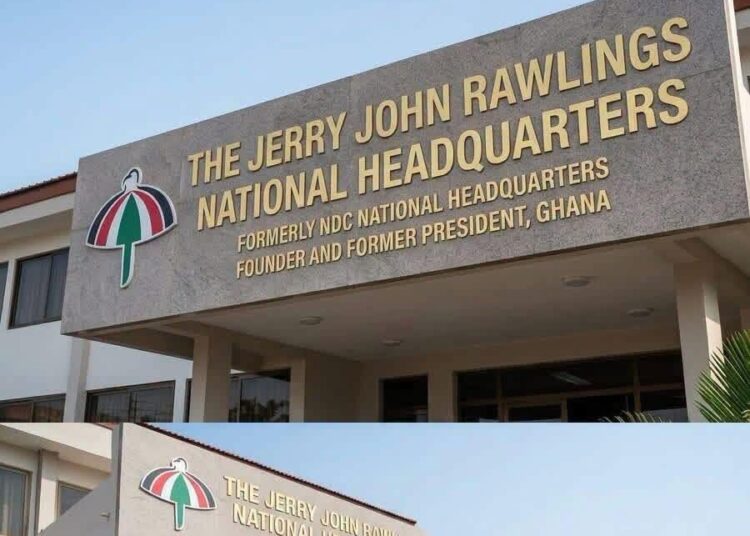
The Accra High Court, General Jurisdiction, presided over by Justice Sedina Agbamava, has dismissed a suit seeking to prevent the National Democratic Congress from directing Ministers, Chief Executive Officers, Managing Directors and persons in similar positions to resign from their roles at least six months before the party’s Regional and National Elections.
The ruling clears the way for the party to fully enforce its 2026 guidelines for internal elections, which had already received approval from the National Executive Committee.
According to the guidelines at the centre of the dispute, the resignation requirement stems from Article 54 of the NDC’s Constitution, which mandates that specific government appointees intending to contest for a party position must resign at least six clear months before filing their nomination forms.
The guidelines establish a staggered timeline depending on the level of contest involved. Those seeking constituency-level positions faced an April 2026 resignation deadline, while candidates for regional positions were required to resign by May 2026.
Those pursuing national-level party positions faced a June 2026 deadline for stepping down from their government roles.
Wide Range of Officials Covered by the Directive
The resignation requirement applies broadly across several categories of government appointees. Affected offices include Ministers and Deputy Ministers, Chief Executive Officers, Managing Directors and their deputies or officers in analogous roles, along with Metropolitan, Municipal and District Chief Executives.

The guidelines specifically exempt certain categories of appointees from the resignation requirement, including chairpersons or members of governing boards and persons occupying similarly structured positions within government institutions.
Beyond the resignation provisions, the NDC’s 2026 guidelines introduce a series of measures aimed at strengthening transparency and fairness throughout the internal election process.
Constituency Executives are required to publicly announce and publish the official venues and times for every Branch meeting, with Branch elections mandated to take place at the same approved venues and scheduled times as regular Branch meetings.
The guidelines also establish strict rules governing the party’s membership register. New member registration must be administered strictly at designated branch locations, and the guidelines explicitly prohibit transferring or swapping the membership number of a deceased member to a new registrant, a practice that will attract the severest sanctions if violated.
To further safeguard the integrity of the process, the guidelines grant members unhindered access to check Branch registers for verification and to make necessary corrections where discrepancies arise.
A Ruling That Reinforces Internal Party Discipline
The court’s decision to dismiss the suit against these provisions removes a significant legal obstacle that had threatened to disrupt the NDC’s internal election timeline.
With the ruling now in place, the party can proceed with enforcing its resignation requirements and broader transparency measures without the uncertainty the litigation had introduced into its preparations for constituency, regional and national-level contests.

For government appointees affiliated with the NDC who harbour ambitions of contesting internal party positions, the ruling reaffirms that stepping down from their government roles within the specified timelines remains a binding requirement rather than an optional guideline subject to legal challenge.
Implications for Government Appointees Eyeing Party Positions
The upheld directive is likely to have direct consequences for sitting Ministers, agency heads and other government officials within the NDC who may have been considering internal party positions while continuing to hold their government appointments.
With the court’s dismissal of the suit, such officials now face a clear choice between retaining their current government roles or resigning within the stipulated timelines to pursue internal party leadership positions.
This requirement reflects a broader effort by the NDC to draw a clearer separation between government office and internal party leadership contests, potentially reducing concerns about appointees leveraging state resources or influence to gain advantage in internal party elections.
Party Positions Itself for a Structured Election Cycle
With the legal challenge now resolved, the NDC’s 2026 internal election guidelines stand fully enforceable, giving the party a clear framework to guide its constituency, regional and national-level elections in the months ahead.

The combination of the resignation requirement, transparent branch meeting protocols and strict membership register controls suggests a deliberate effort by the party leadership to tighten internal discipline and reduce the kind of disputes that have historically accompanied internal party elections in Ghana.
As the party moves forward with its election calendar, attention will likely turn to how strictly these provisions are enforced across various constituencies and regions, particularly regarding the resignation deadlines for government appointees seeking to contest internal party positions.