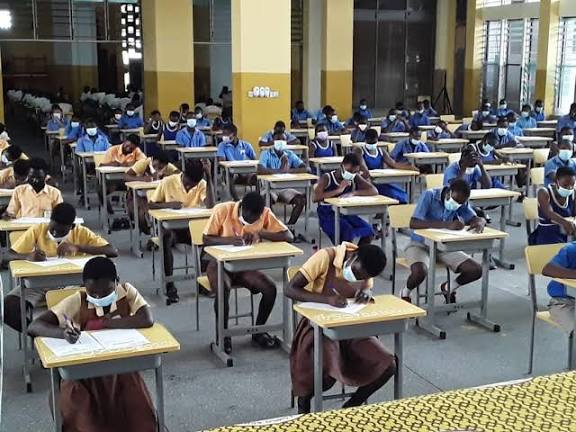
Basic Education Certificate Examination (BECE) candidates have entered a new phase of the school placement process, with the Computerized School Selection and Placement System (CSSPS) rolling out fresh guidelines that require students to make their school choices only after receiving their results.
Coordinator for CSSPS, Sherif Sulemana, explained that the placement process unfolds in three stages, pre-placement, placement, and post-placement, with the pre-placement phase focused on sensitising candidates, guardians, and the general public on the choice selection procedure and guidelines. He disclosed that the choice selection window opened on Monday and will close on Friday, August 7, 2026.
According to Sulemana, candidates are required to make eight school choices this year, but face strict limits on how many elite institutions they can select. He explained that candidates cannot select more than two Category A schools, while the remaining choices are to be distributed across Category B and Category C institutions.
“The new system empowers candidates to make informed school choices instead of relying on guesswork.”
Coordinator for CSSPS, Sherif Sulemana
He clarified that while the cap applies strictly to Category A schools, candidates whose results do not match the standards of top-tier institutions may build their entire list from Category B and C schools, or even include Technical and Vocational (TVET) or STEM institutions in the mix. He added that candidates who avoid Category A altogether are free to select as many as five or six Category B schools, provided their total choices still add up to eight.
Results Before Choices, A Deliberate Shift
Sulemana revealed that CSSPS has departed from the previous system in which candidates made their school choices before sitting the BECE, describing the old approach as forcing students to gamble on their academic fate without knowing their actual performance.
He said the new sequencing, where choices are made only after results are released, allows candidates to make informed decisions based on their actual strengths, easing pressure on Category A schools that have limited capacity to absorb every applicant.

He illustrated this with an example involving a candidate targeting a science programme at a highly competitive girls’ school, noting that under the old system, such a candidate might have wasted a choice on a school clearly beyond their reach, only to be automatically eliminated once results came in.
How Aggregate and Raw Scores Work
Explaining the scoring mechanics behind placement, Sulemana said this year’s candidates sat ten papers, five core subjects and five electives, but noted that only six of those results count toward the aggregate score used for ranking. He said the aggregate is calculated from four core subjects, mathematics, English, science, and social studies, combined with a candidate’s best two elective results, meaning an aggregate of six reflects six ones across those combined papers.
He explained that candidates are first ranked nationally by aggregate score, from the strongest performers to those who have failed outright, before a secondary measure comes into play for candidates who share identical aggregates.
He noted that where two or more candidates share the same aggregate score, CSSPS turns to what is known as the raw score to determine who is ultimately better placed for competitive schools. Sulemana explained that between two candidates with an identical aggregate, the one with the higher raw score stands a greater chance of securing a place at a preferred school.
He acknowledged that raw score data is not made available to the public, a gap in transparency he described as a genuine difficulty for candidates and parents trying to understand the system. Sulemana added that the dynamics can produce surprising outcomes, noting that a candidate with a numerically lower aggregate score, such as an aggregate 8 or even 10, can still outrank a candidate with an aggregate 6 once raw scores are factored in.

He indicated that CSSPS may in future consider placement based solely on aggregate scores to simplify the process for the public.
Placement Based on Choices, Scores, and Vacancies
Summing up how final placements are determined, Sulemana said CSSPS matches three key elements: the choices submitted by candidates, their aggregate scores, and the number of vacancies available in various senior high schools. He explained that once the choice selection period closes, results are retrieved from the West African Examinations Council (WAEC) and cross-referenced against both submitted choices and available school vacancies to generate final placements.

With the choice selection window closing on Friday, candidates, parents, and guardians have been urged to make full use of the sensitisation guidelines provided, as choices made with a clear understanding of one’s academic strengths give candidates a better chance of securing placement in schools suited to their performance.
CSSPS says it remains committed to keeping the placement process transparent and fair, even as it continues reviewing aspects of the system, including the raw score mechanism, ahead of future placement cycles.
READ MORE: Government Urged to Invest in Digital Infrastructure to Transform Healthcare