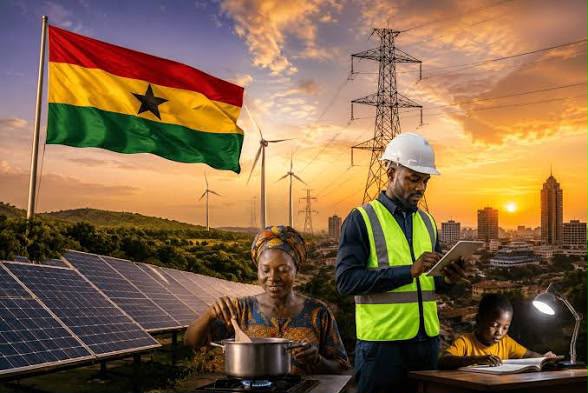
Ghana’s electricity access rate has moved close to 90%, but the remaining gap is increasingly concentrated in communities where conventional grid expansion is more difficult and expensive.
The country’s 2026 Energy Statistics put national population electricity access at 89.13% in 2025, while household electricity access stood at 87.99%. Those figures represent substantial progress in the expansion of electricity infrastructure.
But they also change the nature of Ghana’s access challenge. At lower access levels, the priority is extending the grid.
At close to 90% access, the remaining challenge becomes more targeted: identifying underserved communities, determining whether grid extension is economically viable and deploying alternatives where extending conventional infrastructure is inefficient.
ASEC’s assessment places Ghana in the category of an “Emerging Transition Economy”, identifying the country’s growing renewable-energy policy ecosystem but also pointing to a persistent rural electrification deficit and subsidy reform challenges.
“Ghana and Nigeria face persistent rural electrification deficits.”
Africa Sustainable Energy Centre (ASEC) Energy Outlook 2025
The Last Mile Is Becoming The Hardest
The remaining 10% or so of the population without electricity access cannot necessarily be treated as a simple extension of the previous 90%.
The economics become more difficult as communities become more dispersed, demand density falls and the cost of building transmission and distribution infrastructure rises.
That is where distributed renewable systems can become strategically important.
Solar home systems, mini-grids and other decentralised solutions can potentially provide electricity in locations where connecting every settlement to the national grid would require disproportionately high investment.
ASEC’s broader assessment argues that distributed renewable projects are increasingly viable, but stresses that Ghana’s transmission and distribution networks require significant investment if variable renewable generation is to be absorbed at scale.
This creates a two-sided infrastructure challenge.
Ghana needs to extend electricity access to communities still outside the system, while simultaneously strengthening the existing grid so that additional renewable generation can actually be delivered reliably.
The distinction matters because electricity access is not only a question of connection.
A community may receive a grid connection, but the economic value of that connection depends on reliability, affordability and whether electricity can support productive activity.
A more useful measure of success is therefore whether electrification is creating economically useful energy services rather than simply increasing the number of connected households.
Electrification Must Become Economic Infrastructure
The next stage of Ghana’s access strategy should increasingly connect electrification with economic development.
Electricity can support irrigation, agro-processing, refrigeration, health facilities, schools, small businesses and digital services. Without productive demand, however, expensive infrastructure can remain underutilised.
This is where renewable energy can provide a different opportunity.
Decentralised solar and mini-grid systems can potentially be designed around the needs of particular communities rather than simply reproducing the architecture of the national grid on a smaller scale.
ASEC’s assessment also warns that financing remains a major constraint across renewable-energy development and recommends stronger project pipelines, standardised procurement and investment frameworks capable of attracting private capital.
That is particularly relevant to Ghana.
Public financing alone is unlikely to provide the scale of capital required to close the remaining access gap while simultaneously upgrading transmission, distribution and generation infrastructure.
A credible private-sector framework could therefore become increasingly important, particularly for decentralised systems where projects can be structured around specific communities, productive users or commercial demand.
The Grid Still Matters
None of this means Ghana should abandon conventional grid expansion.
The national grid remains the backbone of the electricity system, and renewable generation at scale will depend on transmission and distribution infrastructure capable of moving electricity from generation centres to demand centres.
The 2026 Energy Statistics show that Ghana’s electricity generation reached 27,945 GWh in 2025.
The country also exported 2,451 GWh while importing only 11 GWh, resulting in net electricity exports of 2,441 GWh.
That performance illustrates that Ghana’s challenge is not simply a lack of electricity production.
The harder question is how efficiently the system can deliver electricity to every community that needs it, while maintaining financial sustainability.
The final stretch of electrification will therefore require a more sophisticated policy mix: selective grid extension, decentralised renewable systems, stronger distribution infrastructure and productive-use programmes that allow newly electrified communities to convert electricity access into economic activity.
Ghana is no longer solving the electricity-access problem it faced two decades ago.
The remaining problem is more targeted, more expensive and more closely tied to the quality of infrastructure and the economics of energy delivery.
That is why the next percentage point of electricity access could be considerably harder to achieve than the previous one.
READ ALSO: Assad Cousin Sentenced To Death In Syria