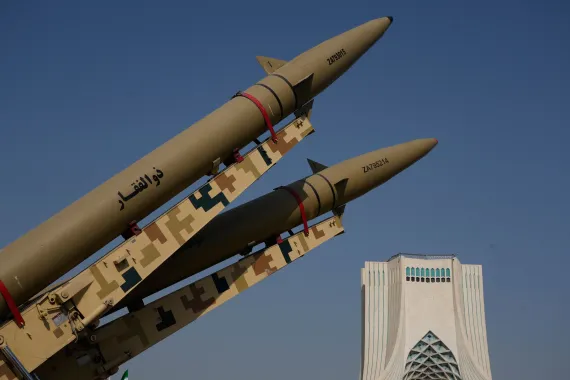
Hostilities between the United States and Iran have flared again after a month-long lull, with U.S. strikes on Iran triggering retaliatory attacks and raising fresh concerns about the security of the strategically vital Strait of Hormuz.
The latest escalation began after U.S. forces carried out airstrikes on two Iranian rocket launchers on Larak Island in the southern part of the Strait of Hormuz on Sunday. A U.S. official said the launchers were targeted because Iran’s Islamic Revolutionary Guard Corps (IRGC) was preparing to fire rockets carrying naval mines into the narrow waterway. Iranian state broadcaster reported that the U.S. strikes killed and wounded several Iranian civilians and military personnel.
Iran responded by announcing attacks on U.S. military positions in the region on Monday. The IRGC said that it had launched ballistic missiles at two U.S. airbases in Jordan, a close U.S. ally, claiming the strikes caused “heavy damage.”
Jordan’s military said that it intercepted eight missiles but did not identify their origin or provide details about whether any reached their intended targets. Iranian forces also said they targeted U.S. military personnel at Al Minhad airbase in the United Arab Emirates.
Iranian officials have defended their actions as a response to U.S. military aggression. Deputy Foreign Minister for Legal and International Affairs Kazem Gharibabadi said foreign powers should be excluded from the region following the attack on Larak Island. He said the United States needed to “learn a serious lesson” and warned against repeating what he described as further aggression.
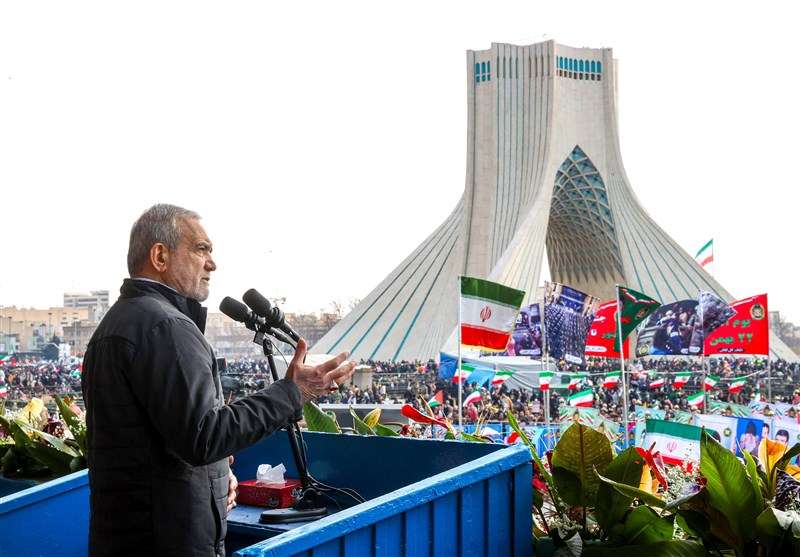
Iranian President Masoud Pezeshkian, meanwhile, sought to portray Tehran’s position as defensive rather than an attempt to initiate a wider conflict.
“We do not seek war, that has been our message to the world. However, in the face of aggression, we will not stand by. We are capable of delivering a decisive response. Instability in this region would affect everyone and create serious problems.”
Masoud Pezeshkian
U.S. President Donald Trump later claimed on social media that Iran’s energy hub of Kharg Island was “being blown to smithereens.” Kharg Island is a major Iranian oil-export facility, making any military action there potentially significant for Iran’s ability to export crude.
The latest confrontation marks the most serious direct exchange between Washington and Tehran since a month-long period of relative calm. It also demonstrates how quickly military activity around the Strait of Hormuz can expand into a broader regional crisis.
Iran’s warnings to commercial vessels, the reported mine incident and the competing claims over attacks on military bases have raised concerns among shipping companies and governments monitoring the waterway. The United States has repeatedly said that protecting its military personnel and maintaining freedom of navigation are important strategic priorities in the Gulf. Iran, meanwhile, has insisted that regional security should not be dictated by foreign military powers.
UAE Rejects Reports Of Airbase Attack
However, the UAE’s Ministry of Defence rejected reports that the airbase had been hit by missiles, describing the claims as false. The UAE separately said that its air-defence systems had intercepted an Iranian drone over its territorial waters.
The country’s Foreign Ministry condemned what it described as a “hostile Iranian attack” and warned that it reserved the “full and legitimate right to respond.”
The competing claims have added to uncertainty across the Gulf, where several countries host U.S. military facilities and where any escalation could threaten commercial shipping and energy supplies. The situation was further complicated by an incident involving a supertanker in the southern Strait of Hormuz.
Iranian state television, citing the IRGC, reported that the tanker caught fire and came to a complete halt after striking two naval mines.The IRGC alleged that the vessel had been attempting to pass through the waterway illegally.
Iranian authorities warned that other vessels violating what they described as security regulations governing passage through the strait could face similar consequences. The IRGC said that compliance with its rules was mandatory.
The incident comes as tensions over access to the Strait of Hormuz remain particularly sensitive. The waterway is one of the world’s most important energy corridors, carrying a significant share of global oil and gas shipments between the Persian Gulf and international markets. Any prolonged disruption could therefore have consequences well beyond the region, potentially affecting energy prices, shipping costs and global supply chains.
For now, governments across the Gulf are closely monitoring developments as Washington and Tehran trade warnings and military strikes. The immediate concern is whether the latest exchanges remain limited or develop into a wider confrontation involving U.S. allies and Iranian forces or their regional partners.
With commercial shipping already facing heightened risks and the Strait of Hormuz remaining central to global energy markets, further escalation could have consequences extending far beyond the Middle East.
READ ALSO: US Sanctions May Deepen Iran Standoff Without Forcing Concessions- Dr. Doke