
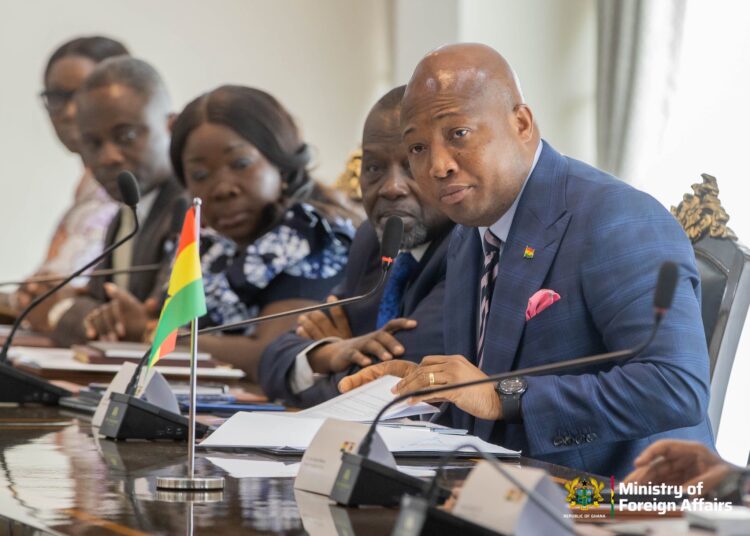
Foreign Affairs Minister Samuel Okudzeto Ablakwa has hailed a landmark report from the United Nations Committee on the Elimination of Racial Discrimination concluding that states responsible for the transatlantic trafficking of enslaved Africans are legally bound to provide reparatory justice for the harm it caused.
The Committee’s General Recommendation No. 40, issued as an advance unedited version, sets out authoritative guidance on the legal basis for state responsibility over both direct and indirect involvement in the trafficking of enslaved Africans and racialised chattel slavery.
Hon Ablakwa’s reaction ties the finding directly to a campaign Ghana has led at the United Nations, arguing that recognition of these historical crimes is now hardening into a binding legal obligation.
What the General Recommendation Establishes
The document clarifies the obligations of states parties under the 1965 Convention on the Elimination of Racial Discrimination and sets out a framework for addressing the enduring consequences of colonialism and enslavement.
It states plainly that the trafficking of enslaved Africans and racialised chattel slavery inflicted grave and systematic harms, and that their legacies remain reflected in contemporary infringements of the rights to security of person, liberty, equality before the law, and the full range of civil, political, economic, social and cultural rights protected under Article 5 of the Convention.
According to the Recommendation, these legacies continue to shape laws, policies and institutions in many societies today.
It identifies specific contemporary manifestations of that continuity, including racial profiling and the disproportionate use of force by law enforcement officials, racial disparities within criminal justice systems, discriminatory laws and institutional practices affecting access to housing, education, employment and healthcare, and persistent structural inequalities affecting people of African descent and other affected communities.
A Framework Beyond Historical Acknowledgment
The Committee’s guidance rests on a central premise: that the elimination of racial discrimination cannot be effective, thorough or lasting without examining and redressing the harms and continuing consequences of colonialism, the trafficking of enslaved Africans, and racialised chattel slavery.
The Recommendation frames addressing these legacies as more than a matter of historical recognition, describing it instead as an essential requirement for achieving substantive equality and fulfilling states’ obligations under the Convention.
The document affirms that meaningful redress demands more than an acknowledgment of past wrongs. It calls for sustained action to address the continuing effects of historical injustices and to transform the structures that perpetuate racial inequality, positioning reparatory justice as an ongoing legal duty rather than a symbolic gesture.
Ghana Ties the Report to Its Own UN Campaign
Hon Ablakwa framed the Committee’s findings as arriving at a deliberately significant moment for Ghana’s diplomatic push on reparations.
He noted that President John Mahama has been presenting a comprehensive report at the African Union’s extraordinary meeting in Angola on the landmark Ghana-led UN resolution declaring the transatlantic enslavement of Africans the gravest crime against humanity.
“A crime does not rot. It was in this spirit that Ghana carried the cause of the enslaved to the United Nations. Today that conviction stands affirmed in international law.”
Minister for Foreign Affairs, Samuel Okudzeto Ablakwa
He argued that the Committee’s guidance dismantles a defence long used against reparations claims. “The long-used excuse, that these crimes were lawful when they were committed, no longer holds,” he said, adding that the Committee itself describes its own findings as representing a paradigm shift in how reparatory justice is understood in international law.

From Moral Cause to Legal Duty
Hon. Ablakwa positioned the General Recommendation as the legal scaffolding beneath Ghana’s earlier diplomatic achievement at the UN. “This is the legal foundation beneath the moral authority of Resolution A/RES/80/250,” he said.
He described a shift already underway in how the international community treats the obligations that follow historical enslavement. Recognition is becoming obligation. Apology, restitution, compensation and guarantees of non-repetition are no longer matters of goodwill, but of duty.
That framing places specific remedial actions, apology, restitution, compensation and guarantees against repetition, within the category of binding duty rather than voluntary goodwill, a distinction Hon Ablakwa presented as central to the Committee’s contribution.
A Coalition Built on Shared History
Hon Ablakwa credited President Mahama’s role as African Union Champion for Reparations with sustaining momentum behind the cause, describing a coalition that extends well beyond Ghana’s own borders.
He pointed to unity across the African Union, the Caribbean Community and the wider global diaspora as the foundation carrying the campaign forward. “The blood that binds us is stronger than the oceans that appeared to separate us,” he said. He closed with a broader claim about the durability of the cause itself. “Justice does not expire with time,” he said.
Hon. Ablakwa disclosed that President Mahama, having already convened the Next Steps Summit in Accra, is set to host a further consequential side event on restitution in New York during the 81st session of the United Nations General Assembly next month.
That event is positioned as the next concrete step in translating the Committee’s legal guidance, and the momentum built through Ghana’s earlier UN resolution, into specific commitments from states implicated in the historical trafficking of enslaved Africans.
READ ALSO: Burnham to Outline Vision for More Optimistic Britain in Commons Debut