Some tourists previously reported missing in Nepal have made contact with authorities, offering a measure of relief as search teams continue looking for thousands of people still unaccounted for after last week’s catastrophic floods.
Nepal’s Foreign Ministry said that 324 foreign nationals had been rescued, while 590 people from 39 countries remained missing following the August 26 floods, which have killed at least 1,118 people and left more than 3,900 people unaccounted for. The latest developments have brought some positive news for families anxiously awaiting information about relatives caught in the disaster.
Australian Prime Minister, Anthony Albanese told reporters in Palau, where he is attending a regional summit today that the number of Australians reported missing had fallen from 43 to 38 after five people were confirmed safe overnight.
“Amidst all of this tragedy, we are seeing some positive news. Today, another five Australians have been confirmed safe. We hope, of course, for positive news further, and we’re doing everything we can to work with authorities.”
Anthony Albanese
The Australian government has been working with Nepalese authorities to establish the whereabouts of citizens who were in areas affected by the floods. The confirmation of five survivors has reduced the number of Australians still listed as missing, although officials continue to seek information about those whose whereabouts remain unknown.
Sunil Sharma, a Spokesperson for the Nepal Tourism Board, said at least five other tourists previously reported missing had also contacted authorities by telephone or email in recent days. The contacts have provided some reassurance that the number of people officially listed as missing may include individuals who survived the disaster but were temporarily unable to communicate with authorities or their families because of damaged telecommunications and transport infrastructure.
For many Nepalese families, however, the search has entered a deeply painful stage. In Nuwakot, one of the districts severely affected by the floods, some families have held symbolic funerals for relatives who remain missing and are presumed dead.The ceremonies reflect the difficulty faced by families who have neither recovered the bodies of their loved ones nor received definitive confirmation of their deaths. In Hindu tradition, cremation is an important final rite, and some families have chosen to perform the ceremony without the bodies as a way of seeking spiritual closure.
Nepalese officials have been recovering bodies from flood-affected areas and, where identification is not immediately possible, placing some remains in temporary graves. Authorities are photographing distinguishing facial features, recording identifying information and preserving DNA samples from recovered bodies.
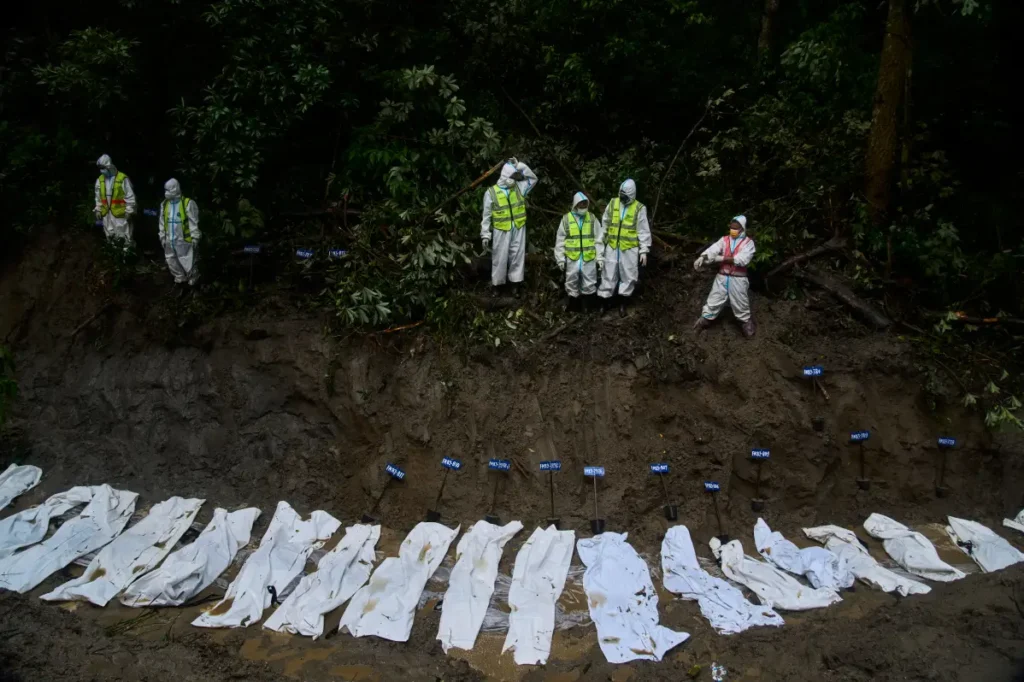
The information is intended to help investigators match remains with missing persons and eventually return identified victims to their families. The scale of the disaster has made the identification process particularly difficult. Floodwaters and landslides have swept through communities, roads and other infrastructure, leaving some areas inaccessible and complicating efforts to determine how many people remain missing.
The disaster has also affected foreign tourists who were travelling through some of Nepal’s popular trekking and tourism areas when the floods struck. Governments whose citizens were reported missing have been working with Nepalese authorities and local organisations to establish their whereabouts.
China Completes Makeshift Road To Gyirong Port
Meanwhile, rescue and recovery operations have continued on the Nepal-China border. Chinese state broadcaster CCTV reported today that rescue crews had completed a makeshift road to the disaster site at Gyirong Port, which was severely damaged by the floods.
The temporary access route is expected to allow heavy machinery to reach the area and support ongoing search and recovery operations. The road leading to the border crossing had been destroyed and buried beneath water, mud and rocks during the disaster.
Crews have been clearing debris and improving access around the crossing complex, which was also heavily damaged. The restoration of road access is expected to make it easier for emergency teams and equipment to reach areas that were previously difficult to access.
The latest developments come as Nepal continues one of its largest search-and-rescue operations in recent years. Thousands of emergency workers, soldiers, police officers and volunteers have been involved in recovering victims, assisting survivors and restoring damaged infrastructure.Although the confirmation of missing tourists provides some relief, the overall humanitarian situation remains severe.
As rescue teams expand access to affected areas and international governments continue coordinating with Nepal, officials say the priority remains accounting for those missing while supporting communities dealing with the devastating consequences of the floods.
The confirmation of additional survivors offers a small measure of hope amid the disaster, but with thousands still unaccounted for, Nepal’s search and recovery operation is expected to continue for some time.
READ ALSO: COCOBOD Pays GH¢2.68bn to Complete 2026 DDEP Obligations, Clears GH¢162m Cocoa Bills