Africa’s transition to a lower-carbon economy is creating a major development opportunity, but without deliberate industrial and economic strategies, the continent could reproduce the resource dependency that has characterised its relationship with global markets, according to Prof. Fatima Denton, Director of the United Nations University Institute for Natural Resources in Africa.
Speaking at the 8th Kwapong Lecture Series in Accra, Prof. Denton argued that Africa’s green transition should not be reduced to the replacement of fossil fuels with renewable technologies.
For a continent still confronting substantial electricity-access deficits, limited industrial capacity and constrained access to affordable finance, the transition must simultaneously address energy security, economic transformation, employment and environmental sustainability.
Her intervention places Africa’s climate debate within a broader question of economic power: whether the continent will merely supply the minerals, land and resources required for the global green economy or use its resource base to develop processing industries, manufacturing capacity and stronger domestic value chains.
“We need a narrative that recognises the importance of Africa’s resources to the global economy.”
Prof. Fatima Denton, Director of the United Nations University Institute for Natural Resources in Africa.
A Development Challenge Beyond Decarbonisation
Africa’s starting point in the energy transition differs sharply from that of advanced economies.
While wealthier economies are largely seeking to replace established energy infrastructure with lower-carbon alternatives, many African countries are still expanding basic electricity systems and industrial infrastructure.

That distinction matters for energy policy. Decarbonisation cannot deliver meaningful development if electricity remains unavailable or unaffordable for large sections of the population, particularly where inadequate power supply constrains manufacturing, mining, agriculture and services.
Prof. Denton therefore challenged policymakers to consider the green transition as an opportunity to build productive economies rather than simply comply with international emissions objectives.
The distinction is particularly relevant for Ghana, where energy security and industrialisation remain closely connected.
Ghana has been pursuing greater utilisation of natural gas for thermal power generation while simultaneously expanding renewable-energy ambitions and seeking investment in energy infrastructure.
The policy challenge is not simply choosing one energy source over another, but determining how the available energy mix can support reliable electricity, industrial competitiveness and long-term economic resilience.
This development-oriented approach also raises questions about the financing of the transition.
If African countries depend heavily on costly external borrowing to finance renewable-energy infrastructure, the climate transition could place additional pressure on already constrained public finances.
The same concern applies to the structure of foreign investment.
Large investment announcements can expand infrastructure and create economic activity, but the development impact depends on how much technology, skills, ownership, manufacturing and value creation remain within the domestic economy.
Critical Minerals Create A Strategic Test
Africa’s resource endowment gives the continent an important position in the global green economy.
Minerals such as cobalt, lithium, copper, manganese and bauxite are increasingly important to batteries, electric vehicles, renewable-energy technologies and other industrial applications.
Yet the existence of these resources does not automatically translate into industrial development.
Historically, African economies have often exported raw materials while importing higher-value processed products.
Prof. Denton warned that the green economy could reproduce this pattern if mineral-producing countries remain concentrated at the extraction stage.
The strategic opportunity therefore lies beyond mining.
African governments face the more difficult task of establishing processing capacity, developing technical expertise, strengthening research institutions and creating the infrastructure required to support industries around those resources.
Her question about “leapfrogging” captures the difficulty.
“Leapfrogging is good, but do we have the space to land comfortably?”
Prof. Fatima Denton
The implication is that technology adoption without supporting economic infrastructure may produce consumption without transformation.
A country can deploy electric vehicles, solar technologies or digital energy systems without developing the manufacturing and technical capabilities needed to capture a significant share of the value generated by those technologies.
For Ghana, this question extends beyond minerals.
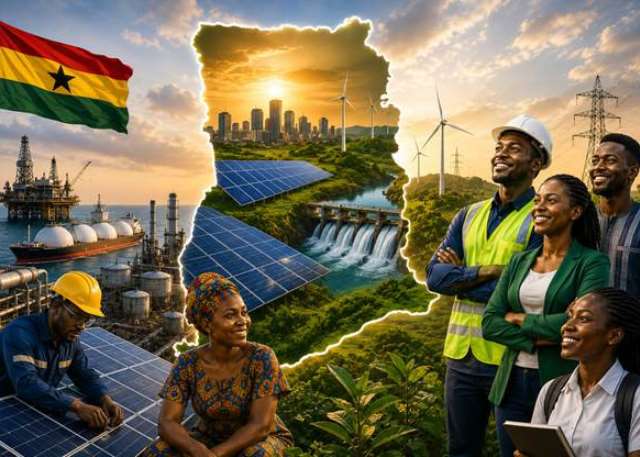
The country’s oil and gas sector, renewable-energy resources and emerging interest in electric mobility all present opportunities for domestic value creation.
But those opportunities require deliberate policies linking energy investment to skills development, local businesses, research and industrial activity.
That is also where regional integration becomes important.
Individual African economies may not possess sufficient domestic markets to support every stage of a modern manufacturing value chain.
Larger regional markets under frameworks such as the African Continental Free Trade Area could provide the scale required for processing and manufacturing investments to become commercially viable.
Africa Must Define Its Own Transition Terms
Prof. Denton also questioned the assumptions embedded in the international architecture surrounding the green transition.
“Who defines what constitutes a transition? Whose terms are being used?”
Prof. Fatima Denton
The questions are particularly significant for Africa because decisions about what qualifies as “green”, which minerals are considered critical, how carbon markets operate and how climate finance is structured can have direct consequences for national development strategies.

The classification of an investment as green, for example, can influence access to finance.
Similarly, the classification of minerals as strategically important can reshape investment flows and geopolitical competition around African resources.
This creates a need for African countries to participate more actively in determining the rules governing the emerging green economy rather than simply adapting to standards established elsewhere.
The environmental dimension also complicates the transition.
Critical-mineral extraction can generate ecological and social pressures, while technologies such as green hydrogen can create competing demands for water.
Deep-seabed mining raises another set of environmental concerns.
Consequently, reducing carbon emissions alone cannot provide a complete measure of sustainability.
A successful transition must also consider resource efficiency, environmental protection, social outcomes and the distribution of economic benefits.
Institutions And Skills Will Determine The Outcome
The industrialisation opportunity presented by the green transition ultimately depends on institutional capacity.
Africa cannot build sophisticated energy and manufacturing systems without engineers, researchers, technicians, entrepreneurs and policymakers capable of designing, financing, regulating and operating them.
Prof. Denton’s argument consequently extends beyond energy technology to the wider foundations of development, including strong institutions, research capacity, economic systems and social participation.
“We must be intentional.”
That intentionality is particularly important for countries such as Ghana, where energy policy increasingly intersects with industrial policy.
Decisions over natural gas, renewable energy, electricity infrastructure and critical resources will influence not only energy security but also the competitiveness of industries that depend on affordable and reliable power.
The lesson is that energy transition policy should be assessed against broader economic outcomes.
The relevant questions include whether electricity becomes more reliable, whether industrial energy costs become more competitive, whether domestic businesses gain access to new value chains and whether the country develops the technical capabilities needed to maintain the infrastructure being deployed.
A transition that delivers renewable generation but leaves domestic industries dependent on imported technology and expertise would achieve only part of the objective.
Similarly, a minerals strategy that increases exports without expanding domestic processing could increase foreign-exchange earnings without fundamentally changing the structure of the economy.
The greatest opportunity, therefore, lies in connecting Africa’s energy transition to a deliberate industrial strategy.
For Ghana, that means treating the energy sector not merely as an infrastructure or environmental policy area, but as an economic foundation for manufacturing, processing, employment and technological development.
The broader continental choice is even more consequential.
Africa can remain a supplier of the raw materials required for the global green economy while importing the technologies produced from them, or it can use its resources, markets and growing energy systems to build a stronger position across emerging value chains.
The green transition will not automatically produce that transformation.
The central challenge is no longer whether Africa should go green. It is whether Africa can make going green an engine of industrialisation rather than another cycle of resource dependence.
READ ALSO: Every Dollar Invested in Climate and Air Action Can Yield $15 – UNEP