Three prominent Hong Kong activists who organised annual vigils commemorating China’s 1989 Tiananmen Square crackdown have been sentenced to between five and seven years in prison, in the latest major penalties imposed under the city’s Beijing-imposed national security law.
Lee Cheuk-yan, Chow Hang-tung and Albert Ho were convicted of inciting subversion earlier this year over their activities with the Hong Kong Alliance in Support of Patriotic Democratic Movements of China, the group that organised the annual Tiananmen vigil in Hong Kong for three decades.
The West Kowloon Court sentenced Chow, a prominent young human rights lawyer who represented herself during the proceedings, to seven years and three months in prison. Former opposition lawmaker Lee received a seven-year sentence, while veteran pro-democracy lawmaker Albert Ho, who pleaded guilty in an attempt to secure a reduced sentence, was sentenced to five years and two months. The court also fined the Hong Kong Alliance HK$1.5 million, equivalent to approximately $191,300.

According to a summary of the ruling provided to reporters, the judges considered the case serious because the defendants continued their activities despite believing that they could be violating Hong Kong’s national security law and constitution.
The judges said the offences took place during “a turbulent and unsettled social atmosphere” and accused the alliance of spreading “subversive” messages through its activities and social media. “Although the present cases did not involve violence or threat of violence, nor had the defendants put forward any specific means of implementation or timetable to carry out ‘end one-party dictatorship,’ the court found that the offense was still of a serious nature,” the judges wrote.
The three activists were originally charged in September 2021 and had remained in custody for years before the sentencing. The court maintained that they were being prosecuted for criminal conduct rather than for their political views.
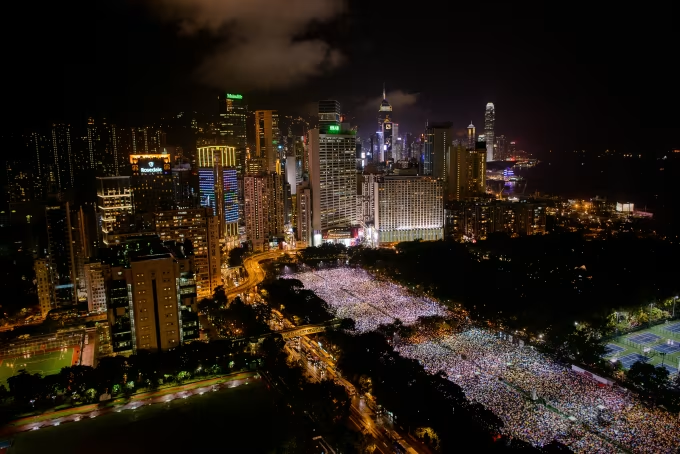
The convictions centre on the work of the Hong Kong Alliance, which for about 30 years organised what was the only large-scale public commemoration of the 1989 Tiananmen crackdown in China. The crackdown occurred when Chinese authorities sent troops and military tanks into central Beijing to suppress student-led pro-democracy protests. Hundreds and possibly thousands of people were killed when troops opened fire to end the demonstrations.
For decades, Hong Kong provided a rare space for public remembrance of the events. Tens of thousands of people gathered at Victoria Park each year for the candlelight vigil. Authorities banned the event in 2020, initially citing coronavirus restrictions. The alliance was later dissolved amid the broader crackdown on dissent in Hong Kong.
Beijing Defends Hong Kong Security Law
The Hong Kong office of China’s foreign ministry defended the territory’s legal system and national security law following criticism from foreign governments over the convictions and sentences of the Tiananmen vigil organisers.
In a statement responding to the criticism, the office insisted that Hong Kong is governed by the rule of law and said no one should be permitted to engage in unlawful activities under the pretext of “freedom of speech and press.”
The statement reflects Beijing’s longstanding defence of the national security framework, which Chinese authorities say is necessary to maintain stability in Hong Kong. The law was imposed by Beijing following huge and sometimes violent pro-democracy demonstrations that shook the city in 2019.
Since its introduction, authorities have prosecuted prominent activists and opposition figures, while numerous civil society organisations have shut down. Hong Kong’s political landscape has changed significantly since the protests. Public participation in elections has been reduced through changes to the electoral system, while prominent media figures and activists have faced prosecution under the security legislation.
The sentencing of the three Tiananmen activists is the latest high-profile use of the law against figures associated with Hong Kong’s former pro-democracy movement. In February, former pro-democracy media tycoon Jimmy Lai was sentenced to 20 years in prison.
Chow, who represented herself in court, has strongly rejected the suggestion that her activities should be treated as criminal conduct. In a statement posted on her Patreon page before today’s sentencing, she said that her guilty verdict effectively declared that pursuing democracy was a crime. “If doing so makes me a criminal for life – if the law truly cannot accommodate our beliefs – then I would rather be a criminal than a person who betrays their conscience,” she wrote.
Her comments shed light on the central dispute surrounding the case, that while Hong Kong and Chinese authorities maintain that the defendants were prosecuted for violating the law rather than for their political beliefs, supporters and critics of the security law view the convictions as another sign of the shrinking space for political dissent in the territory.
READ ALSO: Houthis Announce Maritime Embargo Targeting Saudi Arabia