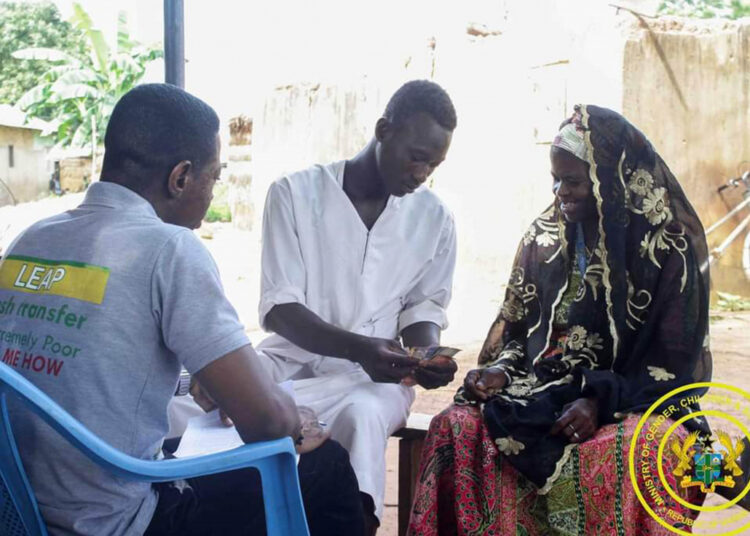
Ghana’s expansion of the Livelihood Empowerment Against Poverty (LEAP) programme to a ceiling of 450,000 households is turning a social-policy announcement into a larger fiscal question: how much will it cost to sustain the wider safety net once the new grant structure operates for a full year?
The ceiling has risen from 350,000 households, while the average grant has moved to about GH¢569.14 per bi-monthly cycle. Payments under the post-reassessment structure began on September 14, with the first two cycles being paid together.
The 2026 Budget allocated GH¢1.1 billion to LEAP. For scale, an illustrative transfer-only calculation suggests that 450,000 households receiving six bi-monthly cycles at the announced average grant would imply gross annual transfers of roughly GH¢1.54 billion.
That is about GH¢437 million, or 40 per cent, above this year’s allocation. The comparison is not a forecast of a 2026 overrun: the new structure is being rolled out late in the year, enrolment is still being completed, and actual spending will depend on the household mix across payment bands.
It does, however, show how sharply the annual funding requirement could rise at full scale. The expansion also comes with inflation protection for grants, making the commitment more than a one-off increase in beneficiary numbers.
Protecting the real value of payments can strengthen household welfare, but it also means future budgets must absorb part of the cost when prices rise. The programme’s latest grant and coverage changes therefore create a recurrent expenditure test as government prepares the 2027 Budget.
Expansion Resets the Annual Cost Baseline
The new ceiling lifts potential coverage by 100,000 households, an increase of about 28.6 per cent. The official LEAP payment notice places revised grants between GH¢380 and GH¢630 per household every two months, depending on household size and vulnerability.
For low-income households, regular transfers can smooth consumption when earnings are weak or irregular, helping protect spending on food, transport, health and schooling. Poorer households generally have limited savings and less access to affordable credit, so predictable payments can reduce the need to cut essential consumption after an income shock.
For the budget, however, cash transfers create a recurring obligation. The question is not only whether government can finance the rollout, but whether subsequent budgets can support the larger programme without payment delays or pressure on other social services.
Inflation Protection Shifts Risk to the Budget
Indexing LEAP grants to inflation helps prevent rising prices from eroding their purchasing power. But the mechanism can also shift part of the inflation risk from beneficiaries to the public budget, because higher prices can require higher nominal spending to maintain the real value of support.

That makes macroeconomic stability directly relevant to social-protection financing. Lower and more stable inflation reduces the pace at which grants may need adjustment, while renewed price pressure would increase the cost of preserving purchasing power.
The issue matters because Ghana’s social-protection system already faces resource constraints. An IMANI assessment reported that LEAP and the Ghana School Feeding Programme absorb about 94.7 per cent of the Ministry of Gender, Children and Social Protection’s budget, leaving a narrow envelope for other welfare responsibilities.
Reassessment Puts Targeting Under Scrutiny
The expansion has been accompanied by a nationwide reassessment using the Ghana National Household Registry. At the Government Accountability Series, Gender Minister Dr Agnes Naa Momo Lartey said: “We completed a comprehensive reassessment of 350,000 beneficiary households using data from the National Household Registry.” She said the exercise allowed more than 226,000 households to graduate out of extreme poverty.

That figure should be read as the government’s assessment from the targeting exercise, rather than independent proof that all affected households have permanently escaped vulnerability. Household welfare can change with employment, food prices and health shocks, so the system’s strength will depend on how accurately the registry identifies need and how effectively grievances are handled.
The reassessment therefore makes the change more than a simple enlargement of the old beneficiary list. Better targeting can improve the value obtained from each cedi of public spending, but exclusion errors would carry a high welfare cost.
2027 Budget Becomes the Credibility Test
The next major test will come with the 2027 Budget. Government will need to show how the 450,000-household ceiling, higher grant levels and inflation protection are reflected in full-year financing, and how the dedicated Social Protection Fund under the new legal framework fits into that architecture.
The trade-off is not simply between fiscal discipline and social protection. Sustainable social protection depends on credible public finances because benefits lose effectiveness when allocations are insufficient, or releases are delayed.
Equally, fiscal consolidation that overlooks severe household vulnerability can weaken the social gains that macroeconomic stability is meant to support. LEAP’s expansion therefore creates a practical benchmark for Ghana’s public finances.
The wider safety net can provide stronger protection only if targeting remains credible, payments remain predictable and future budgets recognise the recurrent cost of the new scale. Those are the numbers to watch when government sets the next social-protection envelope.
READ ALSO: CPS Report Flags Deep Inequalities, Weak Planning in Free SHS Policy