
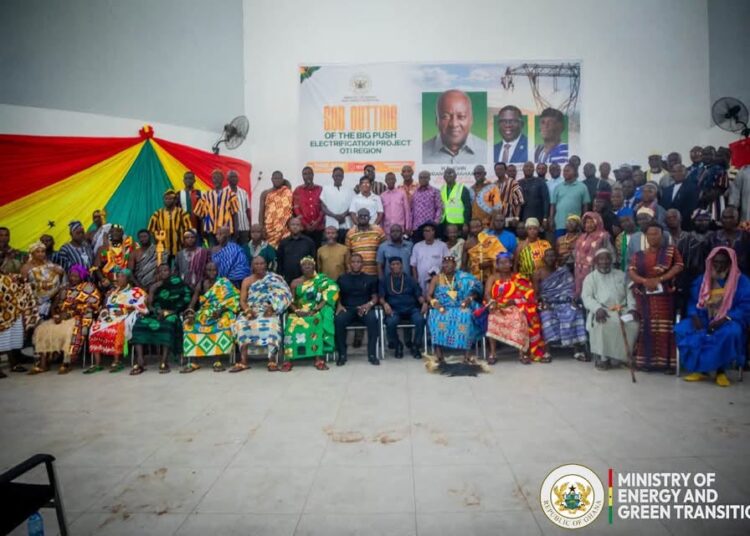
The Oti Region is set to see a major expansion of electricity access under the Rural Electricity Acceleration and Urban Intensification Initiative (REIP), with a GH¢300 million project targeting 90 currently underserved communities across the region’s nine districts.
The Turnkey Electrification Project, implemented by Le Grino Ltd, was launched at Dambai College of Education as part of government’s broader effort to extend the national grid to unelectrified communities while improving the quality and reliability of electricity supply in urban areas.
The project is expected to be completed within six months.
Electrification Drive Targets 90 Communities
The Oti intervention forms part of the government’s flagship “Big Push” agenda, which seeks to accelerate infrastructure development and expand electricity access over a four-year period.
The project will extend electricity infrastructure to communities that remain outside the national grid, creating the physical connection required for households, businesses and public institutions to access power.

The initiative is being implemented across the region’s nine districts, making its impact broader than a single community electrification programme.
At the launch, government representatives urged beneficiary communities and other stakeholders to support implementation and protect the infrastructure once completed.
“Electricity is essential for education, healthcare, businesses, agro-processing, job creation, and improved livelihoods. I encouraged all stakeholders and beneficiary communities to support both the implementation and safeguarding of these significant investments.”
Government officials
The emphasis on protecting new infrastructure reflects a key challenge in expanding electricity access: connecting communities is only one part of delivering reliable power.
Maintaining transformers, distribution lines and other equipment is equally important if new connections are to translate into lasting improvements.
Access Expansion Goes Beyond Grid Extension
The Oti programme is also being implemented alongside other electricity-access interventions.
According to the project announcement, the region is benefiting from ongoing investments in grid extension, mini-grids, solar home systems, all-in-one solar solutions and grid-connected streetlighting infrastructure.
This broader mix is significant because not every underserved community can necessarily be served most efficiently through conventional grid extension.

Mini-grids and standalone solar systems can provide alternatives in locations where extending conventional distribution infrastructure may be more difficult or costly.
The combination of technologies therefore allows government to approach electricity access according to the circumstances of different communities rather than relying exclusively on one delivery model.
Reliability Becomes Next Test
While the immediate focus of REIP is expanding access, the government says it is also investing in the infrastructure needed to improve power reliability and quality.
More than 2,000 distribution transformers are being deployed nationwide across the operational areas of the Electricity Company of Ghana (ECG) and Northern Electricity Distribution Company (NEDCo).
For the Oti Region, the strengthening of the Eastern Corridor transmission system is also expected to support the broader effort to improve the electricity network.

That matters because new connections can place additional demand on existing infrastructure.
Without corresponding investment in transmission and distribution capacity, expanding access could increase pressure on already constrained parts of the network.
The government’s approach therefore links electrification with investment in the wider electricity system.
Regional Development Tied To Power Investment
The economic significance of the Oti project extends beyond household electricity connections.
Reliable electricity can support agro-processing, small businesses, education and healthcare services while creating conditions for greater economic activity within communities.
For a region with rural and dispersed settlements, improved electricity infrastructure can also reduce the gap between communities with access to modern energy services and those still dependent on more limited alternatives.

The project’s six-month completion target places pressure on the implementing company and relevant electricity agencies to move quickly from the launch phase to actual construction and connection.
The involvement of the Ministry of Energy and Green Transition, ECG, NEDCo, local authorities and beneficiary communities will consequently be important to ensuring that the investment translates into functioning infrastructure.
Big Push Adds To Universal Access Effort
The Oti REIP forms part of a wider national objective of achieving universal electricity access.
Its significance lies not only in the number of communities targeted, but also in the attempt to combine access expansion with improvements to transmission and distribution infrastructure.
The GH¢300 million investment represents a substantial commitment to the region, while the additional deployment of transformers and alternative energy systems broadens the intervention beyond conventional grid connections.

For beneficiary communities, however, the ultimate measure of success will be practical: whether electricity reaches homes, schools, health facilities and businesses, and whether the infrastructure remains reliable after commissioning.
The Oti project consequently places both government and implementing partners under pressure to deliver infrastructure within the stated timeline while ensuring that the new assets are properly maintained.
If successfully executed, the initiative will extend electricity access to 90 communities while strengthening the infrastructure needed to support economic and social activity across the region.
READ ALSO: MoFA-ABC Oyeasase Yie Sign Fertiliser Production Deal